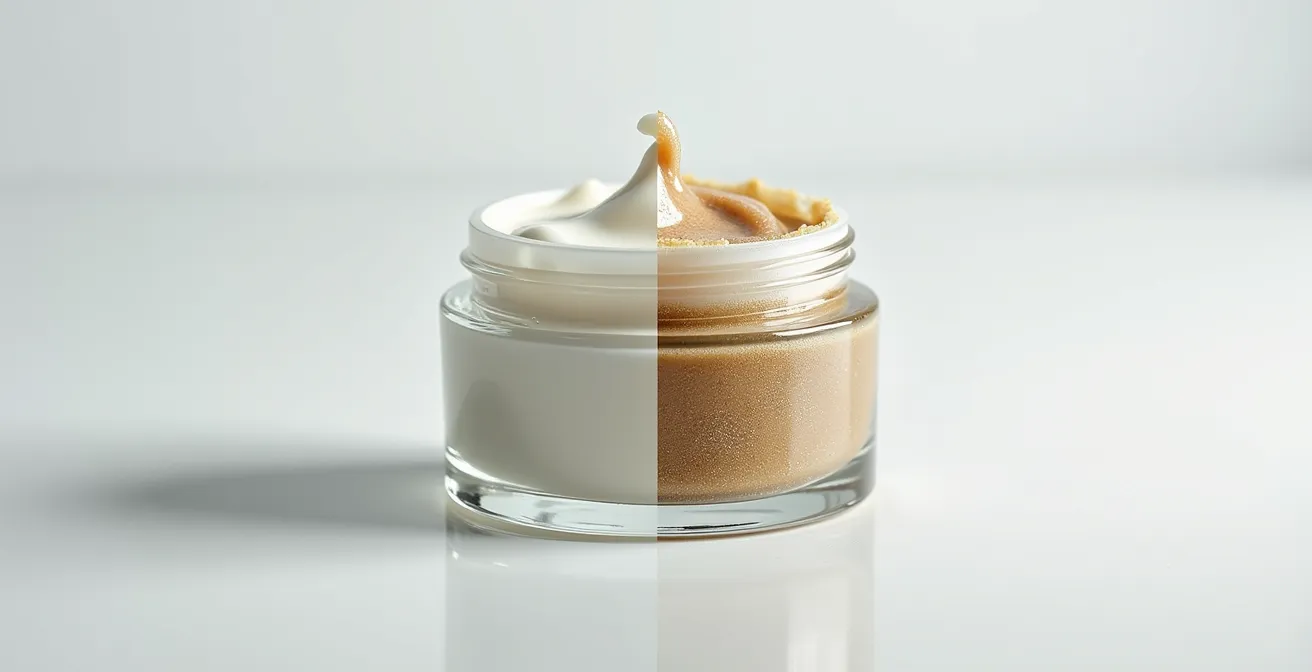
Contrary to the popular « clean beauty » narrative, the absence of effective preservatives in skincare is not a mark of purity but a significant health risk. This article reveals that the true danger isn’t the vilified paraben but the invisible world of microbial contamination that thrives in improperly preserved products, leading to skin infections, irritation, and allergic reactions. True cosmetic safety lies in understanding microbiology, not marketing fears.
The movement towards « clean beauty » has been swift and powerful. Driven by a genuine desire for safer, more transparent products, consumers have learned to scrutinize labels and fear ingredients with chemical-sounding names. At the top of the blacklist are preservatives, particularly parabens, which have been widely demonized. The result is a market flooded with products proudly proclaiming they are « preservative-free. » This label is often perceived as a synonym for « safe. » As a cosmetic microbiologist, I must state this clearly: this assumption is not only wrong, it’s dangerous.
The fear of preservatives has overshadowed a far more immediate and common threat: microbial contamination. Every time you dip your fingers into a jar of cream, you introduce bacteria. Products containing water—which is most of them—are ideal breeding grounds for bacteria, yeast, and mold. Without an effective preservative system, a beautiful, botanically-infused cream can quickly turn into a petri dish of pathogens. This can lead to skin infections, severe allergic reactions, and in the case of eye products, potentially serious vision damage. The quest for « purity » has inadvertently opened the door to a more primitive danger.
This article will not defend specific ingredients, but rather the scientific principle of preservation itself. We will dismantle the marketing myths and refocus the conversation on what truly constitutes a safe product. We will explore how to decode ingredient lists to spot greenwashing, understand the real allergenic potential of « natural » alternatives, and recognize the stakes of using contaminated products. The goal is to empower you not with fear, but with scientific literacy, so you can make choices based on efficacy and safety, not just marketing slogans.
Summary: The Microbiological Truth About « Clean » Cosmetics
- How to Read an INCI List to Spot « Greenwashing » Ingredients?
- Natural vs Synthetic: Which Is More Likely to Cause Allergies?
- The Risk of Using expired Clean Beauty Products on Eyes
- Clean Beauty: What Definition Should You Actually Trust?
- The « Bamboo » Fabric Lie That Many Brands Still Tell
- Efficacy vs Marketing: What Does « Clinically Proven » Really Mean?
- When to Expect the « Purge » When Switching to Natural Deodorant?
- How to Build a Routine with Active Ingredients Without Irritation?
How to Read an INCI List to Spot « Greenwashing » Ingredients?
The International Nomenclature of Cosmetic Ingredients (INCI) list is your most powerful tool against misleading marketing. It lists ingredients in descending order of concentration, down to the 1% mark. Below 1%, they can be listed in any order. This rule is often exploited. Brands may place appealing, « good-sounding » ingredients higher in the post-1% list to give a false impression of their concentration. A classic example is seeing a desirable botanical extract listed before a preservative that you know is only used at 0.5%.
This manipulation isn’t just about marketing puffery; it can have real health consequences. Consider the « paraben-free » trend. In response to consumer fear, many companies replaced parabens with other preservatives like methylisothiazolinone (MI). The result was an unprecedented public health crisis. A European study on the methylisothiazolinone epidemic showed a dramatic spike in contact allergies, with a prevalence that remains significant even after restrictions were put in place. This demonstrates how a « free-from » claim can lead to a less safe product, a fact often hidden in plain sight on the INCI list.
Being an informed consumer means looking beyond the « paraben-free » sticker on the front and analyzing the full ingredient list on the back. If you see a product touting its natural extracts, but they are listed after phenoxyethanol or sodium benzoate, you know their concentration is likely below 1% and their effect may be minimal. True transparency lies in the full formula, not just the marketing claims.
Action Plan: Decoding an INCI List for Greenwashing
- Analyze the Top Five: The first five ingredients typically make up the bulk of the formula. This tells you the true base of the product (e.g., water, glycerin, oils).
- Find the 1% Line: Locate the preservative (e.g., phenoxyethanol, sodium benzoate, potassium sorbate). Ingredients listed after it are present at concentrations of less than 1%.
- Question « Hero » Ingredients: If a brand heavily markets a botanical extract, but it appears after the 1% line, its role is likely more for marketing story than for efficacy. Be especially skeptical of K-beauty products that may reorder lists for their local market, as seen with oat extract moving from 9th to 1st place in one cream’s US vs. Korean list.
- Identify Replacement Preservatives: If a product is « paraben-free, » identify what it’s using instead. Research that alternative for its own potential for irritation or allergy (e.g., MI, MCI, formaldehyde-releasers).
- Cross-Reference with a Decoder: Use online tools like INCIDecoder or CosDNA. They break down the function of each ingredient, helping you understand if an ingredient is a primary active or just « window dressing. »
Natural vs Synthetic: Which Is More Likely to Cause Allergies?
One of the central tenets of the clean beauty movement is that « natural » ingredients are inherently safer than « synthetic » ones. From a microbiological and dermatological perspective, this is a dangerous oversimplification. Natural extracts are chemically complex cocktails of hundreds or even thousands of different molecules. A synthetic ingredient, by contrast, is often a single, highly purified molecule. This purity and predictability are significant advantages in cosmetic formulation.
The complexity of natural extracts means they carry a higher and more unpredictable risk of causing allergic reactions or irritation. Essential oils are a prime example; they are potent sources of known allergens like limonene, linalool, and geraniol. Conversely, many vilified synthetic ingredients, like mineral oil or petrolatum, are highly refined and inert, making them among the least likely ingredients to cause an allergic reaction. Their molecular structure is simple and stable, which is a benefit, not a flaw.
This logic also applies to preservatives. As the beauty science communicator Lab Muffin explains, the rush to replace parabens has led to the use of alternatives that are often more problematic. She notes:
Preservatives are often quite irritating and allergenic, and so having a higher concentration means that people who wouldn’t have had skin reactions with the lower amounts of parabens might react to these newer preservatives. If you look at the data on preservatives, you’ll see how good parabens are.
– Lab Muffin Beauty Science, Clean Beauty Is Wrong and Won’t Give Us Safer Products
The choice is not between a « good » natural ingredient and a « bad » synthetic one. The scientific choice is between an unpredictable mixture of molecules and a well-understood, purified one. For sensitive skin, the latter is often the far safer option.
The Risk of Using expired Clean Beauty Products on Eyes
The area around the eyes is particularly vulnerable. The skin is thinner, and the proximity to the mucous membranes of the eye itself provides a direct pathway for pathogens. This is where the danger of poorly preserved or « preservative-free » products becomes most acute. Mascara, eyeliners, and eye creams that become contaminated can lead to conjunctivitis (pink eye), styes, blepharitis (eyelid inflammation), and in severe cases, microbial keratitis—an infection of the cornea that can cause permanent vision loss.
Many consumers believe that water-free (anhydrous) products like oils, balms, or powder eyeshadows are safe from contamination. This is a misconception. While bacteria thrive in water, some dangerous pathogens can survive and be transferred in these formulas. For instance, a recent review found evidence of P. aeruginosa and S. aureus in several anhydrous products. These bacteria are introduced every time you touch the product with your fingers or a used brush. Pseudomonas aeruginosa is particularly notorious for causing aggressive eye infections that are difficult to treat.
The « Period After Opening » (PAO) symbol (an open jar with a number like « 6M » or « 12M ») is not a marketing suggestion; it’s a safety directive based on the stability and preservative efficacy of the formula. Using a product, especially an eye product, beyond its PAO is a gamble with your health. With « clean » products that use weaker or less stable preservative systems, this risk is even higher. An invisible contamination could be brewing long before you notice a change in smell or texture.
Clean Beauty: What Definition Should You Actually Trust?
The term « clean beauty » has no legal or official regulatory definition. It is a marketing concept created by brands and retailers. Each has its own list of « unacceptable » ingredients, often based more on fear-mongering and misinformation than on scientific consensus. This lack of a unified standard creates massive confusion and allows for the proliferation of misleading claims that sound scientific but are fundamentally meaningless.
Terms like « chemical-free, » « toxin-free, » and even « preservative-free » are prime examples of this pseudoscientific marketing. Water is a chemical. Every plant extract is a complex mixture of chemicals. The term « chemical-free » is a scientific impossibility. Similarly, « toxin-free » ignores a fundamental principle of toxicology: the dose makes the poison. Even water can be toxic in a high enough dose, while many « toxic » substances are harmless or even beneficial at the low concentrations used in cosmetics.
The following table, based on expert consensus, breaks down some of the most common « clean » marketing claims versus the scientific reality. It highlights how these claims often prey on chemical phobia to sell products that are not necessarily safer.
This is demonstrated perfectly in a comparative analysis from beauty editors and dermatologists.
| Marketing Claim | Reality | Expert Explanation |
|---|---|---|
| Chemical-free | Impossible | ‘By definition, a chemical is any substance consisting of matter, so that means water is a chemical, air is a chemical—basically, anything and everything is a chemical. If your beauty product is calling itself chemical-free, then what exactly are you paying for?’ |
| Preservative-free | Dangerous | ‘Unless you want to keep your beauty products stored in the fridge and replaced every three days (!), they need to have preservatives. Most formulas contain water, and preservatives are what keep harmful bacteria and mold from growing in them’ |
| Toxin-free | Misleading | ‘Toxicity means nothing without dosing. Any ingredient—even water—can be toxic depending on the amount’ |
Instead of trusting a vague « clean » label, trust the full INCI list and the reputation of the formulators. A product formulated by experienced cosmetic chemists who understand microbiology and toxicology will always be safer than one formulated around a marketing blacklist.
The « Bamboo » Fabric Lie That Many Brands Still Tell
While our focus is on cosmetics, the concept of greenwashing extends to many consumer goods, and the « bamboo » fabric story is a perfect parallel. Brands market bamboo fabric as a silky, sustainable, and natural choice. The imagery is of gentle bamboo stalks, implying the fabric is simply woven from natural fibers. This is a profound misrepresentation of the manufacturing process.
There is no process to mechanically spin bamboo fibers directly into soft fabric. To create the textile sold as « bamboo, » the plant pulp is put through an intensive chemical process using caustic solvents like sodium hydroxide and carbon disulfide. The end product is not bamboo fiber; it is rayon or viscose, a regenerated cellulose fiber that can be made from any wood pulp, including eucalyptus, pine, or bamboo. The « bamboo » source is largely irrelevant to the final chemical structure of the fabric.
The U.S. Federal Trade Commission (FTC) has repeatedly warned and fined companies for this deceptive marketing. The law is clear: unless the fabric is made directly from bamboo fiber (which would be coarse, like linen), it must be labeled as « rayon » or « viscose made from bamboo. » Calling it simply « bamboo » is a lie. This greenwashing tactic preys on the same consumer desire for « natural » that drives the clean beauty movement, hiding a harsh chemical process behind a green facade. To avoid being misled, consumers should always check the label for the legally required terms « rayon » or « viscose » and be wary of any brand making broad, unsubstantiated claims about the « natural » properties of their bamboo fabric.
Efficacy vs Marketing: What Does « Clinically Proven » Really Mean?
Just as « clean » is an unregulated marketing term, « clinically proven » can be highly misleading. It suggests rigorous, unbiased scientific testing, but the reality is often far from it. A brand can commission a small-scale study with a favorable design, use the results to make a grand claim, and then fail to mention the limitations. For the consumer, there is often no way to verify the quality or context of this « proof. »
A common tactic in the anti-preservative narrative is to cite scientific studies out of context. Activist groups or influencers might point to a paper showing a preservative caused cell damage. As experts at Citruslabs point out, this often involves a critical omission:
When brands or influencers cite research papers claiming the dangers of preservatives, they often take the study results out of context and neglect to mention that the preservatives in question were applied at 100% concentration. This is well above the safe threshold for everyday skincare products, wherein preservative concentrations are often less than 1% of a formula.
– Citruslabs, The Myth of Preservative-Free Skincare
This is a perfect illustration of the dose-response principle being ignored. Applying a pure, 100% concentration of a substance in a lab setting has no bearing on its safety at the sub-1% levels used in a finished cosmetic product. It’s a scare tactic that relies on the consumer not reading the original study. To truly verify claims, one must look beyond marketing and consult unbiased resources. Tools like INCIDecoder and CosDNA help analyze ingredient lists for function and safety, while scientific podcasts like The Beauty Brains provide expert context on industry hot topics, separating genuine clinical evidence from marketing fiction.
Key Takeaways
- The absence of effective preservatives poses a greater health risk (microbial contamination) than the presence of regulated preservatives like parabens.
- « Natural » is not synonymous with « safe. » Natural extracts are chemically complex and can be more allergenic than purified synthetic ingredients.
- Marketing terms like « clean beauty, » « chemical-free, » and « toxin-free » are unregulated and often scientifically meaningless, designed to capitalize on consumer fear.
When to Expect the « Purge » When Switching to Natural Deodorant?
The switch to « natural, » aluminum-free deodorant is a rite of passage in the clean beauty world. It’s often accompanied by warnings of a « detox period » or « purge, » where a person may experience increased odor or irritation for a few weeks. This is typically explained as the body « expelling toxins. » From a scientific standpoint, this explanation is unfounded. Your body does not « detox » through its armpits. The more likely cause of this « purge » is twofold: an adjustment of the skin’s microbiome and, quite often, a reaction to the new ingredients.
Antiperspirants work by using aluminum salts to form temporary plugs in sweat ducts, reducing wetness. Deodorants work by masking odor or using ingredients to inhibit odor-causing bacteria. When you stop using an antiperspirant, your sweat ducts are no longer blocked, and your skin’s bacterial ecosystem (microbiome) begins to shift. This can temporarily lead to a change in body odor.

However, the irritation, redness, and rash many people experience is often a form of contact dermatitis. Many natural deodorants rely on baking soda, which is highly alkaline and can disrupt the skin’s natural acidic pH, causing severe irritation. Others use high concentrations of essential oils, which are known allergens. Furthermore, the preservatives used in these « clean » formulas can also be culprits. For example, The American Society of Contact Dermatitis lists phenoxyethanol as one of its core allergens, even in concentrations as low as 1%. What is marketed as a healthy « purge » is, in many cases, simply your skin reacting negatively to a poorly formulated or irritating product.
How to Build a Routine with Active Ingredients Without Irritation?
The goal of this discussion is not to induce fear of all cosmetics, but to foster a healthy, science-based skepticism towards marketing. A safe and effective skincare routine is built on well-formulated products used correctly, not on a checklist of « free-from » claims. The cornerstone of a safe formula is a robust preservative system, which ensures the product you put on your face is the same product the chemists intended, free from dangerous microbial growth.
Building a routine without irritation involves prioritizing formula stability and being mindful of how products are used. Every product in your routine, from water-based serums to oil-based cleansers, needs an effective preservative system. The idea that oil-based or dry products are immune to contamination is false. As one analysis points out, cross-contamination is a daily reality. Dipping fingers into jars, using unwashed brushes, or letting products sit in a warm, humid bathroom all introduce bacteria and moisture, creating a need for preservation in every single formula.
To build a safe routine:
- Trust Formulation, Not Fear: Choose products from reputable brands known for their commitment to cosmetic science and safety testing, rather than brands that rely on fear-mongering about « nasty » chemicals.
- Respect the PAO: Always discard products, especially for the eyes and lips, after their « Period After Opening » has expired. Write the opening date on the product with a marker.
- Practice Good Hygiene: Wash your hands before applying skincare. Use clean spatulas for jar products to minimize introducing bacteria. Clean your makeup brushes regularly.
- Patch Test New Products: Before applying a new product to your face, test it on a small, discrete area (like behind your ear or on your inner arm) for 24-48 hours to check for any adverse reactions.
Ultimately, a safe product is a stable product. The expertise of a cosmetic microbiologist is essential in creating that stability. By prioritizing well-preserved formulas and practicing hygienic use, you can build an effective routine that delivers results without the hidden risk of microbial contamination.
Evaluate your current routine today not by its « clean » claims, but by its formulation integrity and your own safe usage habits. Your skin’s health depends on it.
Frequently Asked Questions About Preservative-Free Skincare
Why can’t water-based products be truly preservative-free?
Bacteria and other microbes absolutely thrive in water. Any product containing water (listed as ‘Aqua’ or ‘Water’ on the INCI list) provides the perfect environment for them to multiply rapidly. Without a preservative system, a water-based product would become dangerously contaminated within days. Very few microbes can survive in completely water-free environments, which is why some pure oils may not require added preservatives.
What happens if I use contaminated cosmetics?
Using products contaminated with bacteria, mold, or yeast can cause a range of health problems. These include mild to severe skin reactions, rashes, acne-like breakouts, and skin infections. For products used near the eyes, the consequences can be far more serious, potentially leading to conjunctivitis, styes, or even infections that threaten your vision.
Are products with « natural preservatives » like Vitamin C or grapefruit seed extract considered preservative-free?
No, this is a misleading marketing claim. If an ingredient like Vitamin C (ascorbic acid) or grapefruit seed extract is being used in a formula to inhibit microbial growth, it is, by definition, functioning as a preservative. Claiming a product is « 100% preservative-free » while using these ingredients for their preservative properties is scientifically inaccurate and deceptive.
What resources can help me verify ingredient safety claims?
Several excellent, unbiased resources exist. You can use online databases like INCIDecoder or CosDNA to analyze a product’s full ingredient list for function, irritation potential, and safety levels. For a European regulatory perspective, the CosIng database is an official tool. Finally, for in-depth explanations on cosmetic science topics, listening to podcasts like The Beauty Brains, hosted by cosmetic chemists, is a great way to stay educated.