The premium on a niche perfume is not for the liquid, but for the cost of its story—transforming it from a product into a piece of personal art.
- Designer scents are engineered for mass appeal and quick impressions; niche fragrances are crafted as complex olfactory narratives that evolve uniquely on skin.
- Exclusivity is not a byproduct but a core strategy, using scarcity and curated experiences to build desire and justify the price as a signal of quality.
Recommendation: Approach your next fragrance purchase not as a hunt for a ‘nice smell,’ but as a search for a personal story that resonates with you, justifying the investment in its artistry.
You stand before a wall of fragrances, a designer bottle in one hand, a niche flacon in the other. The liquid inside looks similar, but the price tag tells a different story—one is an accessible luxury, the other a significant investment. The immediate question arises: why the staggering difference? Many will point to common explanations like higher-quality ingredients or extravagant packaging. While true, these are merely single notes in a much more complex accord. The real answer lies not in a simple list of materials, but in a fundamental difference in philosophy.
Designer fragrances are engineered for consensus. They are the product of market research, focus groups, and massive advertising campaigns, designed to be instantly likable and appeal to the broadest possible audience. They shout their presence. Niche perfumery, in contrast, whispers a story. It is an art form born from a perfumer’s singular, uncompromised vision. The higher cost is a direct reflection of this artistic integrity—an investment in a unique, evolving narrative that becomes deeply personal to the wearer.
This isn’t about mere scent; it’s about the entire architecture of the experience. It’s about the sourcing of a rare, difficult-to-work-with absolute, the defiance of fleeting trends, and the creation of something that feels less like an accessory and more like a second skin. This guide will deconstruct the true value behind that price tag, moving beyond the surface-level talk of ingredients to explore the very soul of niche perfumery. We will uncover how the journey of a fragrance—from its creation to the way it lives on your skin—is what you are truly investing in.
To fully grasp the distinction, we will journey through the key elements that define this luxurious world. This exploration will reveal why every facet, from testing to bottling, contributes to the final, elevated cost.
Summary: The True Cost of Olfactory Art
- How to Test Perfume on Skin vs Blotter for True Scent?
- Chypre vs Fougère: What Is the Difference in Scent Profile?
- The Risk of Blind Buying Fragrances Based on TikTok Reviews
- How to Make Perfume Last All Day Without Re-spraying?
- When Does Perfume Expire and How to Delay It?
- How to Maintain Exclusivity While Scaling a Luxury Brand?
- Why the Unboxing Experience Matters More Than the Product for Retention?
- Why Price Increases Actually Build Desire for Luxury Brands?
How to Test Perfume on Skin vs Blotter for True Scent?
The paper blotter is the fragrance world’s elevator pitch. It offers a fleeting, two-dimensional snapshot, heavily biased towards the volatile top notes. For a designer scent, engineered for immediate impact at the sales counter, this is often enough. But for a niche fragrance, testing on a blotter is like judging a symphony by its opening chord. You miss the entire development, the heart of the composition, and the soul of its base. The true story of a niche perfume can only be told through a chemical dialogue with your skin.
Niche creations are built with a high proportion of natural, complex, and sometimes temperamental ingredients. For instance, some transparent formulations from houses like Essential Parfums contain 86-93% natural ingredients. These molecules are designed to react to the unique warmth, pH, and oils of your epidermis. An indolic jasmine may bloom sweetly on one person, while turning animalic on another. The vetiver that smells clean and earthy on paper might pull smoky and rich on your wrist. This living, breathing interaction is the entire point of the art form—the perfume is not complete until you wear it.
This table illustrates the fundamental difference in what each testing method reveals, especially when comparing the two fragrance philosophies.
| Testing Method | Designer Fragrances | Niche Fragrances |
|---|---|---|
| Blotter Test | Immediate top-note impact for quick sales | Limited representation of complex heart & base notes |
| Skin Test | Stable, predictable synthetics | Dynamic evolution with natural ingredients reacting to skin chemistry |
| Development Time | Linear progression | Multi-hour journey revealing hidden accords |
Therefore, testing a niche perfume requires patience. It demands you live with the scent for several hours, allowing it to unfold its chapters. This personal, unique result is a core part of its value. You are not just buying a scent; you are co-creating a personal olfactory signature.
Chypre vs Fougère: What Is the Difference in Scent Profile?
Beyond individual notes, perfumery is built upon grand olfactory architectures known as families. Two of the most foundational and revered are Chypre and Fougère. To understand them is to understand the difference between two distinct philosophies of structure and emotion. A Fougère (French for « fern ») is not a smell of a plant but an accord, a harmonious blend built on a skeleton of lavender, oakmoss, and coumarin. It evokes a clean, aromatic, and often barbershop-esque elegance—think damp forest floor meets freshly groomed gentleman. It is the backbone of classic masculine perfumery.
A Chypre, in contrast, is an architecture of tension. Its classic structure pits a bright, citrusy opening (typically bergamot) against a deep, dark, and earthy base of oakmoss and labdanum, with a floral heart often acting as the bridge. The result is an incredibly sophisticated, abstract, and often moody scent profile that can range from fruity to leathery to mossy green. It feels intellectual, chic, and timeless.
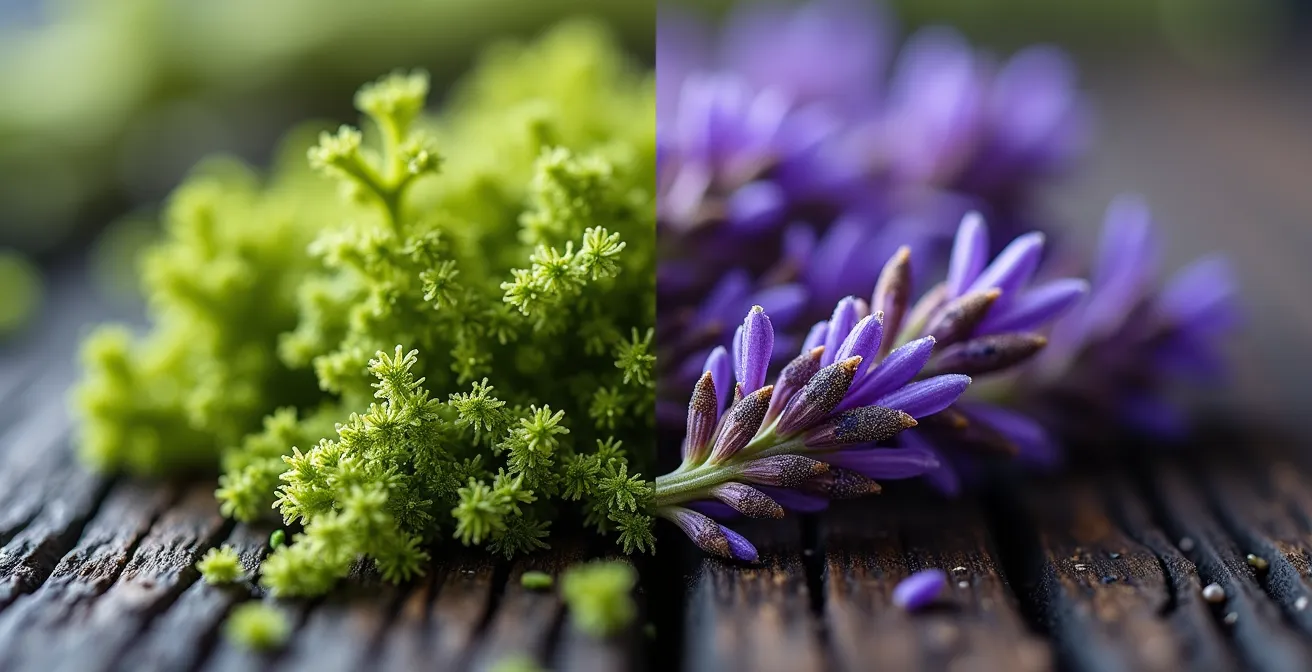
The cost of creating these classic structures today is a perfect example of the niche price difference. For instance, the use of natural oakmoss, the very soul of both families, has been heavily restricted by IFRA regulations due to allergen concerns. Designer brands often resort to cheaper, flatter synthetic substitutes. Niche houses, however, see this not as a problem but as an artistic challenge. They invest heavily in sourcing or developing high-cost, compliant oakmoss reconstructions and fractional distillations that preserve the original’s multi-faceted, rich complexity. This dedication to upholding the integrity of an artistic form, even when it is costly and difficult, is a hallmark of niche perfumery and a direct contributor to its price.
The Risk of Blind Buying Fragrances Based on TikTok Reviews
In the age of social media, trends move at the speed of a swipe. The #PerfumeTok phenomenon has turned countless users into fragrance influencers, capable of making a scent go viral overnight. While this has brought welcome attention to the world of fragrance, it has also created a significant pitfall for the aspiring connoisseur: the temptation of the blind buy. The very nature of platforms like TikTok is at odds with the philosophy of niche perfumery.
Short-form video rewards immediacy, simplicity, and high impact. As one industry analysis highlights, « The short-form video format structurally favors scents with a simple, powerful, and easy-to-describe opening. » This perfectly describes the designer fragrance model. A reviewer can spray a scent, exclaim « it smells like a summer holiday! » and generate thousands of sales. This format struggles to capture the slow, multi-hour evolution of a complex niche fragrance. The dry-down, the heart, the subtle shifts on the skin—the entire olfactory narrative—is lost in a 30-second clip. This is evidenced by the virality of certain scent profiles; the hashtag #ArabianPerfume, often associated with potent and linear sweet-oud compositions, has amassed a staggering number of views, encouraging impulse purchases based on a simplified promise.
Blind buying a niche perfume based on a TikTok review is like buying a painting based on a verbal description. You miss the texture, the nuance, and the personal emotional response. A fragrance described as « a cozy vanilla » might reveal a challenging, smoky leather note on your skin three hours later. The risk is not just financial; it’s experiential. You cheat yourself out of the joy of discovery and the intimate process of finding a scent that truly speaks to your personal story, not just to a fleeting algorithm. A sample or a skin test is always the wiser investment.
How to Make Perfume Last All Day Without Re-spraying?
One of the most tangible benefits of a niche perfume’s higher price is its longevity. This is rooted in a simple, technical reality: concentration. Most designer fragrances are formulated as Eau de Toilette (EDT), with a fragrance oil concentration of 5-15%. Niche fragrances, however, are almost universally offered as Eau de Parfum (EDP) or Extrait de Parfum, which boast significantly higher concentrations. In fact, The Fragrance Foundation notes that niche creations can feature 20-30% more fragrance oil than their mass-market counterparts. This higher ratio of aromatic compounds to alcohol means the scent evaporates more slowly, clinging to the skin for many hours.
However, concentration is only half the story. The quality and type of ingredients play an equally vital role. Niche perfumers often utilize powerful, expensive base notes—such as natural resins, precious woods, animalic musks (reconstructed), and ambergris accords—that act as fixatives. These heavy molecules have low volatility and anchor the lighter, more fleeting top and heart notes to the skin, dramatically extending the life of the entire composition. This is a costly decision, as a single gram of real oud or iris absolute can cost more than an entire bottle of a designer scent.
Beyond the inherent quality of the juice, the wearer can employ specific techniques to maximize the fragrance’s performance, turning a single application into an all-day experience. Proper application is not just about where you spray, but how you prepare the canvas of your skin.
Your Action Plan for Scent Longevity
- Moisturize First: Apply fragrance to pulse points immediately after using an unscented lotion. Scent adheres better to hydrated skin than to dry skin.
- Target Pulse Points: Spray on areas where blood flows close to the surface, like the wrists, back of the neck, and behind the ears. The warmth helps diffuse the scent.
- Don’t Rub: Resist the urge to rub your wrists together. This crushes the delicate top note molecules and heats up the skin, accelerating evaporation.
- Layer with Fabric: For a subtle, prolonged aura, spray your fragrance on natural-fiber clothing like wool or cotton from a distance. The scent will linger in the fibers.
- Scent Your Hair: Lightly mist a hairbrush with your perfume before styling. This creates a beautiful scent trail, or sillage, that is released as you move.
When Does Perfume Expire and How to Delay It?
A common fear among fragrance collectors is expiration. We’ve all heard that perfumes « go bad » after a few years. For many designer fragrances, heavy on volatile synthetic top notes and stored improperly, this can be true. Light, heat, and oxygen are the enemies of fragrance, breaking down delicate molecules and leading to a scent that smells sour, metallic, or faded. The typical shelf life is often cited as 3-5 years.
However, when we enter the world of niche perfumery, the conversation shifts. Here, we encounter the concept of perfume as temporal art. Because of their reliance on a high percentage of natural resins, woods, and absolutes, many niche scents do not simply expire; they mature. When stored correctly—in a cool, dark, stable environment like a drawer or closet, and away from the bathroom’s fluctuating humidity—these fragrances can evolve beautifully over time, much like a fine wine. The top notes may soften slightly, but the heart and base notes can deepen, meld, and become richer and more complex.
Case Study: Niche Perfumes as Appreciating Assets
A fascinating phenomenon exists in the secondary market for discontinued or pre-reformulation niche fragrances. For example, certain batches of Tom Ford’s Private Blends have become highly sought-after by collectors. Unlike mass-market scents whose volatile synthetics degrade, high-quality niche perfumes with stable natural resins and woods can actually improve with age. This has created a vibrant market where bottles can sell for two to three times their original retail price, proving that a well-chosen, properly stored niche fragrance can be not just a personal treasure, but an appreciating asset.
The key to longevity is proper storage. The beautiful bottle should not be displayed on a sunny windowsill. Treat it like a precious artifact: keep it in its original box, upright, in a cool and dark place. By protecting it from its enemies, you are not just preventing expiration; you are allowing your investment to age gracefully, its olfactory story growing deeper and more nuanced with each passing year.
How to Maintain Exclusivity While Scaling a Luxury Brand?
For a luxury brand, growth is a paradox. How do you increase sales and global presence without diluting the very exclusivity that makes you desirable? Designer brands solve this by being ubiquitous; their goal is to be in every department store. Niche brands do the opposite. They practice engineered scarcity, turning distribution into a strategic pillar of their storytelling and a justification for their price.
Instead of flooding the market, niche houses carefully select their retail partners. They favor high-end, independent boutiques, concept stores, or their own standalone galleries where the brand story can be told in a controlled, immersive environment. The act of purchasing the perfume becomes part of the experience. This strategy is seeing incredible success; the global luxury niche perfume market is projected to grow from $2.397 billion in 2024 to an astonishing $8.12 billion by 2033. This proves that scarcity, when managed correctly, fuels desire rather than limiting growth.
Some brands take this concept to an even greater extreme, creating an almost mythical level of desire through hyper-local exclusivity.
Case Study: The Le Labo City Exclusives Strategy
As detailed by The Business of Fashion, Le Labo’s City Exclusives model is a masterclass in scaling exclusivity. The brand has created unique fragrances that are only available for purchase in the specific city they are named after (e.g., Gaiac 10 in Tokyo, Vanille 44 in Paris). This strategy transforms a simple purchase into a « scent pilgrimage, » where collectors must travel to acquire the bottle. The fragrance becomes a trophy, a travel story, and an undeniable status symbol, allowing the brand to maintain its ultra-premium positioning while expanding its global footprint.
This deliberate limitation of access ensures that owning the fragrance feels like being part of a select club. The price tag is no longer just for the juice in the bottle; it’s the cost of admission to this exclusive world.
Why the Unboxing Experience Matters More Than the Product for Retention?
In the world of e-commerce, the first physical interaction a customer has with a product is the unboxing. For designer fragrances, this is often a utilitarian process involving a simple box and cellophane. For niche brands, it is the first chapter of the olfactory narrative and a critical moment for solidifying brand loyalty. The experience is meticulously designed to be a sensory ritual that builds anticipation and affirms the customer’s decision to invest.
Every detail is considered: the weight of the box, the texture of the paper, the satisfying sound of a magnetic closure, a hand-written note, or the way the bottle is nestled in custom-fit velvet. This is not just packaging; it is a performance. Niche brands understand that this experience is highly shareable. As one marketing analysis puts it, « Niche brands design their packaging to be ‘Instagrammable,’ creating a viral loop of desire and exclusivity. » The customer becomes a brand ambassador, their unboxing video or photo serving as a powerful, authentic advertisement that a multi-million dollar campaign could never replicate.
This investment in the unboxing experience does more than create social media content; it forges an emotional connection. It makes the customer feel valued and initiated into the brand’s world. It transforms a simple transaction into a memorable event, justifying the premium price by delivering value even before the bottle is opened. Furthermore, this attention to detail often extends to sustainability, with nearly 40% of niche perfume houses now investing in eco-friendly and refillable packaging, adding another layer of conscious value that resonates with modern luxury consumers. The unboxing is the brand’s promise, and the fragrance is its fulfillment.
Key Takeaways
- Artistry Over Accessibility: Niche perfume’s cost is tied to the perfumer’s uncompromised artistic vision, using rare and complex ingredients to tell a story, unlike the mass-market appeal of designer scents.
- Experience as the Product: The value lies in the entire journey—from the skin test that creates a unique scent, to the engineered scarcity that makes it a prize, to the ritual of unboxing.
- Price as a Signal: In the luxury niche market, a higher price is not a deterrent but a feature, signaling superior quality, exclusivity, and artistic integrity, which in turn builds desire.
Why Price Increases Actually Build Desire for Luxury Brands?
In conventional economics, raising the price of a product should lead to a decrease in demand. But the world of luxury, and particularly niche perfumery, operates under a different set of rules. Here, price is not just a number; it is a powerful market signal of quality, scarcity, and desirability. This phenomenon is known as the « Veblen effect, » where demand for a good increases as its price rises, because the expense itself confers status upon the owner.
Niche fragrance houses understand this psychology implicitly. A price increase is rarely just about covering rising ingredient costs; it’s a strategic move to reinforce the brand’s position at the apex of the market. It sends a message to consumers: « This product is more valuable, more exclusive, and more desirable than it was yesterday. » This can create a sense of urgency, prompting loyalists to purchase before the next inevitable increase, further solidifying their commitment to the brand. This strategy is working, as premium fragrances are anticipated to continue with a strong 12% growth into 2025.
Case Study: The Veblen Effect in Niche Perfumery
The niche perfume market is a perfect illustration of a Veblen good. According to market research, 58% of consumers in this space actively seek personalized, unique scents at premium prices. For this audience, the high price is not a bug; it’s a feature. It acts as a filter, ensuring that what they wear remains exclusive. Brands that implement strategic price increases often report stronger, not weaker, brand loyalty. The price confirms the consumer’s belief that they have invested in something of true artistic merit and rarity, transforming a purchase into an act of self-affirmation.
Ultimately, the high price of a niche perfume is the final, tangible element of its story. It is the culmination of the rare ingredients, the perfumer’s artistry, the engineered scarcity, and the ritualistic experience. It is the cost of owning not just a fragrance, but a piece of wearable art.
When you next consider investing in a niche fragrance, reframe the question. Instead of asking, « Why is this so expensive? » ask, « What story is this telling, and is it a story I want to make my own? » That is where you will find the true value.