Contrary to popular belief, a « hypoallergenic » or « natural » label on a skincare product offers no guarantee against allergic reactions due to a complete lack of regulatory definition.
- The only reliable way to ensure safety is to adopt a rigorous, personal testing protocol like the Repeated Open Application Test (ROAT).
- Understanding the difference between immediate irritation and a delayed allergic reaction is critical for accurate trigger identification.
Recommendation: Instead of trusting marketing claims, learn to methodically patch test every new product and build a routine based on your skin’s proven tolerance, not the brand’s promises.
You followed the rules. You meticulously selected a product labeled « hypoallergenic, » « dermatologist-tested, » or « for sensitive skin. » Yet, within days, your skin is red, itchy, and inflamed. This frustrating experience is not a failure on your part; it’s a failure of an industry that uses these terms without any binding regulatory oversight. The comforting labels you rely on are often little more than marketing tools, providing a dangerous false sense of security for those with reactive skin.
The common advice is to simply « choose fragrance-free » or « stick to natural ingredients, » but this guidance is critically flawed. Many plant-based extracts are potent allergens, and even a « fragrance-free » product can be packed with other preservatives and stabilizers that trigger contact dermatitis. The fundamental truth is that there is no universally « safe » product. Skin sensitivity is deeply personal, and an ingredient that one person tolerates perfectly can be a major trigger for another.
This guide will shift your focus away from the futile search for the « perfect » product. Instead, it will equip you with a medical-grade, evidence-based methodology to become your own skin’s expert. We will dismantle the myths surrounding skincare labels and provide you with the systematic protocols dermatologists use to identify specific triggers. You will learn not what to buy, but how to test—a skill that will empower you to build a truly safe and effective skincare routine for life.
To navigate this complex topic, this article provides a structured approach. The following sections break down the essential steps and knowledge you need to take control of your skin’s health, from identifying triggers to safely repairing your skin barrier.
Summary: A Medical Approach to Skincare Safety
- How to Keep a Skin Diary to Identify Your Specific Triggers?
- How to Patch Test a New Product Before Putting It on Your Face?
- The Risk of Assuming Fragrance-Free Means Irritant-Free
- When to Introduce New Products After a Reaction?
- Fragrance-Free vs Unscented: Which Is Safer for Eczema?
- Natural vs Synthetic: Which Is More Likely to Cause Allergies?
- The Risk of Developing a Gel Allergy from Home Kits
- How to Fix a Damaged Skin Barrier in Under 2 Weeks?
How to Keep a Skin Diary to Identify Your Specific Triggers?
Identifying the precise cause of a skin reaction feels like detective work because it is. A skin diary is your most critical investigation tool. It moves you from guessing to gathering evidence. Instead of just noting a major flare-up, a methodical diary tracks subtle changes and correlates them with new products, environmental factors, or even stress levels. This detailed log is essential for uncovering patterns that a simple memory recall would miss. Your goal is to create a timeline that connects a potential cause (a new cream) with a specific effect (redness on your jawline 48 hours later).
The core of this process is a systematic testing method known as the Repeated Open Application Test (ROAT). This is far more reliable than a simple one-off patch test. The ROAT is designed to mimic normal product use in a controlled area, making it excellent at detecting delayed hypersensitivity reactions. By applying a product to the same small patch of skin twice a day for at least a week, you give your immune system enough time to mount a response if it recognizes an ingredient as an allergen. Documenting the results at 24, 48, and 72-hour intervals is key.
Your diary should have columns for the date, the product being tested, the application site (e.g., inner arm), and observations. Be specific in your notes. « Redness » is good, but « pinprick-sized red bumps with mild itching » is better. Also include a section for external factors: Did you introduce a new laundry detergent? Are pollen counts high? Did you eat a specific food? This comprehensive data is what allows you, or a dermatologist, to accurately pinpoint the culprit behind your skin’s distress.
How to Patch Test a New Product Before Putting It on Your Face?
Applying a new product directly to your face is a high-stakes gamble, especially when you consider that 94.8% of skin reactions to cosmetics occur on the face. A proper patch test is a non-negotiable safety step. The goal is to test the product on a small, discreet area of skin to see how it reacts before committing to full-face application. The ideal location is an area with similar skin sensitivity to your face, such as the side of the neck, behind the ear, or on the jawline. Avoid using the inner arm for facial products, as the skin there is often less reactive.
The process is simple but requires patience. Apply a small amount of the product to your chosen test spot twice daily for 7 to 10 days. This extended period is crucial because, as the American Academy of Dermatology confirms, skin allergies can take hours to days to develop. A one-day test might only reveal an immediate irritant reaction but will likely miss a true allergic reaction, which can take up to 72 hours or more to appear. During the test, do not introduce any other new products to avoid confusing results.
It’s vital to distinguish between an irritant reaction and a true allergic reaction. Irritant contact dermatitis usually appears quickly as stinging or redness and fades soon after you stop using the product. Allergic contact dermatitis is a delayed immune response, presenting with escalating itching, redness, and potentially even blisters or scaling. Understanding this difference is key to diagnosing the issue correctly.
To help you interpret your skin’s signals, the following guide breaks down the key differences between reaction types. This will help you determine whether you’re experiencing simple irritation or the onset of a genuine allergy.
| Reaction Type | Onset Time | Symptoms | Duration |
|---|---|---|---|
| Irritant Contact Dermatitis | Immediate to few hours | Stinging, burning, redness that fades quickly | Resolves within 24-48 hours after stopping use |
| Allergic Contact Dermatitis (Type IV) | 24-72 hours delayed | Progressive worsening, intense itching, possible blistering | Can persist for days to weeks |
| Sensitization Development | After 7-10 days repeated use | Gradual onset of redness, scaling, itching | Becomes permanent allergy |
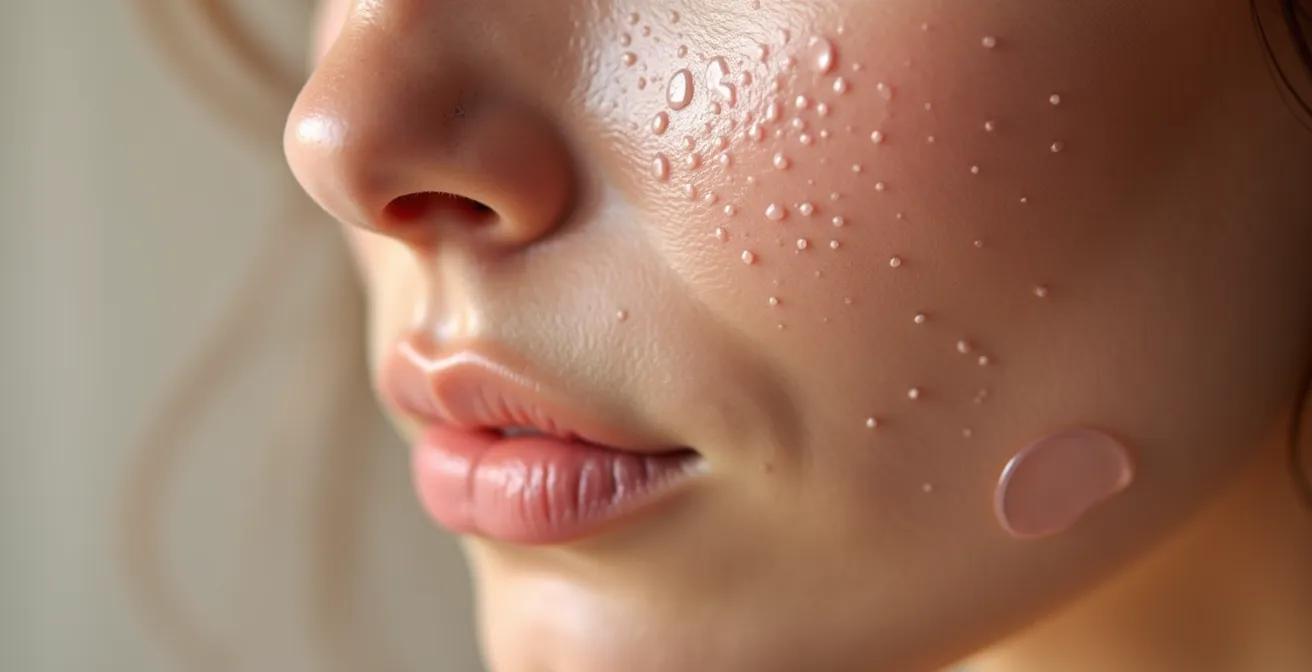
As this visual implies, different facial zones have varying levels of sensitivity. The delicate skin around the eyes is far more prone to reaction than the more resilient skin of the jawline, reinforcing the need for careful, localized testing before widespread application.
The Risk of Assuming Fragrance-Free Means Irritant-Free
The terms « fragrance-free » and « hypoallergenic » are perhaps the most misunderstood in skincare. Consumers are trained to see them as seals of safety, but the reality is starkly different. These claims exist in a regulatory void, meaning companies can use them without adhering to any government-mandated standard or proving their product is any less likely to cause a reaction. This lack of regulation turns these labels into unreliable marketing jargon.
A « fragrance-free » label simply means no ingredients have been added for the express purpose of creating a scent. However, the product can still contain numerous other potential irritants, such as preservatives (like parabens), sulfates, or even essential oils added for a « natural » therapeutic purpose, which are themselves potent allergens. Furthermore, a product labeled « unscented » is even more deceptive; it often contains masking fragrances used to neutralize the chemical smells of other ingredients.
The term « hypoallergenic » is equally meaningless. As the Twentyeight Health Medical Team points out, the bar for these claims is alarmingly low and they should not be trusted as a measure of safety.
‘Dermatologist tested’ could mean one dermatologist looked at it once. ‘Hypoallergenic’ has no regulated definition.
– Twentyeight Health Medical Team, Debunking Common Skincare Myths
This lack of oversight places the full burden of safety on the consumer. You cannot outsource your safety to a label. The only way to be certain a product is safe for you is through the diligent, personal testing protocols discussed earlier. Every new product, regardless of its claims, must be treated as a potential trigger until proven otherwise through a ROAT.
When to Introduce New Products After a Reaction?
After a skin reaction, the immediate impulse is to find a new « safe » product to fix the problem. This is a critical mistake. A reactive state means your skin barrier is compromised and inflamed. Introducing new products at this stage, even gentle ones, is like asking a sprained ankle to run a marathon. The first priority is not to add, but to subtract. Your skin needs time to heal and rebuild its defenses in a neutral environment.
The recovery process should be managed in distinct phases. During the initial « Calm » phase, which can last up to five days, strip your routine back to the absolute bare minimum: lukewarm water and, if necessary, a thin layer of a simple occlusive like petroleum jelly. Avoid all cleansers, serums, and active ingredients. The goal is to remove all potential variables and let the inflammation subside on its own. Cold compresses can provide immediate relief from itching and burning.
Once the initial inflammation has visibly reduced, you can enter the « Rebuild » phase. This can last from day 6 to day 15. Here, you reintroduce a minimal barrier-repair routine consisting of only a bland, trusted cleanser and a gentle moisturizer rich in ingredients like ceramides, glycerin, or hyaluronic acid. Monitor your skin closely. If you experience any tightness or stinging after cleansing, it’s a sign your barrier is still too fragile. A healthy barrier should feel calm and comfortable after contact with water.
Only after your skin can tolerate a basic routine without any signs of distress for several consecutive days (typically around day 16 or later) can you begin the « Reintroduce » phase. Add back products one at a time, with a full 7-10 day patch test for each new addition. This methodical, one-in-one-out approach is the only safe way to rebuild your routine and ensures that if a reaction does occur, you will know the exact culprit.
Fragrance-Free vs Unscented: Which Is Safer for Eczema?
For individuals with eczema, the distinction between « fragrance-free » and « unscented » is not just semantic—it’s a critical factor for skin safety. The National Eczema Association identifies synthetic fragrances as one of the leading causes of skin allergies and flare-ups. Therefore, a product labeled « fragrance-free » is unequivocally the safer choice. This designation means the product is formulated without any added aromatic compounds, significantly reducing the risk of a fragrance-induced reaction.
In contrast, « unscented » products often pose a hidden risk. This term indicates that the product may contain chemicals, known as masking fragrances, which are added specifically to neutralize or cover up the natural odors of other ingredients. These masking agents are still fragrances and can be just as irritating as perfumes. For someone with a compromised skin barrier, as is common with eczema, these hidden chemicals can easily trigger inflammation, itching, and a full-blown flare-up.
However, even a « fragrance-free » label is not a complete guarantee of safety. As organizations like the National Eczema Association highlight in their certification processes, other ingredients can also be problematic. These include certain preservatives, such as parabens, which can disrupt the skin’s balance, and sulfates (like Sodium Lauryl Sulfate), which are commonly found in foaming cleansers and are known to strip the skin’s natural moisture barrier, leading to dryness and irritation. Therefore, while choosing « fragrance-free » is the correct first step, it’s still essential to read the full ingredient list and patch test any new product.
Natural vs Synthetic: Which Is More Likely to Cause Allergies?
One of the most pervasive myths in beauty is that « natural » or « organic » ingredients are inherently safer than synthetic ones. This belief is not only incorrect but also dangerous for people with sensitive skin. The reality is that many plant-based and botanical ingredients are among the most common causes of both irritant and allergic contact dermatitis. Poison ivy is a perfect, if extreme, example of a potent natural allergen. Many essential oils, like lavender, tea tree, and citrus oils, are also frequent triggers.
As dermatologist Dr. Jay Wofford states, the « all-natural » claim should be a red flag for those with reactive skin, not a green light.
The terms ‘all-natural’ and ‘organic’ generally mean the product contains plant-based and/or herbal ingredients. These ingredients are very common causes of irritant and allergic reactions for people with sensitive skin and inflammatory skin conditions.
– Dr. Jay Wofford, U.S. Dermatology Partners
In contrast, many synthetic ingredients are engineered for purity and stability. A lab-created ingredient can be formulated to a high degree of consistency, free from the natural impurities and secondary compounds found in botanical extracts that can cause reactions. For example, synthetic emollients or humectants are often designed specifically to be inert and non-reactive. The idea that « synthetic » equals « harsh chemicals » is a gross oversimplification. Ultimately, an ingredient’s potential to cause an allergy depends on its molecular structure, not its origin.

The decision should never be based on an ingredient’s source (natural vs. synthetic) but on its proven safety profile for your individual skin. The FDA provides no official definition or regulation for terms like « natural, » leaving it up to marketing departments. This reinforces the core message: personal testing is the only path to certainty.
The Risk of Developing a Gel Allergy from Home Kits
The rise of at-home gel manicure kits has corresponded with a significant increase in cases of contact dermatitis to acrylates, the chemical compounds that make gel polish harden. The problem often isn’t the gel itself, but improper application. When uncured gel touches the skin around the nail, it can trigger a process called sensitization. This is where the immune system learns to recognize the chemical as a threat. You may not react the first, second, or even tenth time, but with repeated exposure, your body can suddenly develop a severe, permanent allergy.
Once an acrylate allergy develops, it’s for life. The reaction typically presents as intense itching, redness, blistering, and sometimes even causes the nail plate to lift away from the nail bed (onycholysis). Because acrylates are used in many medical and dental procedures—such as in white fillings, dental crowns, and orthopedic bone cement—developing this allergy from a home manicure can have serious future health implications. It can prevent you from being able to receive certain types of essential medical care.
This risk highlights why even seemingly harmless beauty treatments require a cautious approach. The development of a weak or minor reaction after using a product should never be ignored; it can be the first sign of sensitization. For individuals with a history of atopic dermatitis, the risk is even higher. This is another scenario where a ROAT can be invaluable for determining if a low-grade, questionable reaction is clinically significant before it escalates into a full-blown, lifelong allergy. Research shows that a limited number of common allergens are responsible for the vast majority of reactions, making diligent avoidance of known triggers paramount.
Key Takeaways
- Marketing labels like « hypoallergenic, » « dermatologist-tested, » and « natural » are unregulated and offer no guarantee of safety.
- The only reliable method to ensure a product is safe for you is a systematic personal testing protocol, such as the Repeated Open Application Test (ROAT).
- A damaged skin barrier must be repaired with a minimal, supportive routine before any new products are introduced to avoid a cycle of reactions.
How to Fix a Damaged Skin Barrier in Under 2 Weeks?
A damaged skin barrier is the underlying condition behind most sensitivity, redness, and reactivity. It’s a state where the protective outer layer of your skin has been compromised, allowing moisture to escape and irritants to enter. Fixing it is not about finding a magic product, but about implementing a strict, supportive protocol that gives your skin the space and materials it needs to heal itself. With a disciplined approach, significant improvements can be seen in as little as two weeks.
The foundation of barrier repair is a « less is more » philosophy. For the first few days, you must strip your routine down to the absolute essentials: a gentle, non-foaming cleanser used once a day, a bland, fragrance-free moisturizer loaded with barrier-supportive ingredients, and a mineral-based sunscreen. During this period, you must avoid all forms of exfoliation (both physical scrubs and chemical acids like AHAs/BHAs), all active ingredients like retinoids or vitamin C, and use only lukewarm water. The goal is to eliminate all potential stressors.
After the initial calming phase (Days 1-3), the focus shifts to actively supporting repair (Days 4-14). Your moisturizer should be the star of the show. Look for key ingredients like ceramides (the lipids that make up over 50% of your skin barrier), glycerin (a humectant that draws in water), and soothing agents like oat extract or centella asiatica. You’ll know your barrier is healing when your skin no longer feels tight or dry after cleansing and can tolerate your basic moisturizer without any stinging. This methodical approach is the fastest and safest path back to healthy, resilient skin.
Action Plan: 14-Day Barrier Recovery Protocol
- Days 1-3: Strip routine to basics – gentle cleanser + bland fragrance-free moisturizer + mineral SPF only.
- Days 4-7: Focus on barrier-supportive ingredients – ensure products contain ceramides, glycerin, and hyaluronic acid.
- Days 8-10: Incorporate soothing actives like aloe, oat extract, or centella asiatica if no irritation is present.
- Days 11-14: Monitor for restoration signs – no tightness post-cleansing, reduced redness, and comfortable product application.
- Throughout the 14 days: Use only lukewarm water, pat dry gently (never rub), and avoid all exfoliation (physical and chemical).
By abandoning the misleading promises of marketing labels and adopting this diligent, evidence-based approach, you can move from a state of constant reaction to one of control and confidence in your skincare choices. The next step is to begin this process today by committing to methodically testing every product in your cabinet.