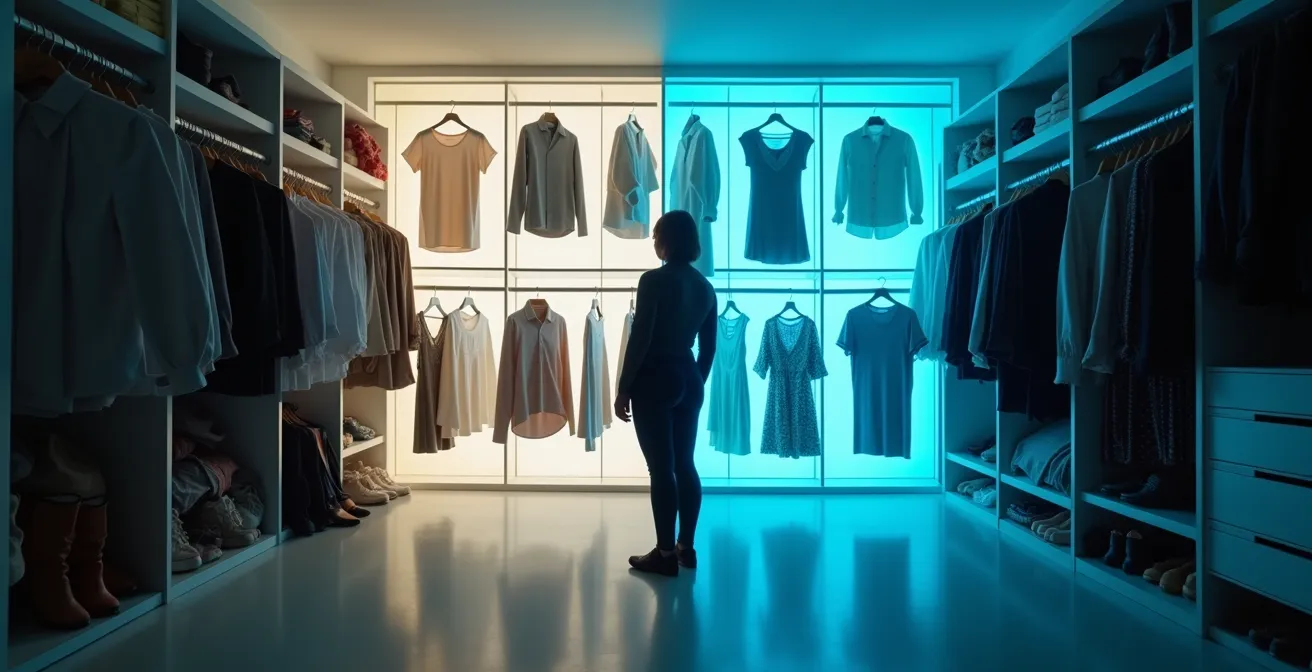
Digital fashion offers the only viable path to end the destructive cycle of overconsumption by fundamentally separating self-expression from physical production.
- It eliminates nearly all the water use, textile waste, and carbon emissions tied to a traditional garment’s lifecycle.
- It empowers limitless creativity and identity exploration in the metaverse and through augmented reality without real-world environmental consequences.
Recommendation: Begin viewing your digital identity not as a secondary self, but as a primary canvas for expression, and prioritize investing in assets built for interoperability and long-term value.
The relentless churn of fast fashion has an undeniable appeal: novelty, self-expression, and the thrill of the new. Yet, this cycle is built on a foundation of ecological devastation and unsustainable consumption. For years, the conversation has centered on recycling, upcycling, and conscious consumerism—noble efforts that unfortunately only chip away at the edges of a systemic crisis. We’ve been told to buy less, choose better, and make it last. But what if the problem isn’t the desire for novelty, but the physical medium we use to express it?
The prevailing wisdom suggests we must curb our creative impulses to save the planet. This approach pits human nature against environmental responsibility, a battle we are destined to lose. The truth is, the desire to evolve our style and present different facets of our personality is fundamental. The solution cannot be to suppress this desire, but to find a new, non-destructive outlet for it. This is where the paradigm shifts, moving beyond the physical limitations that have defined fashion for centuries.
This is the promise of digital fashion. It’s not an alternative or a quirky niche; it is the inevitable evolution of identity itself. By embracing a future where our self-expression is decoupled from material constraints, we can unlock a new era of frictionless creativity and true sustainability. This isn’t about replacing your favorite real-world jacket; it’s about augmenting your identity in a world that is increasingly lived online. It’s about satisfying our hunger for the new without consuming the planet in the process.
This article will explore the mechanics, risks, and staggering potential of this post-physical reality. We will dissect how digital assets provide value, navigate the investment landscape, and look ahead to a future where our virtual and augmented selves are just as important as our physical ones. Get ready to rethink everything you know about your wardrobe.
Summary: The Inevitable Shift to a Post-Physical Wardrobe
- Buying Clothes for Avatars vs Real Life: Is It Worth It?
- How to Invest in Fashion NFTs Without Getting Scammed?
- The Risk of Platform Incompatibility for Your Digital Assets
- How to Use Digital Filters to Create Content Without Buying Clothes?
- When Will We Wear Digital Clothes in Augmented Reality Meetings?
- The Risk of Ignoring Fabric Physics in 3D Simulations
- When Will Smart Textiles Replace Traditional Medical Monitors?
- How to Implement Sustainable Production Without Doubling Your Costs?
Buying Clothes for Avatars vs Real Life: Is It Worth It?
The question of « worth » is central to the debate around digital fashion, and it hinges on a radical re-evaluation of value. In the physical world, a garment’s worth is tied to its material, brand, and craftsmanship. In the digital realm, worth is defined by expression, community, and environmental impact—or lack thereof. When you buy a physical shirt, you buy cotton, dye, and labor. When you buy a digital one, you acquire pure, unadulterated style, a piece of decoupled identity that can be worn by your avatar in a metaverse, flexed in a video game, or used as an AR filter on social media.
The environmental argument is staggering and undeniable. Producing a single cotton t-shirt requires thousands of gallons of water, while its digital counterpart requires none. One study highlights that replacing a single physical garment with a digital version can save 3,300 gallons of water. This isn’t an incremental improvement; it’s a quantum leap in sustainability. As Daria Shapovalova, a pioneer in the space, noted, « Digital fashion allows us to satisfy our desire for novelty without the environmental cost. » It addresses the core driver of overconsumption—the desire for newness—by providing an infinite, zero-impact solution.
The financial worth is also becoming increasingly tangible. While many digital garments cost a fraction of their physical counterparts, high-end pieces are proving to be serious investments. The concept of digital scarcity, enabled by NFTs, creates a market for unique and collectible items.
Case Study: The Multi-Million Dollar Value of Digital Sneakers
In early 2021, the digital fashion house RTFKT (later acquired by Nike) made headlines when a collaboration with a young artist resulted in the sale of three sneaker NFTs for over $3 million. This wasn’t about wearing shoes; it was about owning a piece of cultural history and a status symbol within a burgeoning digital community. This event demonstrated that when creativity and community converge, digital assets can achieve and exceed the value of their physical inspirations.
Ultimately, a digital garment is « worth it » if you value expression over possession and sustainability over disposability. It’s a purchase that invests in a cleaner future and expands your ability to define who you are in the digital world.
How to Invest in Fashion NFTs Without Getting Scammed?
As the digital fashion market explodes, so does the potential for scams and bad investments. The allure of quick profits can cloud judgment, but a strategic approach can help you navigate this new frontier safely. Investing in fashion NFTs isn’t like buying stocks; it’s more akin to art collecting, where an item’s value is tied to its creator’s reputation, its cultural significance, and its utility. The key is to look beyond the hype and assess the long-term fundamentals of a project.
The most common pitfall is the « rug pull, » where anonymous developers launch a project, sell the NFTs, and then disappear with the funds, leaving buyers with worthless assets. The first line of defense is due diligence on the team. Are they « doxxed » (publicly identified)? Do they have a proven track record in fashion, art, or technology? A transparent team with a clear vision is a fundamental sign of a legitimate project. Conversely, anonymity and vague promises are major red flags.

Beyond the team, the most critical factor is utility. A pretty JPEG is not an investment. A valuable fashion NFT should offer tangible benefits. Does it grant access to an exclusive community or events? Can the garment be worn on an avatar across multiple metaverse platforms (interoperability)? Does it come with a physical counterpart? A project with a detailed utility roadmap shows a commitment to building sustained value for its holders, transforming the NFT from a simple collectible into a key that unlocks an ecosystem.
Your Action Plan: Vetting a Fashion NFT Project
- Verify the Team: Confirm that the creators are publicly identified and possess verifiable backgrounds in fashion, design, or blockchain technology.
- Analyze the Roadmap: Look for a concrete utility plan that extends beyond simply owning the asset. What will this NFT do for you in one, three, or five years?
- Check for Interoperability: Assess the project’s plans to ensure the asset can be used across multiple metaverse platforms, not just in a single, closed ecosystem.
- Assess Community Health: Examine the community’s engagement levels on platforms like Discord and Twitter. Is communication from the team transparent and frequent?
- Distinguish Risk Types: Learn to differentiate between the risk of a malicious ‘rug pull’ and the normal, inherent market volatility of all digital assets.
Investing in fashion NFTs requires a mindset shift from a consumer to a digital art collector. By prioritizing projects with strong teams, clear utility, and a focus on interoperability, you can build a digital collection that is not only stylish but also a sound long-term asset.
The Risk of Platform Incompatibility for Your Digital Assets
The dream of a universal digital wardrobe—where a single purchased item can be worn in any game, social platform, or virtual world—is the holy grail of the metaverse. However, the current reality is a fragmented landscape of « walled gardens. » A digital jacket bought for your Fortnite avatar cannot be worn in Decentraland, and a Gucci dress from Roblox is confined to that universe. This issue of platform incompatibility is the single greatest technical and philosophical hurdle to the mass adoption of digital fashion.
This fragmentation directly undermines the core value proposition of digital ownership. If your assets are trapped within a single platform, do you truly own them? Or are you simply licensing them from the platform owner? As the organization Threading Change aptly puts it, « The inability to carry your digital style across platforms fragments your digital self. » It forces you to repurchase and recreate your identity for every new digital space you enter, perpetuating a new form of digital consumerism that ironically mirrors the problems of the physical world.
The challenge is both technical and commercial. Each platform has its own proprietary code, rendering engines, and avatar standards, making universal compatibility a massive undertaking. Commercially, platforms are incentivized to keep users and their assets locked within their ecosystem to maximize revenue. Despite a 65% increase in brand partnerships with Web3 platforms in 2024, many of these collaborations are exclusive, further reinforcing the walled gardens.
The solution lies in the collective push towards open standards and interoperability. Visionary projects are building their assets on open-source principles, designing them to be adaptable to future platforms. As a consumer and investor, your power lies in supporting these projects. Before purchasing a digital asset, ask the critical question: « Where can I use this? » Prioritize brands and platforms that are actively working with organizations like the Open Metaverse Alliance (OMA3) and are committed to a future where your digital identity is portable, not partitioned.
How to Use Digital Filters to Create Content Without Buying Clothes?
While the metaverse and avatar-based fashion represent the long-term vision, the most immediate and accessible form of digital fashion is already in your pocket: augmented reality (AR) filters. For content creators, influencers, and anyone looking to create a stunning social media presence, AR fashion offers a revolutionary tool for limitless expression without consumption. It allows you to « wear » intricate, impossible, or avant-garde designs for a photo or video, achieving high-fashion aesthetics with zero environmental impact and zero cost.
The principle is simple. Instead of buying a physical outfit for a single Instagram post—a major driver of fast fashion waste—you apply a digital layer over your real-world self. These filters, available on platforms like Instagram, Snapchat, and TikTok, can range from virtual makeup and accessories to full-body outfits that move and react with you. This technology is not a gimmick; it’s a mainstream behavior. Research indicates that 92% of Gen Z is interested in using virtual try-on and AR technologies, signaling a massive cultural shift in how we interact with clothing.
The most empowering aspect is that you are no longer just a consumer; you can be a creator. Free software like Meta’s Spark AR Studio and Snap’s Lens Studio have democratized the creation of AR filters. With a basic understanding of 3D assets, anyone can design their own virtual fashion. You can import 3D models of garments, create glowing animated textures, or design fantastical accessories that defy gravity. By anchoring these designs to the body’s tracking points, you can produce high-quality fashion content that is unique to your personal brand.
This approach completely severs the link between content creation and physical consumption. It allows for constant stylistic experimentation and novelty—the very things that fuel fast fashion—but redirects that creative energy into a sustainable, digital-first workflow. It’s a powerful way to build an audience and a personal brand based on creativity and vision, rather than purchasing power.
When Will We Wear Digital Clothes in Augmented Reality Meetings?
The idea of wearing digital clothes for a professional video call might seem futuristic, but the convergence of technology and cultural shifts suggests this reality is closer than you think. The question is not *if*, but *when* our professional presentation will become a blend of physical and augmented reality. The groundwork is already being laid through widespread adoption of AR-capable devices and a growing demand for more immersive digital experiences.
The primary driver is hardware accessibility. Market forecasts predict 1.7 billion active mobile AR devices by 2024. While these are primarily smartphones, the technology is paving the way for AR glasses and more advanced integrations. As remote and hybrid work become permanent fixtures of the corporate world, the demand for better virtual presence will only intensify. A static, poorly lit webcam image fails to convey professional presence; a sharp, well-fitted digital blazer or accessory layered over your real-world self could become the new standard for making a strong impression.

The demand is not just speculative; it’s already being measured. A report from Rock Paper Reality found that a staggering 72% of luxury fashion consumers believe it’s important for brands to provide AR experiences. This indicates a powerful market pull. As consumers become accustomed to interacting with brands through AR, the expectation will naturally bleed into other areas of life, including the workplace. Platforms like Microsoft Teams and Zoom are already experimenting with 3D avatars, and the next logical step is sophisticated AR overlays for live video.
We can expect to see early adoption within the next 2-3 years, initially in creative and tech-forward industries. As the technology becomes more seamless and photorealistic, and as a new generation of digital natives enters the workforce, wearing digital attire in an AR meeting will become as normal as using a virtual background. It will solve the « Zoom-shirt » dilemma, allowing for professional presentation without sacrificing comfort or adding to one’s laundry pile, all while saving significant resources.
The Risk of Ignoring Fabric Physics in 3D Simulations
For digital fashion to be a true replacement for physical goods, it must be believable. The illusion shatters the moment a digital silk dress moves like cardboard or a virtual knit sweater stretches like rubber. The single greatest artistic and technical challenge is simulating fabric physics, and ignoring it is a critical risk that devalues the entire concept of digital materiality. Believability isn’t just an aesthetic concern; it’s directly tied to an asset’s perceived value.
In the physical world, we intuitively understand the properties of different materials. We know how satin will catch the light, how denim will crease, and how chiffon will float on a breeze. Our brains are hardwired to recognize these subtle cues. When a 3D simulation fails to replicate them, it triggers an « uncanny valley » effect. The garment feels fake, lifeless, and cheap, regardless of how beautifully it was designed. As the INURU Digital Fashion Report states, « Believability is Value – without accurate physics, digital garments look like stiff armor. »
Achieving realistic physics is computationally intensive. It requires complex algorithms that account for variables like weight, drape, stiffness, and friction. A designer must define not only the look of a garment but its very essence—how it interacts with a moving body, with wind, and with light. This is where artistry meets data science. The most advanced digital fashion houses employ teams of technical artists who specialize in creating these physics-based materials, ensuring every fold and ripple feels authentic.
Ignoring this crucial step is a shortcut to failure. Brands that release clunky, unrealistic digital garments risk damaging their reputation and eroding consumer trust in the medium as a whole. As consumers become more sophisticated, they will demand a higher level of realism. The projects that will succeed are those that invest heavily in the science of simulation, understanding that the value of a digital asset is not just in its design, but in its soul—the way it moves, breathes, and exists in the virtual space.
When Will Smart Textiles Replace Traditional Medical Monitors?
At first glance, the world of medical smart textiles seems distant from digital fashion. One is about biometric data, the other about aesthetic identity. However, this is a false dichotomy. Both are part of the same macro-trend: the digitization of the human form. Smart textiles are creating the biometric data layer, while digital fashion is building the identity layer. The future is a seamless merger of the two, where what we wear not only expresses who we are but also monitors our well-being.
Smart textiles embed sensors directly into fabrics to monitor vital signs like heart rate, respiration, and body temperature. This technology is poised to replace cumbersome medical monitors, offering continuous, comfortable health tracking. Digital fashion, on the other hand, is about creating virtual layers of clothing for our avatars and augmented selves. The connection becomes clear when we envision a « digital twin »—a real-time, 3D replica of ourselves that exists in the cloud.
Smart textiles add a biometric layer while digital fashion adds an identity layer. The convergence of these two fields will create a truly holistic digital self.
– Amor Design Institute, Fashion and the Metaverse Report
This digital twin would be fed a constant stream of data from the smart textiles we’re physically wearing. Simultaneously, it could be dressed in any digital fashion imaginable. This opens up revolutionary possibilities. For example, your digital twin’s outfit in the metaverse could subtly change color to indicate a rising stress level, alerting you or even a remote healthcare provider. This « phygital » (physical + digital) link is already being pioneered by major brands. This strategy was famously demonstrated by Nike’s integration of its RTFKT sneakers with digital twins, where an embedded chip in the physical shoe unlocks exclusive digital content and verifies authenticity.
The replacement of traditional medical monitors by smart textiles is likely to occur in stages over the next 5-10 years, starting with wellness and fitness applications before moving into clinical settings. As this happens, the data infrastructure being built will become the foundation for a much richer, more integrated digital identity, where our health and our style are two sides of the same digital coin.
Key Takeaways
- Decoupled Identity: Digital fashion’s true power is separating self-expression from physical production, directly solving the core driver of overconsumption.
- Utility is Value: The worth of a fashion NFT is not in its image, but in its utility—interoperability, community access, and its creator’s vision are paramount.
- The Phygital Future: The convergence of physical smart textiles (biometrics) and digital fashion (identity) will create a holistic, data-rich « digital twin. »
How to Implement Sustainable Production Without Doubling Your Costs?
The question of implementing sustainable production without incurring prohibitive costs has plagued the fashion industry for decades. The answer has been hiding in plain sight: you don’t reduce the cost of sustainable physical production; you eliminate physical production altogether. Digital fashion is not just a more sustainable option; it is the only scalable model that makes sustainability inherently profitable by sidestepping the material world’s resource and logistical constraints.
Consider the traditional fashion supply chain: sourcing raw materials, spinning yarn, weaving fabric, dyeing, cutting, sewing, shipping, and retail. Each step adds significant cost and environmental impact. According to a stark prediction from McKinsey, the fashion industry could be responsible for 2.7 billion metric tons of carbon by 2030 if it continues on its current path. Digital fashion collapses this entire chain into a single step: design. A 3D artist creates a garment on a computer, and it is instantly ready for global distribution. There are no material costs, no shipping fees, and no unsold inventory going to landfill.
This lean production model fundamentally rewrites the economic equation of sustainability. For brands, it dramatically lowers the barrier to entry for creating and testing new ideas. They can release a digital collection, gauge consumer interest, and only then decide whether to produce a limited run of physical items, eliminating the guesswork that leads to overproduction. This « digital-first » workflow is not just a cost-saving measure; it’s a powerful tool for market research and waste reduction.
The economic viability is no longer a question. The global digital clothing market is projected to reach a staggering $4.8 billion in value by 2031, proving that there is immense consumer demand for these assets. For consumers, this translates to more choice, more creativity, and the ability to support a truly sustainable ecosystem without compromise. The answer to the cost-sustainability paradox isn’t a new fabric or a better recycling program; it’s a new dimension of existence.
The future isn’t about owning more clothes; it’s about owning your identity. It’s about expressing every facet of your personality without leaving a trace on the planet. The shift is already underway. Embrace the digital revolution and start building your post-physical wardrobe today, because in the new world, the most sustainable garment is the one that isn’t made at all.