
The most profitable fashion collections are not balanced; they are engineered with financial discipline.
- Success depends on defining a specific financial ‘job’ for every SKU, from high-margin basics to brand-building statement pieces.
- Optimizing your assortment through data-driven ratios and release schedules drastically increases SKU productivity and mitigates inventory risk.
Recommendation: Shift your mindset from ‘creative balance’ to ‘assortment engineering’. Implement an Open-to-Buy (OTB) plan and track SKU productivity as your primary KPI.
For product managers and creative directors, the directive to « balance art and commerce » is a familiar refrain. It’s often presented as a mystical tightrope walk between pure creative expression and the stark reality of sales targets. Most advice centers on vague concepts like « knowing your customer » or creating mood boards. But in a market defined by tight margins and shifting consumer behavior, this approach is no longer sufficient. Relying on intuition alone is a direct path to bloated inventories, painful markdowns, and diluted brand messaging.
The fundamental flaw in the « balance » narrative is that it frames creativity and commercial success as opposing forces. They are not. A truly successful collection is a system where every single piece has a purpose, a strategy, and a Key Performance Indicator (KPI) attached to it. The challenge isn’t about compromise; it’s about building a robust, data-informed framework that allows creativity to thrive within commercially viable boundaries. It’s about moving from artistry to what can be called assortment engineering.
This guide abandons the platitudes. Instead, it provides the operational framework of a merchandising director. We will deconstruct the collection into its core financial and strategic components. You will learn how to structure your product mix with precision, mitigate the all-too-common risk of product cannibalization, and make data-driven decisions on everything from channel strategy to production sampling. This is not about stifling creativity; it’s about giving it the commercial structure it needs to succeed and scale.
To navigate this strategic approach, we will explore the critical levers that transform a collection from a creative gamble into a calculated success. This summary breaks down the key decisions you’ll need to master.
Summary: Engineering a Profitable Fashion Collection
- How Many Basic Items Should Be in Your Collection vs Statement Pieces?
- Capsule Collections or Seasonal Drops: Which Model Fits Your Brand?
- The Cannibalization Risk That Occurs When Your Products Are Too Similar
- When to Release Outerwear in a Warming Climate?
- Why Narrow Collections Often Sell Better Than Wide Assortments?
- The Risk of Buying Too Many SKUs and Diluting the Offer
- Wholesale vs Direct-to-Consumer: Which Model Maximizes Profit for Startups?
- Why Virtual Sampling Is Not Yet Enough to Replace Physical Prototypes?
How Many Basic Items Should Be in Your Collection vs Statement Pieces?
The foundation of any commercially successful collection is the ratio between core, evergreen products and trend-driven, seasonal items. Getting this balance right is not a matter of taste but a critical financial decision. The most widely adopted industry standard is the 70/30 rule, which dictates that a collection should be composed of approximately 70% timeless staples and 30% trend-led pieces. This framework ensures that the bulk of your investment is in high-sell-through, higher-margin products while still allowing for brand expression and newness.
Visually, this can be understood as a collection pyramid. The wide base is your commercial foundation: the basic t-shirts, denim, and classic knits that generate consistent revenue. The middle tier consists of seasonal « fashion » items that inject color and novelty. At the very top, the apex is your « statement » or « halo » pieces—often used for press and marketing to define the brand’s creative vision, even if they don’t sell in high volume.
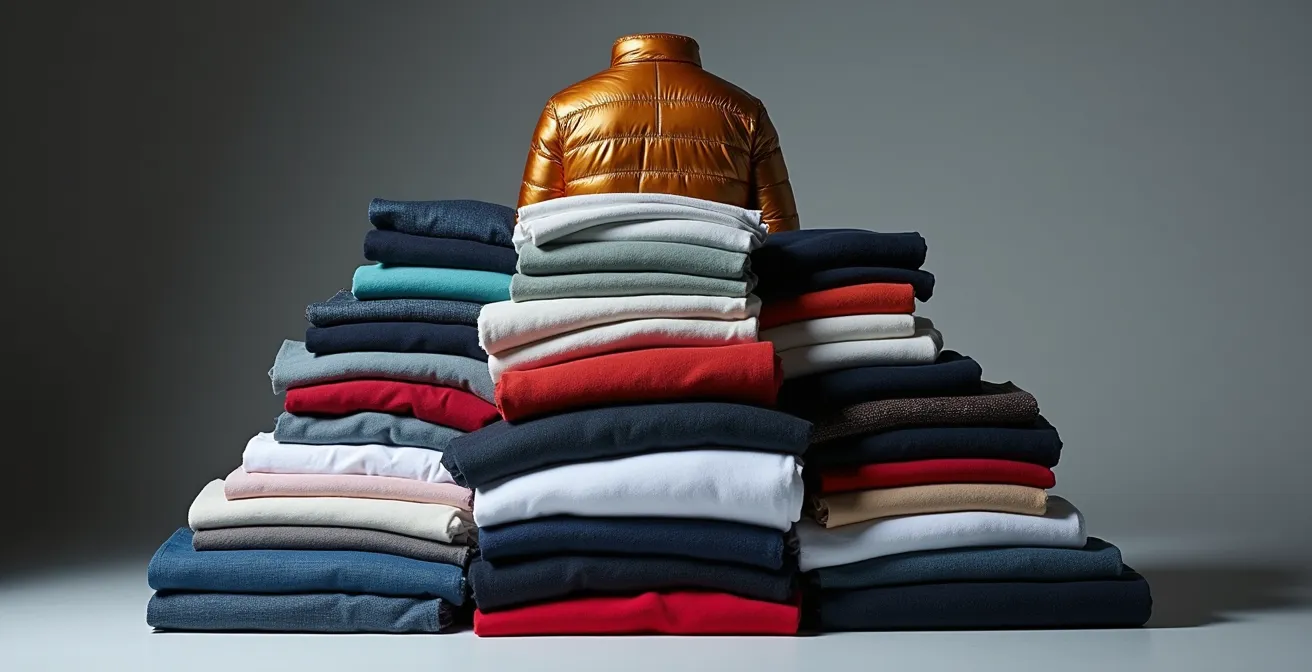
As the pyramid model illustrates, your core basics are the workhorses of the collection. They typically have lower production costs, predictable demand, and higher gross margins. Statement pieces, while crucial for brand identity, are inherently riskier. The key is to use data, not just intuition, to refine your specific ratio over time. A younger, fast-fashion-oriented brand might skew closer to a 60/40 split, while a luxury brand known for timelessness might operate on an 80/20 model. The starting point is the rule, but the end goal is a ratio optimized for your specific sell-through rates and profit margins.
Capsule Collections or Seasonal Drops: Which Model Fits Your Brand?
Once the composition of your collection is defined, the next strategic layer is the delivery cadence. The traditional model of two to four large seasonal collections per year is being challenged by the agility of smaller, more frequent « drops » or capsule collections. The choice is not a simple binary one; a brand’s ideal model depends on its production capabilities, channel strategy (DTC vs. wholesale), and brand positioning.
Large seasonal collections are well-suited for wholesale-heavy businesses that need to present a complete vision to retail buyers months in advance. They allow for long-lead-time production and coordinated global marketing campaigns. However, they carry significant inventory risk and can feel slow to respond to emerging micro-trends. In contrast, the « drop » model, popularized by streetwear and DTC brands, creates urgency and excitement. It allows brands to test new ideas with minimal risk, react quickly to market feedback, and maintain a constant stream of fresh content for social media.
Case Study: The Rise of the Hybrid Drop Model
Many successful brands are no longer choosing one or the other but are adopting a hybrid model. According to an analysis by The Business of Fashion, this strategy involves anchoring the year with main seasonal collections to satisfy wholesale partners while interspersing them with smaller, DTC-exclusive capsule drops. This approach offers the best of both worlds: it maintains the stability of wholesale relationships while leveraging the agility and marketing power of the drop model. It allows brands to test new concepts and fabrics in limited runs before committing them to the main collection, effectively de-risking product development.
For a product manager, the key is to align the release model with the business’s core objectives. Is the priority to maximize wholesale orders or to drive DTC engagement and gather customer data? The hybrid model demonstrates that these goals are not mutually exclusive but can be served by a thoughtfully phased release schedule that balances large-scale planning with nimble, trend-responsive opportunities.
The Cannibalization Risk That Occurs When Your Products Are Too Similar
One of the most insidious and costly mistakes in assortment planning is product cannibalization. This occurs when you introduce new products that are too similar to existing ones, causing them to compete for the same customer’s attention and budget. Instead of generating incremental sales, the new SKU simply steals sales from a core item, often at a lower margin. This not only fails to grow revenue but also complicates inventory management and confuses customers.
The problem is often exacerbated in the digital space. When SKUs lack clear differentiation, you are essentially competing against yourself. This forces you to spend more on marketing to explain subtle differences, driving up customer acquisition costs. A report highlighted a potential 75% increase in digital marketing costs when brands expand their SKU count without a clear differentiation strategy. The customer, faced with two nearly identical black blazers, experiences decision fatigue and may abandon the purchase altogether.
To mitigate this, every SKU must have a distinct « job. » This can be defined by price, function, or fashion level. For example, within a single category like « blazers, » you might have:
- The Entry-Point: A simple, unstructured cotton version at an accessible price.
- The Margin-Driver: A classic, tailored wool version with a high-profit margin.
- The Brand-Statement: A fashion-forward, oversized leather version for marketing and press.
By creating a clear « Good-Better-Best » tiering or assigning functional roles, you ensure each product serves a unique purpose and a specific customer need. A minimum price gap of at least 20% between similar items is a sound rule of thumb to create clear perceptual and financial separation.
When to Release Outerwear in a Warming Climate?
The traditional fashion calendar, set in stone decades ago, is becoming increasingly obsolete in the face of a warming climate and unpredictable weather patterns. Releasing heavy winter coats in August and September, when many regions are still experiencing peak temperatures, is a recipe for low sell-through and early markdowns. This disconnect between the industry’s schedule and the customer’s actual need is a major source of financial waste.
Leading brands are abandoning this outdated model in favor of a data-driven approach to timing their releases. This involves a more nuanced strategy focused on transitional and multi-functional pieces. Instead of a single « winter » drop, smart merchandising involves phasing in outerwear based on its weight and function. For example, lightweight transitional jackets and gilets can drop in early autumn, followed by mid-weight wool coats, with the heaviest parkas held back until the first real cold snaps are forecast.

Case Study: Data-Driven Release Scheduling
To perfect this timing, brands are now actively using external data sources. They track historical temperature data for key markets and monitor Google Trends for search terms like « winter coat » or « puffer jacket. » By correlating search interest spikes with actual weather patterns, they can identify the optimal two-to-three-week window when consumer intent is at its peak. This agile, data-informed scheduling is far more effective than the old « set it and forget it » calendar. Brands using this method report 15-20% better sell-through rates, as the product arrives in-store and online precisely when the customer starts feeling the need for it.
This shift requires a more flexible supply chain but pays significant dividends by aligning product availability with real-time demand, maximizing full-price sales and reinforcing the brand’s relevance to the modern consumer’s lifestyle.
Why Narrow Collections Often Sell Better Than Wide Assortments?
The conventional wisdom that « more choice is better » has been thoroughly debunked in modern retail. Offering an overwhelmingly wide assortment often leads to decision paralysis for the consumer and creates massive operational drag for the brand. In contrast, a tightly curated, narrow collection can lead to significantly better commercial outcomes. The key metric here is SKU productivity—the amount of revenue generated per style. A focused approach is a direct path to improving this critical KPI.
Research in assortment planning consistently shows that brands with focused collections achieve 40-60% higher SKU productivity compared to those with sprawling, unfocused ranges. A narrow assortment forces discipline. Every piece must earn its place. This not only improves financial performance but also strengthens brand identity. A brand that presents a curated selection positions itself as a confident expert, telling the customer, « These are the best, most essential pieces you need. » This builds trust and simplifies the shopping experience.
Case Study: The Psychology of Curation
The success of narrow collections is rooted in psychology. By offering fewer, more considered options, a brand reduces the cognitive load on the customer. This is particularly effective in the luxury space, where curation reinforces exclusivity and desirability. Furthermore, a well-engineered narrow collection is built on a modular philosophy, where each piece is designed to be styled with three or four others in the assortment. This multiplies the perceived value for the customer; they are not just buying a single item but investing in a versatile wardrobe system. This creates a more compelling value proposition than a wide assortment of disconnected items.
For product managers, the goal is to ruthlessly edit the collection down to only the most productive and brand-right styles. This strategy reduces inventory risk, lowers marketing costs, and ultimately creates a stronger, more profitable business by focusing investment on proven winners.
Key Takeaways
- The 70/30 Rule: Anchor your collection with 70% core staples and 30% trend pieces to secure revenue while allowing for creative expression.
- SKU Productivity is King: A narrow, curated collection with high SKU productivity is more profitable than a wide, unfocused assortment that causes decision paralysis.
- Data-Driven Timing: Abandon the traditional fashion calendar. Use weather data and search trends to time product releases with actual consumer demand for higher sell-through.
The Risk of Buying Too Many SKUs and Diluting the Offer
Expanding the number of Stock Keeping Units (SKUs) in a collection can feel like progress. It seems to offer more choice to the customer and capture more market segments. However, without rigorous financial discipline, it is one of the fastest ways to destroy profitability. Every additional SKU introduces a cascade of hidden costs that go far beyond the initial production investment. These include increased costs for photography, copywriting, warehousing, and inventory management.
More SKUs inevitably lead to a higher rate of returns, as customers are more likely to make poor choices from a confusing assortment. Each of these returns comes at a significant cost. Beyond the lost sale, processing a returned item—including shipping, inspection, restocking, and potential damage—can cost a brand anywhere from $21 to $46 per product. When you multiply this by thousands of units, the financial impact of a bloated SKU count becomes devastatingly clear. This is the definition of a diluted offer: more products, less profit.
The antidote to this is a disciplined financial framework known as Open-to-Buy (OTB) planning. An OTB plan is essentially a budget for inventory. It sets a hard limit on the total amount of money that can be spent on new products for a given season, allocated by category based on past sales performance and future forecasts. It forces merchandising teams to make strategic choices and prioritize investments in products with the highest potential return.
Your Action Plan: Implementing an Open-to-Buy (OTB) Framework
- Set Hard Limits: Establish a total inventory investment budget for each season and stick to it.
- Allocate by Performance: Distribute the budget across product categories based on their historical sell-through rates and gross margin.
- Track SKU Productivity: Monitor revenue per SKU on a monthly basis. This is your core metric for assortment health.
- Implement the 80/20 Rule: Identify the bottom 20% of your SKUs by productivity and create a plan to eliminate them each season.
- Justify Additions: Require a formal business case, including revenue and margin projections, for any new SKU that is added beyond the initial plan.
Wholesale vs Direct-to-Consumer: Which Model Maximizes Profit for Startups?
For a startup, choosing the right sales channel is a foundational decision that impacts everything from cash flow to brand control. The two primary models, Direct-to-Consumer (DTC) and wholesale, offer vastly different risk and reward profiles. While DTC is often touted as the modern, high-margin path to success, the reality is far more nuanced. For many startups, net profitability can end up being surprisingly similar across both models.
The primary appeal of DTC is margin. By selling directly to the end customer, a brand can capture the full retail price, leading to gross margins of 50-70% or more. In contrast, wholesale requires selling to a retailer at a significant discount (typically 50-60% off retail), resulting in lower gross margins of 20-40%. However, this simple comparison ignores the hidden costs of DTC. In the DTC model, the brand is solely responsible for marketing and customer acquisition, which can be prohibitively expensive. Wholesale outsources this cost to the retailer.
The following table breaks down the key financial and operational differences, showing how high DTC gross margins are often offset by high operating costs.
| Metric | Direct-to-Consumer | Wholesale |
|---|---|---|
| Gross Margin | 50-70% | 20-40% |
| Customer Acquisition Cost | $30-100 per customer | $0 (retailer’s responsibility) |
| Net Profit Margin | 5-10% | 5-10% (similar despite lower gross) |
| Data Ownership | Full customer insights | Limited/no customer data |
| Inventory Risk | 100% brand-owned | Shared with retailers |
Case Study: A Phased Growth Strategy
The most successful modern startups often don’t choose one model but phase them strategically. They begin with DTC to build brand equity, gather invaluable customer data, and test products with controlled inventory risk. Once they have proven bestsellers and a strong brand narrative, they leverage this success to enter wholesale from a position of strength. Brands like Vuori and Cult Gaia used their DTC data to negotiate better terms with retailers, securing premium store placement and avoiding the deep markdowns that often plague unproven brands in the wholesale channel. This phased approach allows a startup to maintain a high-margin DTC business as its core while using wholesale for volume, brand awareness, and de-risking inventory.
Why Virtual Sampling Is Not Yet Enough to Replace Physical Prototypes?
The promise of 3D virtual sampling is alluring: faster iterations, lower costs, and a reduced carbon footprint. Digital design tools have made incredible strides, allowing designers to create photorealistic renders of garments, test different colorways, and even simulate fabric drape on virtual avatars. For many early-stage design decisions, these tools are transformative. However, relying solely on virtual sampling to bring a collection to market is a significant risk that even the most technologically advanced brands are unwilling to take.
The reality is that virtual technology, for all its benefits, cannot yet fully replicate the tactile and physical experience of a garment. The subtle nuances of fabric hand-feel, the true weight and drape of a material in motion, and the precise fit on a range of human bodies are all elements that can only be validated with a physical prototype. For a premium brand, these details are what justify a higher price point. A dress that looks perfect in a 3D render might feel stiff or uncomfortable when actually worn, a fatal flaw that no amount of digital polish can fix.
As one industry expert from a leading fashion technology firm noted in a recent report:
Virtual avatars still cannot perfectly replicate the nuances of a human body in motion, which is essential for validating the wearability and comfort of a garment.
– Fashion Technology Expert, Tukatech Fashion Technology Report 2022
The most effective and efficient workflow today is a hybrid « smart sampling » approach. Brands use 3D virtual tools for the initial creative and approval stages—approving silhouettes, iterating on prints, and narrowing down options. This can achieve a 30-40% reduction in initial sample costs. However, once a design is finalized, a physical sample is created. This physical prototype is the final gate for quality control, used for fit sessions on live models and to validate that the garment’s real-world quality meets the brand’s standard. This preserves the tactile integrity of the product while still capturing significant efficiencies from digital tools.
By shifting from a mindset of « balancing » to one of « engineering, » you equip your brand with the financial discipline and strategic clarity needed to thrive. Implementing these data-driven frameworks is the next logical step to transform your creative vision into a commercially powerful reality.