
The key to affordable sustainable production isn’t spending more, but investing smarter in high-impact areas with proven long-term returns.
- Effective ethical oversight can be achieved remotely through digital vetting, saving significant travel costs.
- Green manufacturing processes often lead to substantial savings on water, energy, and waste disposal within two years.
- Focusing on fabric waste reduction and leveraging the resale market can create new efficiencies and revenue streams.
Recommendation: Shift your mindset from viewing sustainability as a cost center to seeing it as a strategic framework for building a more resilient and profitable brand.
For many aspiring fashion entrepreneurs, the dream of building an ethical brand quickly collides with a harsh reality: the perceived high cost of sustainability. You want to do right by the planet and its people, but you’re also running a business with tight margins. The conventional wisdom suggests a painful choice between your values and your financial viability. You hear about the importance of organic fabrics, fair wages, and eco-friendly processes, and each one sounds like another line item on an already strained budget.
But what if this premise is flawed? What if the narrative that « ethical equals expensive » overlooks the bigger picture of smart, strategic business? The most successful sustainable brands don’t just throw money at problems; they redesign their systems for efficiency, transparency, and long-term value. This isn’t about absorbing higher costs; it’s about making deliberate investments that pay dividends in operational savings, customer loyalty, and brand resilience. The true key is moving beyond the surface-level advice and understanding the practical mechanisms that make sustainable production not just possible, but profitable.
This guide is designed to give you that practical framework. We will break down how to implement ethical and sustainable practices without destroying your margins. By focusing on remote verification, long-term ROI, strategic certification, and waste reduction, you’ll see how to build a brand that is both principled and profitable.
In this article, we’ll explore the actionable strategies that allow you to build a sustainable fashion brand on a realistic budget. The following sections provide a clear roadmap, from vetting your suppliers remotely to making informed choices about materials.
Summary: A Pragmatic Path to Sustainable Fashion
- How to Vet Overseas Factories for Ethical Labor Without Traveling?
- Why « Green » Production Saves Money After 2 Years of Operation?
- GOTS vs OEKO-TEX: Which Certification Matters More for Your Brand?
- The Greenwashing Trap That Can Destroy Your Brand Reputation
- How to Reduce Fabric Waste by 15% During the Cutting Stage?
- How to Verify the Origin of Your « Organic » Fabric?
- How to Transition from Fast Fashion to Thrifting Step-by-Step?
- Natural vs Synthetic Fibers: Which Is Really More Durable for Workwear?
How to Vet Overseas Factories for Ethical Labor Without Traveling?
One of the biggest perceived costs in ethical sourcing is the need for on-site factory inspections. For a startup, international travel is a luxury you can’t afford. The good news is, technology and smart networking have made digital vetting not just a viable alternative, but a highly effective one. The goal is to create a web of accountability through documentation, third-party verification, and peer-to-peer insights, all from your desk.
Start by demanding a paper trail. Ask for Transaction Certificates (TCs) that track materials through the supply chain and cross-reference them with other documents to spot inconsistencies. But don’t stop there. You can hire local freelance auditors through platforms like Upwork for a fraction of the cost of a plane ticket. Instruct them to conduct live video tours, focusing not just on the production floor, but on worker facilities like canteens and dorms—these areas often tell the real story of labor conditions.
Finally, leverage the power of community. Search for online forums and worker-review sites in the factory’s country to get unfiltered feedback. Platforms like Common Objective connect brands using the same facilities, allowing you to pool resources and share due diligence reports. This collaborative approach creates transparency and reduces the burden on any single brand.
Your Action Plan: The 5-Step Digital Factory Vetting Checklist
- Request Transaction Certificates (TC): Ask for these chain-of-custody documents to track materials from the spinner to the fabric mill for specific batches.
- Hire Local Freelance Auditors: Use platforms like Upwork for affordable, live video facility tours, focusing on worker areas like canteens, dorms, and bathrooms.
- Cross-Reference Documents: Compare raw material purchase orders with shipping manifests to detect any signs of unauthorized subcontracting.
- Investigate Worker Feedback: Search local worker forums and Glassdoor-equivalent sites in the manufacturing country for unfiltered employee reviews.
- Pool Due Diligence: Connect with other brands using the same factory via platforms like Common Objective to share audit costs and findings.
Case Study: Patagonia’s Transparency Model
Patagonia is a pioneer in ethical fashion, known for implementing fair labor practices and regularly auditing its supply chain. The brand sets an industry benchmark by providing a comprehensive supply chain map on its website, allowing consumers to trace products back to their origins. This level of transparency builds immense trust and demonstrates that detailed factory oversight is possible without constant physical presence, creating a model for others to follow.
Why « Green » Production Saves Money After 2 Years of Operation?
The initial sticker shock of sustainable production—higher costs for certified fabrics, new equipment, or factory compliance—can be intimidating. However, this view is short-sighted. Viewing sustainability as a one-time expense misses the crucial point: it is a capital investment with a clear, demonstrable long-term ROI. After an initial period, green production practices consistently lead to significant operational savings.
The financial benefits stem from radical efficiency. Sustainable technologies are designed to use fewer resources. This means lower monthly bills for water and energy, which are often volatile and rising costs in traditional manufacturing. Furthermore, smarter pattern-making and waste-reduction strategies decrease raw material expenditure and minimize expensive disposal fees. These compounding savings can quickly offset the initial setup cost, turning a perceived liability into a source of financial strength. The market for ethical fashion is not just a niche; it has expanded at a compound annual growth rate (CAGR) of 8.0%, proving there is a growing and lucrative customer base waiting for these products.
As PwC research highlights, this shift also enhances revenue. Their 2024 survey reveals a crucial insight:
Consumers are willing to spend an average of 9.7% more on sustainably produced or sourced goods, even amidst concerns about cost-of-living.
– PwC Research Team, PwC’s 2024 Voice of the Consumer Survey
This willingness to pay a premium, combined with higher customer retention for brands whose values align with their own, creates a powerful financial case for going green.
The table below breaks down the typical financial trajectory, illustrating how initial costs are eclipsed by long-term benefits. While the numbers are illustrative, they reflect a common pattern for brands that commit to sustainable operations.
| Cost Factor | Traditional Production | Sustainable Production | 2-Year Savings |
|---|---|---|---|
| Initial Setup Cost | $100,000 | $150,000 | -$50,000 |
| Water Usage Costs | $40,000/year | $20,000/year | +$40,000 |
| Energy Costs | $60,000/year | $35,000/year | +$50,000 |
| Waste Disposal | $25,000/year | $10,000/year | +$30,000 |
| Customer Retention Value | Standard | +15% higher LTV | +$45,000 |
| Total Net Benefit After 2 Years | +$115,000 | ||
GOTS vs OEKO-TEX: Which Certification Matters More for Your Brand?
Once you commit to using better materials, you’ll enter the world of certifications. GOTS (Global Organic Textile Standard) and OEKO-TEX are two of the most recognized, but they serve very different purposes. Making the right choice isn’t about which one is « better » overall, but which one is strategically right for your brand’s specific goals, budget, and target market. This is a clear example of certification pragmatism.
OEKO-TEX Standard 100 is fundamentally a safety certification. It tests the final product for a list of harmful substances, ensuring it’s safe for human skin. It’s relatively affordable and easier to adopt because it focuses on the end-product, not the entire manufacturing process. This makes it an excellent starting point for startups who want to guarantee product safety to their customers without the complexity of a full supply chain audit.
GOTS, on the other hand, is a holistic sustainability certification. It’s the gold standard, covering not just the final product but the entire process, from harvesting of the raw materials through socially responsible manufacturing to labeling. It requires at least 70% certified organic natural fibers and enforces strict environmental and social criteria. While GOTS carries significant weight in premium markets and tells a powerful brand story, it is also more expensive and complex to achieve. For a small brand, the choice depends on your positioning: are you leading with a message of product safety (OEKO-TEX) or holistic, top-to-bottom sustainability (GOTS)?

The table below offers a strategic decision matrix to help you decide. There is no one-size-fits-all answer; use this to align your certification strategy with your business reality.
| Criteria | GOTS | OEKO-TEX | Best For |
|---|---|---|---|
| Certification Cost | $5,000-15,000 | $1,500-5,000 | OEKO-TEX for startups |
| Consumer Recognition | High (premium markets) | Moderate (safety focus) | GOTS for luxury positioning |
| Supply Chain Requirements | Process-wide compliance | Final product testing only | OEKO-TEX for simpler adoption |
| B2B Market Access | Premium retail required | Standard retail accepted | GOTS for high-end channels |
| Marketing Story | Holistic sustainability | Product safety guarantee | GOTS for brand storytelling |
The Greenwashing Trap That Can Destroy Your Brand Reputation
As consumers become more eco-conscious, the temptation for brands to use vague, unsubstantiated claims grows. This is the greenwashing trap: marketing your products as more environmentally friendly than they truly are. For a new brand, a greenwashing accusation isn’t just bad press; it’s an existential threat that can shatter customer trust before it’s even been built.
The biggest mistake is using broad, meaningless terms like « eco-friendly, » « green, » or « conscious. » These words have no standard definition and open you up to criticism. Authenticity in sustainability comes from specificity and transparency. If you’ve made an improvement, quantify it. Instead of saying a shirt is « eco-friendly, » say, « This shirt is made with organic cotton and uses 50% less water in its dyeing process compared to industry standards. »
Transparency also means acknowledging trade-offs. No product is perfect. If you use recycled polyester to reduce waste, be honest about the ongoing challenge of microplastic shedding and explain what steps you’re taking to mitigate it. This honesty builds more trust than pretending to have a flawless solution. A sustainability roadmap with public, measurable goals is a powerful tool to show you’re on a journey, not just making a static claim.
Cautionary Tale: The Aftermath of ‘The True Cost’
The documentary ‘The True Cost’ put a spotlight on the fashion industry’s dark side. In its wake, major brands like H&M and Zara, which were featured in the film, were forced to defend their practices. Their struggle to counter specific criticisms with vague, corporate sustainability statements highlighted a critical lesson: general ‘eco-friendly’ marketing is a fragile defense. Credibility is built on specific, quantifiable, and verifiable commitments, not broad platitudes.
To avoid this trap, every sustainability claim you make should pass a simple test. Ask yourself: is it specific, is it measurable, and can I prove it? If the answer to any of these is no, go back to the drawing board. Here are the core principles to follow:
- Quantify Your Claims: Replace vague adjectives with hard numbers. Instead of « uses less water, » state « uses 2 million liters less water annually. »
- Disclose Trade-Offs: If your « sustainable » material has a downside (e.g., microplastics from recycled polyester), acknowledge it and explain your mitigation plan.
- Publish a Roadmap: Create a public document with measurable milestones and report on your progress regularly. This shows commitment to a journey, not just a destination.
- Prepare for Missteps: Have a crisis communication plan ready that prioritizes accountability and corrective action over defensiveness.
How to Reduce Fabric Waste by 15% During the Cutting Stage?
In fashion manufacturing, one of the most significant and controllable sources of waste occurs before a single stitch is sewn: the cutting stage. It’s a silent margin killer. Statistics are sobering; studies show that more than 60% of material used in clothing production ends up in incinerators or landfills within a year, and a significant portion of that is pre-consumer waste from the factory floor. For a startup, every square inch of fabric counts. Reducing cutting waste by just 15% can have a dramatic impact on your cost of goods sold (COGS).
The solution lies in a combination of smart design and accessible technology. The concept of zero-waste pattern design isn’t just for avant-garde brands; it involves creating garments from geometric shapes that interlock like puzzle pieces, utilizing 100% of a rectangular piece of fabric. This requires creativity at the design stage but eliminates waste almost entirely. For more complex shapes, digital tools are your best ally. Open-source software can optimize « markers »—the layout of pattern pieces on the fabric—to maximize yield far better than the human eye can.
Beyond technology, creative systems for managing offcuts can turn waste into a resource. This is thinking of waste as revenue. A tiered system can be highly effective: large scraps can be used for smaller items like pockets or accessories, medium-sized pieces can be donated or sold to artisan groups for quilting or other crafts, and the smallest remnants can be sent to a textile recycling facility. This not only reduces disposal costs but can also generate goodwill and even small revenue streams, transforming a problem into an opportunity.
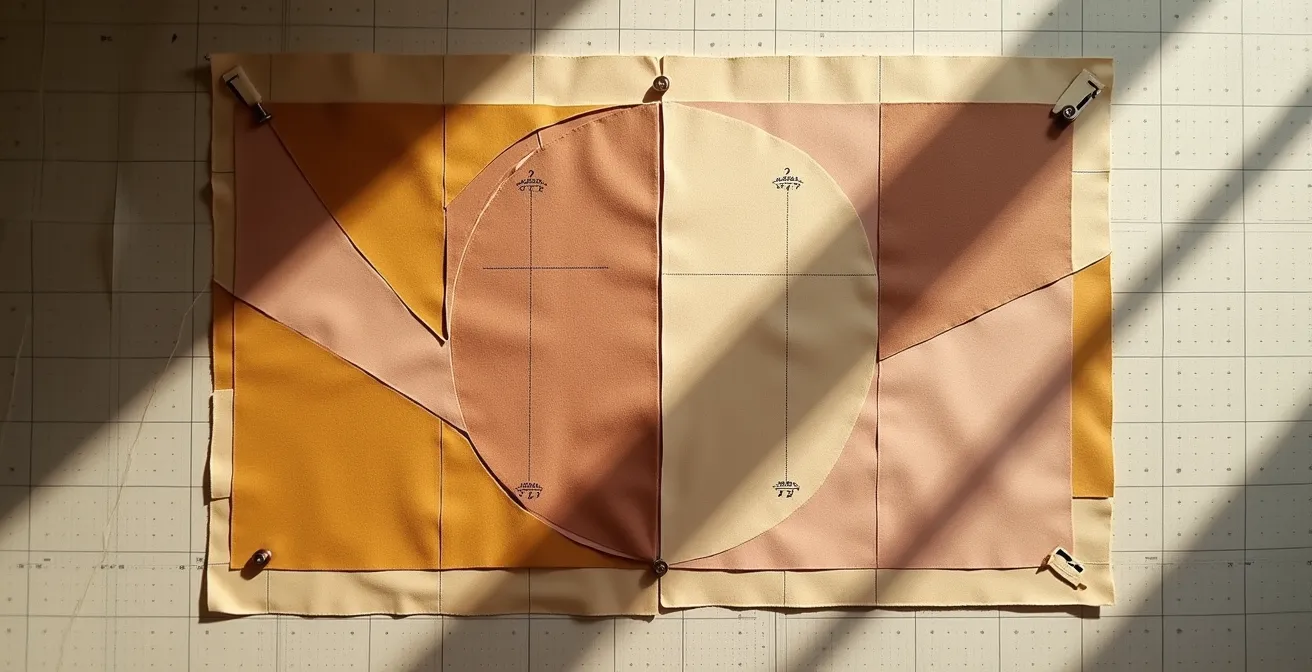
Here are several actionable techniques to implement immediately:
- Use Digital Nesting Software: Implement open-source software like Inkscape with specific extensions to optimize your pattern markers and maximize fabric utilization.
- Explore Zero-Waste Design: Design garments using geometric patterns that leave no offcuts, effectively using 100% of your fabric.
- Create an Offcut Hierarchy: Systemize what happens to scraps. Tier 1 (large) for accessories, Tier 2 (medium) for artisan partnerships, Tier 3 (small) for textile recycling.
- Negotiate Wider Fabric Bolts: A simple negotiation with your mill for 5% wider fabric can sometimes reduce waste by over 15% by allowing for more efficient layouts.
How to Verify the Origin of Your « Organic » Fabric?
You’ve paid a premium for certified organic cotton or another sustainable material. Your marketing depends on it. But how do you *really* know that the fabric you received is the same fabric that was certified at the mill? This is a critical link in the chain of trust, and verifying it is essential to protect your investment and your brand’s integrity. Simply accepting a supplier’s general GOTS certificate is not enough.
The key is to demand batch-specific proof. For any significant order, you should request the Transaction Certificate (TC) that corresponds to that specific batch of fabric. This document is the passport for the material, tracing its journey and verifying its certified status. Cross-referencing the timeline and details on TCs from the spinner, weaver, and dyer can reveal inconsistencies that might signal a problem.
For brands that want to go a step further, new technologies offer unprecedented levels of verification. This is where the concept of Traceability as a Service (TaaS) comes in. Some companies now use forensic science, like isotope testing, to verify the geographical origin of a natural fiber. Services like Oritain can create a chemical fingerprint of cotton from a specific farm and test your final fabric against it to prove its origin. While this has a cost, it offers an ironclad guarantee. On the consumer-facing side, many brands are now using blockchain technology. By linking a QR code on the garment’s label to a blockchain record, they can provide customers with an immutable, transparent history of their product’s journey from farm to closet.
To build a robust verification protocol, you should implement a multi-layered approach:
- Demand Batch-Specific TCs: Never accept a general, company-wide certificate. Always ask for the Transaction Certificate for the specific fabric roll you are purchasing.
- Cross-Reference Documentation: Check for consistency in dates, quantities, and company names across documents from different stages of the supply chain.
- Consider Isotope Testing: For core materials, use a service like Oritain for quarterly chemical signature verification to provide definitive proof of origin.
- Use a Detailed Supplier Questionnaire: Your onboarding process should include questions about how they track batches and their willingness to provide full documentation.
- Leverage QR Codes for Transparency: Implement QR codes on product labels that link to a digital record of the material’s journey, building direct trust with your customers.
How to Transition from Fast Fashion to Thrifting Step-by-Step?
For a fashion entrepreneur, the explosive growth of the secondhand market isn’t a threat; it’s one of the most exciting business opportunities of the decade. The conversation isn’t about you, the brand owner, « transitioning to thrifting. » It’s about how your brand can strategically integrate with and profit from the circular economy. This shift moves your business model from a linear « make-sell » path to a circular one that extends the life of your products and deepens your relationship with customers.
The financial incentive is massive. The global market for used clothing was worth $177 billion worldwide and is projected to nearly double by 2027. This growth is driven by younger consumers who are actively seeking sustainable options and value longevity. By ignoring resale, you are leaving money on the table and failing to meet the expectations of a core demographic.
There are two primary models for a brand to enter this space. The first is to partner with established resale platforms. Services like ThredUp and Poshmark have built the infrastructure and audience, and many offer « Resale-as-a-Service » (RaaS) programs that allow you to quickly launch a branded resale experience for your customers. This is a low-friction way to test the waters and begin participating in the circular economy.
Case Study: Building a Brand with Resale
Patagonia’s ‘Worn Wear’ program is the gold standard for brand-owned resale. By buying back used Patagonia gear, repairing it, and reselling it on their own platform, they create a new revenue stream from items they’ve already sold once. This not only generates profit but also powerfully reinforces their brand message of durability and sustainability. It demonstrates that a product’s lifecycle—and its ability to generate revenue—can extend far beyond the initial purchase, building incredible customer loyalty in the process.
The second, more integrated model is to launch your own in-house program, similar to Patagonia’s Worn Wear. This requires more logistical effort but offers greater control over branding and customer experience. You can offer store credit for returned items, which cleverly ensures that revenue stays within your ecosystem. By taking ownership of your products’ entire lifecycle, including repair and resale, you transform from a mere seller into a lifelong product steward, creating a much deeper and more profitable customer relationship.
Key Takeaways
- Think Investment, Not Cost: Sustainable practices are long-term investments in efficiency and brand value that pay measurable dividends.
- Embrace Digital Due Diligence: You can effectively vet overseas suppliers without expensive travel by using a multi-layered strategy of documentation, remote audits, and peer networks.
- Turn Waste Into a Resource: Smart design and systematic offcut management can drastically cut material costs and even create new revenue streams.
Natural vs Synthetic Fibers: Which Is Really More Durable for Workwear?
The « natural is always better » argument is a common oversimplification in sustainable fashion. When it comes to durability—especially for hardworking garments like workwear—the answer is far more nuanced. The most sustainable fabric is the one that lasts the longest, and the choice between natural and synthetic fibers depends on a holistic lifecycle analysis, balancing initial impact, use-phase performance, and end-of-life options.
Natural fibers like high-density cotton canvas or hemp blends are strong, breathable, and biodegradable. They feel great against the skin and have a lower carbon footprint in their initial production compared to petroleum-based synthetics. However, they may require more energy and water to care for over their lifetime (e.g., hot washes, ironing) and can be less resistant to abrasion and tearing than their synthetic counterparts.
Advanced synthetics like Cordura, on the other hand, offer exceptional tear strength and abrasion resistance, often lasting significantly longer under heavy use. Their care is typically less resource-intensive (cold washes, no ironing). The major drawback is their origin from fossil fuels and the challenge of recycling at their end-of-life. A blended fabric (poly-cotton) might seem like a cheap and durable compromise, but it often represents the worst of both worlds: it’s not biodegradable and is very difficult to recycle, leading to a high end-of-life impact.
For a brand making a strategic choice, the decision should be based on the total cost of ownership and intended use, not just the initial fiber cost. The following table provides a lifecycle cost analysis for common workwear fabrics over a 5-year period.
| Fiber Type | Initial Cost | Durability (Years) | Care Cost/Year | Total 5-Year Cost | End-of-Life Impact |
|---|---|---|---|---|---|
| High-Density Cotton Canvas | $80 | 4-5 | $15 | $155 | Biodegradable |
| Cordura (Synthetic) | $120 | 6-8 | $8 | $160 | Recycling challenges |
| Hemp Blend | $100 | 5-7 | $12 | $160 | Biodegradable |
| Poly-Cotton Blend | $60 | 2-3 | $150 (2 replacements) | Mixed recycling issues | |
| Merino Wool Blend | $140 | 4-6 | $20 | $240 | Biodegradable |
By shifting your perspective from short-term expenses to long-term value, you can build a fashion brand that is not only ethical and sustainable, but also resilient and profitable. The strategies outlined here provide a realistic, budget-conscious path to achieving that goal. The next step is to start implementing them.