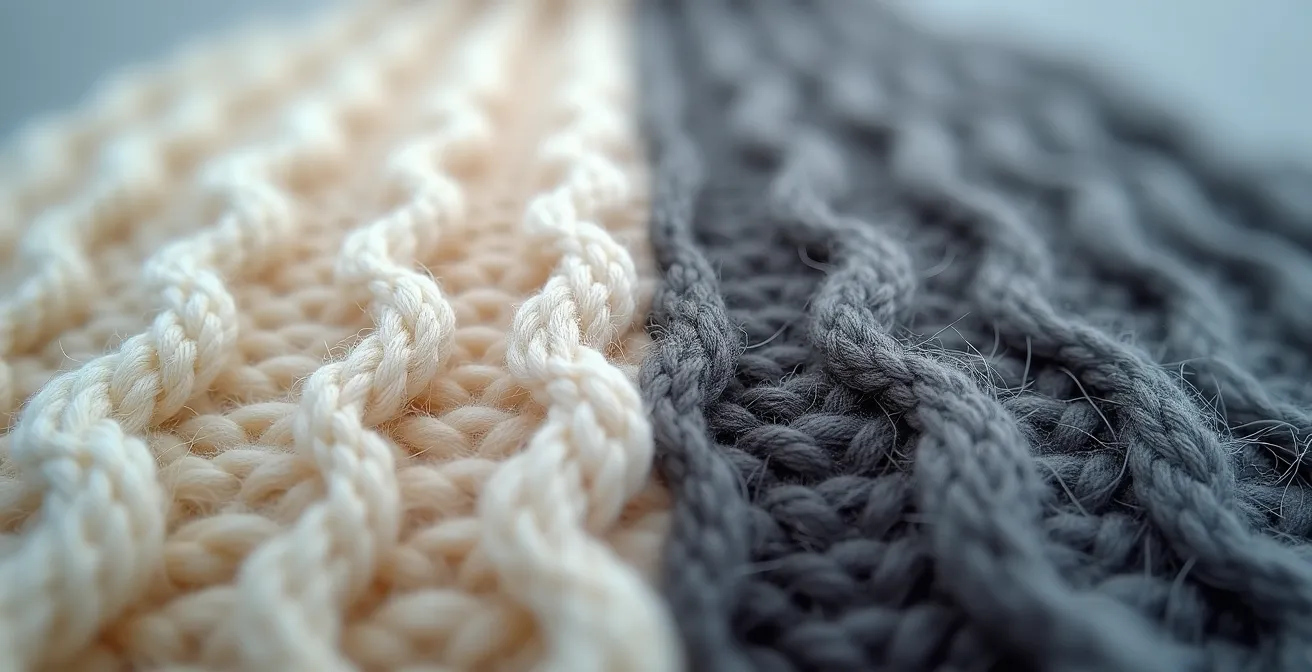
Pilling is not a random defect but a predictable mechanical failure directly controlled by yarn construction, primarily twists per inch (TPI).
- Low-twist yarns allow short staple fibers to migrate to the surface under abrasion, forming pills.
- High-twist yarns create superior « fiber anchorage, » locking fibers into the yarn structure and drastically increasing pilling resistance.
Recommendation: Specify minimum TPI targets in your tech packs based on fiber staple length to engineer pilling resistance directly into the fabric.
For any knitwear designer or quality controller, the appearance of pills on a sweater after a few wears is a frustrating and costly sign of failure. The common explanations—blaming friction or recommending gentler washing—are only part of the story and largely unhelpful from a production standpoint. The widespread belief that certain fibers are simply « pilly » is another oversimplification. Even premium fibers like cashmere are notorious for pilling, not because the fiber is poor, but because its short staple length presents a significant engineering challenge. The root cause of this failure often lies hidden from the consumer, deep within the architecture of the material itself.
The true culprit is a lack of structural integrity at the yarn level. When a yarn is spun with insufficient twist, its constituent fibers are not securely anchored. Under micro-abrasion, these loose fibers migrate to the surface, entangle, and form the unsightly bobbles we know as pills. This article moves beyond surface-level advice to provide a material science perspective. The real key to creating a pill-resistant garment is not found in a fabric shaver, but in the technical specifications of the yarn itself. Understanding the physics of fiber anchorage allows a designer to shift from hoping for durability to engineering it from the ground up.
This analysis will deconstruct fabric performance from the macro to the micro level. We will explore how weave and finishing choices impact durability, and ultimately demonstrate why mastering yarn twist is the most powerful tool for preventing the mechanical failure of pilling.
This comprehensive guide breaks down the key technical decisions that influence fabric performance, from its visible structure to its molecular composition. The following sections provide a detailed roadmap for any textile professional seeking to engineer quality and durability into their products.
Summary: A Technologist’s Guide to Fabric Performance and Pilling
- Twill vs Satin Weave: Which Is More Snag-Resistant?
- How to Identify Fiber Content Using the Burn Test Method?
- The Risk of Selecting Silk for High-Abrasion Garments
- How Do Water-Repellent Finishes Work on a Molecular Level?
- How to Improve Fabric Hand-Feel Through Mechanical Finishing?
- What Is the Difference Between Solution Dyed and Piece Dyed?
- The Fabric That Pills After One Wash: How to Avoid It?
- Why Fast Fashion Remains the Only Option for Low-Income Families?
Twill vs Satin Weave: Which Is More Snag-Resistant?
A fabric’s resistance to snagging is fundamentally determined by its weave structure, specifically the length of its « floats »—the segments of yarn that travel over other yarns. A twill weave, characterized by its diagonal rib, features short, tight floats. This construction creates a dense, durable fabric where yarns are well-integrated and less exposed to external abrasion. The inherent structure of a 3/1 twill, for example, gives it superior tear strength and robustness compared to weaves with longer floats. In contrast, a satin weave is designed to create a smooth, lustrous surface by using very long floats. While this achieves a desirable aesthetic, it leaves long yarn segments exposed and vulnerable to catching on sharp objects, resulting in snags.
The core principle is that longer floats create more opportunities for mechanical failure. As research from the Austin Publishing Group highlights in their work on fabric properties:
The float length in woven fabrics can affect their resistance to abrasion. Long floats in a weave are more exposed and will abrade faster.
– Austin Publishing Group Research Team, Effect of Fabric Structure on Mechanical Properties
However, this does not mean satin is always an inferior choice for durability. Modern textile engineering can mitigate this inherent weakness. A case study involving a European outerwear brand illustrates this point effectively. When developing bomber jacket linings, the brand tested an engineered polyester satin against a standard polyester twill. By using high-twist yarns in the satin construction, they significantly increased its structural integrity. The engineered satin demonstrated superior performance in practical wear tests, proving that thoughtful yarn selection can overcome the traditional limitations of a satin weave, challenging conventional assumptions about its fragility.
How to Identify Fiber Content Using the Burn Test Method?
In quality control and material sourcing, a quick and effective method for preliminary fiber identification is the burn test. While not as definitive as microscopic or chemical analysis, it provides critical indicators about a fiber’s origin—natural, synthetic, or blended. The test involves observing a fiber sample’s reaction to a flame, the characteristics of its smoke, and the nature of the ash or residue it leaves behind. For a textile technologist, this field test is an invaluable tool for verifying composition claims and identifying potential mislabeling before more costly and time-consuming laboratory tests are initiated. Safety and a controlled environment are paramount to obtaining clear results and preventing accidents.
Executing this test requires a systematic approach to ensure the observations are consistent and reliable. The following checklist outlines the industry-standard protocol for conducting a fiber burn test safely and effectively.
Action Plan: Safety Protocol for Fiber Burn Testing
- Prepare Sample: In a well-ventilated area, prepare a controlled sample of fibers or yarn, approximately 1-2 inches in length.
- Handle Safely: Use metal tweezers to hold the sample over a non-flammable surface, such as a ceramic dish or metal tray.
- Observe Flame: Carefully introduce the sample to a flame. Note the flame’s color—a blue base often indicates a synthetic, while a yellow or orange flame suggests a natural fiber.
- Note Smoke: Observe the smoke’s color and odor as the sample burns and after the flame is extinguished. Black, sooty smoke is typical of many synthetics.
- Examine Residue: Analyze the ash or residue. Synthetics like polyester and nylon typically melt and form a hard, non-crushable bead, while natural fibers like cotton and wool leave a soft, brittle ash.
- Cross-Reference: For definitive identification, especially with blends, cross-reference burn test findings with a microscopic analysis to examine the fiber’s physical structure.
The visual below illustrates a proper laboratory setup for this type of analysis, emphasizing the clean, controlled conditions required for accurate assessment.

By methodically documenting these characteristics—flame, smoke, and residue—a quality controller can quickly differentiate between major fiber categories like cellulosic, protein, and synthetic, providing an essential first pass in the material validation process.
The Risk of Selecting Silk for High-Abrasion Garments
Silk is prized for its luster, drape, and luxurious hand-feel, but these same properties make it a high-risk choice for garments subjected to significant abrasion. As a protein-based filament fiber, silk consists of long, smooth, and continuous strands. This uniformity contributes to its sheen, but it also means there is very little surface texture to dissipate friction. When abraded, the smooth filaments can easily snag and break, leading to a loss of surface integrity and a « fuzzy » appearance long before pilling occurs. The fiber’s inherent fineness makes it susceptible to mechanical damage, a critical consideration for applications like upholstery, linings in high-movement areas, or everyday apparel.
From a material science perspective, silk’s tensile strength is notably lower than that of many engineered synthetic fibers. For instance, while silk’s tenacity is respectable, technical analyses show that polyester fabrics demonstrate a tensile strength of 2.5-6.5 cN/tex, a range that significantly surpasses that of natural silk. This disparity in strength means that under the same abrasive force, a polyester fiber is far more likely to resist breaking than a silk fiber. Therefore, specifying silk for an application where durability and abrasion resistance are key performance indicators (KPIs) introduces a predictable point of failure into the product’s lifecycle. A designer must weigh the aesthetic benefits of silk against the quantifiable risk of premature wear.
The choice between a natural filament like silk and a manufactured staple or filament fiber like polyester or nylon should be driven by the end-use requirements. For a decorative, low-contact item like a formal scarf, silk is an excellent choice. For the seat of a trouser or the cuff of a jacket, its use is a technical liability. Ignoring the material’s physical limitations in favor of its aesthetic appeal is a common but avoidable design flaw.
How Do Water-Repellent Finishes Work on a Molecular Level?
Water-repellent finishes function by drastically lowering the surface energy of a fabric, preventing water from wetting and spreading across it. Instead of soaking in, water beads up and rolls off. This effect is achieved by applying a chemical coating that forms a microscopic, spiky, or film-like structure on the fiber surfaces. The effectiveness of the finish is determined by its chemical composition and the strength of its bond to the fabric. At a molecular level, these finishes are composed of polymers with a hydrophobic (water-hating) part that orients itself away from the fiber and toward the air, creating a new, non-polar surface.
There are two primary categories of these finishes: durable and non-durable. Durable Water Repellents (DWR), often based on fluorocarbon chemistry (C6 or older C8), create a chemical bond with the fabric through polymerization. This robust bond allows the finish to withstand numerous wash cycles. Non-durable repellents, which use substances like waxes or silicones, adhere to the fabric physically and are more easily removed during laundering. The following table provides a clear comparison of these technologies.
As detailed in this comparative analysis, the choice between DWR and non-durable options involves a trade-off between performance longevity and chemical composition. The surface energy measurement, in millinewtons per meter (mN/m), quantifies the effect: the lower the number, the more repellent the surface.
| Property | Durable (DWR) | Non-Durable |
|---|---|---|
| Bonding Type | Chemical polymerization | Physical adhesion |
| Durability | 50+ washes | 5-10 washes |
| Technology | C6/C8 fluorocarbons | Waxes, silicones |
| Surface Energy | Ultra-low (15-20 mN/m) | Low (25-30 mN/m) |
In response to environmental concerns about long-chain fluorocarbons (PFCs), the industry is advancing sustainable alternatives. Modern approaches now include PFC-free chemical formulations and even enzymatic treatments. According to a study on textile finishing, some modern textile finishers apply polymers that bind loose fibers to the fabric surface. Concurrently, cellulase enzymes can be used to selectively digest the short, fuzzy fibers responsible for wetting out, creating cleaner and more inherently water-resistant surfaces without relying on traditional DWR chemistries.
How to Improve Fabric Hand-Feel Through Mechanical Finishing?
Mechanical finishing refers to a range of dry processes that modify a fabric’s surface and structure without the use of chemicals, directly influencing its hand-feel, drape, and appearance. These techniques are critical for transforming a raw, loom-state fabric into a product with desirable tactile qualities. Processes like sueding (or « peaching ») use abrasive rollers to raise fiber ends, creating a soft, velvety surface. Similarly, napping uses wire-covered rollers to pull fiber ends from the yarn structure, creating the lofty, insulating surface of flannel. These methods fundamentally alter the fabric’s topography to enhance softness.
Another crucial mechanical process is compressive shrinkage, commercially known as Sanforization. This treatment is primarily aimed at improving dimensional stability and preventing shrinkage after washing. However, it also yields a significant improvement in hand-feel. The process involves dampening the fabric and running it through a series of heated rollers and a rubber belt, which compresses the yarns and relieves internal stresses. A detailed industrial analysis of this process showed that Sanforization not only controls lengthwise change to within a tight tolerance (0.86-5.71%) but also increases fabric density, resulting in a fuller, smoother hand and improved pilling resistance ratings of grade 4-5.
These improvements, however, can sometimes come at the cost of abrasion resistance. The very act of raising fibers in sueding or napping can make them more susceptible to wear. Therefore, quality control often involves balancing hand-feel with durability, measured by tests like the Martindale method. For general domestic use, a fabric that can withstand 15,000-25,000 Martindale cycles is considered to have optimal abrasion resistance. A skilled textile technologist must manipulate these mechanical finishing processes to achieve the desired softness without excessively compromising the fabric’s structural integrity, representing a classic performance trade-off in textile production.
What Is the Difference Between Solution Dyed and Piece Dyed?
The distinction between solution dyeing and piece dyeing lies in the stage at which color is introduced into the textile manufacturing process. Piece dyeing, the more conventional method, involves dyeing the fabric after it has been woven or knitted. This allows for greater flexibility and faster response to fashion trends, as coloration is one of the final steps. However, it is an incredibly water- and energy-intensive process, and the color only penetrates the surface of the fibers, making it more susceptible to fading from UV light and harsh chemicals like bleach.
In stark contrast, solution dyeing (also known as dope dyeing) integrates the pigment directly into the liquid polymer solution before the fiber is extruded. As the microscopic image below illustrates, the color becomes an integral part of the fiber’s core, not just a surface treatment. This method is exclusive to synthetic fibers like polyester, nylon, and acrylic.

This fundamental difference in process yields profound differences in performance and sustainability. The color in solution-dyed fibers is exceptionally permanent and resistant to fading. As a Textile Engineering Research Team notes:
Solution dyeing positions pigments within the polymer matrix during fiber formation, making them impervious to UV degradation and bleaching agents.
– Textile Engineering Research Team, Sustainable Cotton Processing Study 2024
Furthermore, the environmental benefits are significant. By eliminating the need for large-scale water-based dye baths, life-cycle analysis shows that a 90% reduction in water usage can be achieved with solution dyeing compared to traditional piece dyeing methods. While it requires longer lead times and commitment to a color, the superior durability and sustainability make it a preferred method for high-performance applications like outdoor gear, automotive textiles, and commercial carpeting.
Key Takeaways
- Pilling is a mechanical failure, not a material flaw, and can be engineered out of a product.
- Yarn twist (TPI) is more critical than fiber type for controlling pilling; higher twist provides better fiber anchorage.
- Every design choice—from weave structure and fiber selection to dyeing and finishing—is a performance trade-off that must be technically justified.
The Fabric That Pills After One Wash: How to Avoid It?
When a garment pills after a single wash, it is an unambiguous sign of poor yarn construction. This rapid mechanical failure is caused by the use of short-staple fibers combined with a low-twist yarn. During the agitation of laundering, the minimal friction is enough to dislodge the poorly anchored short fibers. They migrate to the fabric’s surface, entangle, and form pills. This is a deliberate manufacturing choice made to reduce costs; low-twist yarns can be spun faster and often feel softer initially, creating a deceptive « shelf appeal » that quickly degrades.
To prevent this, the single most effective intervention for a designer or quality controller is to specify a minimum twists per inch (TPI) for the yarn. Increasing the TPI forces the fibers into a tighter, more helical structure, dramatically improving the « fiber anchorage » within the yarn. This makes it significantly harder for fiber ends to work their way loose. For premium knitwear, this is a non-negotiable specification. Industry analysis indicates that while standard yarns may have a low TPI, premium manufacturers optimize twist levels at around 16-18 TPI for luxury sweaters to ensure both a pleasant hand-feel and excellent durability.
However, this is a classic performance trade-off, a concept central to textile engineering. As noted by the Textile Technology Journal:
High-twist yarns (20+ twists per inch) resist pilling better than low-twist alternatives, but they sacrifice some softness.
– Textile Technology Journal, Industry Insight Report 2024
A « hard-twist » yarn feels crisper and less lofty than its « soft-twist » counterpart. The designer’s job is to find the optimal balance for the product’s intended end-use and price point. For a high-contact item like a daily-wear sweater, specifying a higher TPI is essential. For a fashion piece intended for limited wear, a softer, lower-twist yarn might be acceptable. Avoiding immediate pilling is therefore not a matter of chance, but a direct result of informed technical specification.
Why Fast Fashion Remains the Only Option for Low-Income Families?
The prevalence of fast fashion among low-income consumers is not a simple matter of trend-chasing but a direct consequence of economic necessity. For many families, the high durability and engineered quality of premium garments are an inaccessible luxury. Fast fashion’s business model is built on a foundation of radical cost reduction at every stage of production, which translates to the only price point that is feasible for a significant portion of the population. This cost-cutting is achieved through specific technical compromises—the very ones that lead to issues like pilling, poor colorfastness, and low structural integrity.
From a textile technologist’s perspective, fast fashion achieves its low prices by using lower-grade raw materials, such as very short-staple cotton or recycled synthetics with inconsistent fiber lengths. To maximize yield and speed, these fibers are spun into low-twist yarns, which, as we’ve established, are inherently prone to pilling. Production is optimized for speed, not longevity. Weave densities are often lower, dyeing processes are chosen for speed over fastness (e.g., piece dyeing over solution dyeing), and mechanical finishing is minimal to save time and money. Each of these decisions shaves cents off the final cost, but collectively they create a product with a severely limited lifespan.
This creates a difficult cycle. The low initial cost makes the clothing accessible, but its poor durability necessitates frequent replacement, potentially leading to higher long-term spending than investing in fewer, more durable items would. However, this « investment » option requires a higher upfront capital outlay that is simply not available to many households. Therefore, fast fashion remains the only viable option for clothing families and meeting immediate needs, despite its known flaws. The choice is not between a $10 shirt and a $50 shirt; for many, it’s between a $10 shirt and no shirt at all. The technical shortcomings are a built-in, accepted feature of a system designed to meet a specific economic reality.