
Fashion trends now operate on a predictable, algorithm-driven product lifecycle with a built-in obsolescence of 90 days.
- Spotting them early requires tracking specific digital signals and data points, not just observing aesthetics.
- Investing heavily in fleeting aesthetics creates massive inventory liability and significant financial risk.
Recommendation: Shift from chasing trends to strategically analyzing their lifecycle as a product to calculate real ROI and build wardrobe resilience.
There’s a palpable sense of exhaustion in the fashion industry. A feeling that the treadmill is spinning faster than ever before. What was once a seasonal rhythm has become a frantic, weekly scramble. Aesthetics like « Barbiecore » or « Cottagecore » explode on TikTok, dominate online discourse, and then vanish into digital ether, all within a single financial quarter. This isn’t just a feeling; it’s a structural shift. The traditional fashion cycle, which spanned years from runway to mass market, has been compressed into months, or even weeks. While a macro-trend like « sustainability » might evolve over a decade, these internet-driven « micro-trends » live and die at an unprecedented speed.
The common culprit cited is TikTok’s algorithm, and while it’s a major catalyst, simply blaming the platform is a surface-level analysis. It fails to equip fashion professionals—designers, buyers, marketers, and stylists—with a functional framework to navigate this new reality. The advice to simply « develop personal style » is unhelpful for those whose job is to engage with the market as it is, not as they wish it would be. The challenge isn’t to ignore the storm, but to understand its mechanics.
This analysis takes a different approach. We will treat the modern micro-trend not as an organic cultural phenomenon, but as a predictable, algorithm-driven product with a distinct lifecycle: emergence, acceleration, saturation, and obsolescence. By decoding this cycle, we can move from a reactive state of chasing trends to a proactive strategy of anticipating their trajectory, managing risk, and measuring what truly matters. This article will break down how to spot trends before they peak, assess the real inventory risks, adapt viral looks for the real world, understand the true costs of this new speed, and ultimately, calculate a meaningful return on investment in an age of ephemeral style.
This guide provides a complete framework for understanding and navigating the rapid lifecycle of modern fashion trends. Below is a summary of the key strategic areas we will deconstruct to help you move from being trend-driven to trend-aware.
Summary: Why Trends Die in 3 Months Now Instead of 3 Years?
- How to Identify the Next « Core » Aesthetic Before It Blows Up?
- The Risk of Investing Inventory in a Fleeting Aesthetic
- Personal Style vs Viral Dressing: Which Builds a Better Wardrobe?
- How to Adapt Viral Looks to a Normal Work Environment?
- What Is the Environmental Cost of « Haul » Culture?
- How to Spot Micro-Trends on TikTok Before They Peak?
- Why « Haul » Culture Is the Primary Driver of Textile Waste?
- How to Calculate Real ROI from Fashion Influencer Campaigns?
How to Identify the Next « Core » Aesthetic Before It Blows Up?
Identifying the next « core » aesthetic is no longer an art; it’s a science of signal detection. The lifecycle of a trend has been drastically compressed. While trends used to simmer for seasons, research now shows micro-trends peak and decline in a matter of weeks, not years. This extreme acceleration, or « algorithmic velocity, » means that by the time a trend is named in a magazine, it’s often already past its peak profitability. The key is to spot the precursors before they consolidate into a named aesthetic.
The process follows a predictable pattern we can call the « Trend-as-Product Lifecycle. » It begins with niche communities (on Discord, Reddit, or niche TikTok circles) creating or re-contextualizing a style. This is the « incubation » phase. The « acceleration » phase begins when larger influencers adopt it, and the content becomes replicable. Saturation is achieved when fast-fashion brands release their versions, flooding the market. Finally, obsolescence occurs when the original community moves on, and the items become cultural debris.
A perfect example is the green knitted Hockney dress from House of Sunny. Worn by Kendall Jenner, it gained explosive popularity on TikTok and Instagram. This triggered the « saturation » phase, where it was quickly duplicated by fast-fashion giants. Within a year, the original and its dupes were piling up in thrift stores, a clear marker of the « obsolescence » phase. The lesson is clear: identifying a trend isn’t about spotting the finished product (the dress) but about tracking the digital signals that precede its explosion.
The Risk of Investing Inventory in a Fleeting Aesthetic
For brands and retailers, the hyper-accelerated trend cycle transforms potential profit into significant inventory liability. Investing heavily in a « Barbiecore » pink collection or Y2K-inspired cargo pants means you are betting against the clock. If the trend’s peak lasts only 90 days, any stock that doesn’t sell within that window becomes a financial burden. It either needs to be heavily discounted, eroding margins, or it contributes to the deadstock problem, representing tied-up capital and physical waste.
The paradox is that the very system that creates this risk also fuels its growth. Driven by the demand for newness, the fast fashion sector is projected to reach $150.8 billion by 2025. This creates a high-pressure environment where brands feel compelled to participate, asking themselves: how do we keep up with micro-trends without going bankrupt? The answer lies in shifting the approach from mass production to data-driven, limited-run « test » batches. This strategy allows brands to gauge real market demand before committing to a larger inventory order, mitigating the risk of being left with a warehouse full of yesterday’s news.
This visualization below perfectly captures the concept of inventory risk, where today’s hottest items become tomorrow’s ghosts on the shelves.
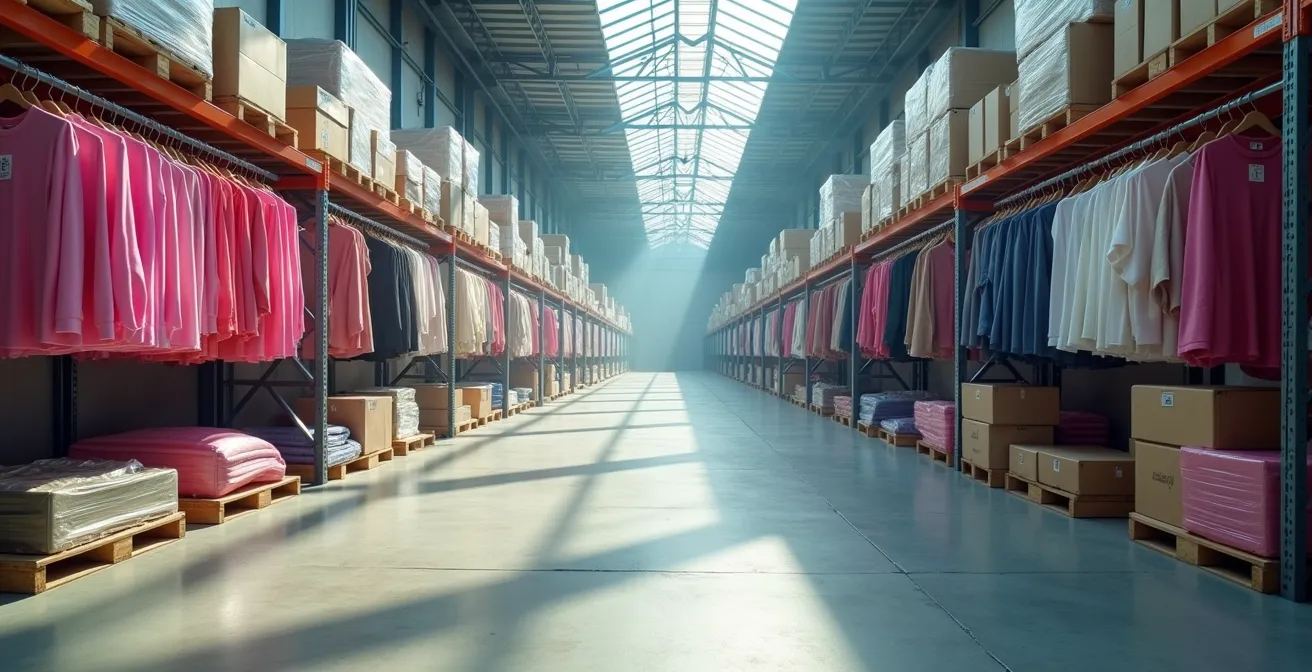
As the image illustrates, the items in the foreground are solid and in demand, but they rapidly fade into obsolescence. This visual metaphor highlights the critical need for agile inventory management. Without it, companies are perpetually chasing a moving target, with a high probability of financial loss and material waste. The core strategy is not to guess the next big trend, but to build a system that can respond to it without over-committing.
Personal Style vs Viral Dressing: Which Builds a Better Wardrobe?
The relentless pressure of micro-trends creates a fundamental conflict: are we dressing for our lives or for our social media feeds? This is the core of the « Personal Style vs. Viral Dressing » dilemma. Viral dressing is about adopting a pre-packaged aesthetic wholesale, often for the purpose of creating content or participating in a momentary digital conversation. It’s performative and temporary. Personal style, in contrast, is an evolving narrative—a curated collection of silhouettes, colors, and textures that reflect an individual’s identity over time.
The danger of viral dressing is that it outsources taste to the algorithm. It encourages consumption as a means of staying relevant, leading to a wardrobe full of disconnected items that feel dated within months. As journalist Florenne Earle Ledger aptly puts it:
In short, some of us are buying clothes for pictures, not for life.
– Florenne Earle Ledger, Will Core Trends be the Death of Personal Style
This « dressing for pictures » mindset kills creativity and creates a cycle of dissatisfaction. A better wardrobe is built on a strong foundation of personal style, using viral trends as data points, not directives. Instead of buying a full « balletcore » outfit, a person with a minimalist style might integrate a single silk-blend wrap top to explore the trend’s softness and silhouette, incorporating one element that resonates rather than adopting the entire uniform. This approach builds a resilient, authentic, and ultimately more sustainable wardrobe.
Your Action Plan: Auditing Personal Style vs. Viral Impulse
- Document the ‘Why’: Before buying into a trend, write down what you like about it—is it the silhouette, a specific color, or the feeling it evokes? This separates the core appeal from the viral hype.
- Identify Your Core Theme: Look at your favorite pieces over the years. Is there a consistent theme, like « ’70s-inspired minimalist » or « structured and architectural »? Define this personal style formula.
- Use Trends as Data: Treat each viral aesthetic as a data point for your style’s evolution. Does this trend offer a new color or shape that fits your core theme? If not, discard it.
- Practice ‘One Element’ Integration: Challenge yourself to integrate only one piece or accessory from a trending aesthetic into your existing wardrobe, forcing creative and personal interpretation.
- Build an 80/20 Platform: Ensure 80% of your wardrobe consists of timeless, high-quality « platform » pieces that can support the other 20% of more transient, trend-influenced items.
How to Adapt Viral Looks to a Normal Work Environment?
One of the biggest challenges for fashion-conscious professionals is translating the exaggerated aesthetics of TikTok into a wearable, office-appropriate context. A full « Barbiecore » hot pink suit might be perfect for an Instagram post, but it’s often impractical for a corporate meeting. The key is not to discard the trend entirely, but to practice « aesthetic dilution »—isolating the core element of the trend and integrating it into a professional wardrobe in a more subtle form.
This technique involves deconstructing the viral look into its components: color, silhouette, texture, and a more abstract « vibe. » Instead of replicating the entire look, you select just one of these elements. For example, the « Y2K Cargo Pants » trend isn’t about wearing low-rise, baggy pants to the office. It’s about a relaxed, utilitarian silhouette. This can be translated into a pair of well-tailored, wide-leg trousers in a high-quality fabric. You keep the essence (relaxed fit) while adapting the form to the environment. Interestingly, this is a method used even by content creators; one study found that 70% of items in micro-trend videos were borrowed, showing a focus on single-element styling rather than full wardrobe acquisition.
The following table provides a practical guide for this translation process, breaking down popular viral trends into their professional counterparts.
| Viral Trend | Professional Adaptation | Key Element to Keep |
|---|---|---|
| Barbiecore Pink Everything | Single fuchsia blazer with neutrals | Color accent only |
| Balletcore Sheer Delicates | Silk-blend blouse or cashmere wrap | Soft, flowing silhouette |
| Y2K Cargo Pants | Well-tailored wide-leg trousers | Relaxed fit, utility details |
| Gorpcore Technical Wear | Structured outerwear with clean lines | Performance fabrics |
By applying this dilution method, professionals can participate in fashion conversations and express their style without compromising workplace norms. It’s a strategic approach that values interpretation over imitation, ensuring that personal style remains the foundation upon which trends are thoughtfully layered.
What Is the Environmental Cost of « Haul » Culture?
The hyper-accelerated trend cycle is inextricably linked to « haul » culture—the social media phenomenon of showcasing massive quantities of newly purchased clothing. This practice, driven by ultra-fast fashion brands, has a staggering environmental cost. The core issue is that it promotes a model of extreme disposability. Clothing is treated not as a durable good, but as single-use content. Once a trend is over, the garments are discarded, contributing to a global waste crisis.
The scale of the problem is immense. According to the United Nations, the fashion industry produces over 10% of global carbon emissions—more than international flights and maritime shipping combined. A significant driver of this is the production of polyester and other synthetic fabrics, which are energy-intensive and non-biodegradable. Furthermore, the constant production and disposal cycle leads to colossal waste. Once a micro-trend’s 90-day lifecycle is complete, the associated fast-fashion items are thrown out, contributing to what some reports estimate is over 17 million tons of global fashion waste annually.
This creates a direct « Haul-to-Landfill Pipeline, » where garments are designed for a short-term viral moment and an eternity in a landfill. The environmental cost is not just a byproduct of fashion; in the ultra-fast model, it is a direct consequence of a business model built on planned obsolescence. The low prices of haul items mask their true cost, which is externalized to the environment in the form of carbon emissions, water pollution from dyes, and overflowing landfills of non-degradable textile waste.
How to Spot Micro-Trends on TikTok Before They Peak?
Spotting a micro-trend on TikTok before it reaches its saturation point requires a data-analyst mindset. It’s about tracking leading indicators, not just popular videos. Since most trends have a peak that lasts about 2 to 4 months, the window for strategic action is small. Waiting for the trend to be named by media outlets is too late. The goal is to identify the « incubation » and early « acceleration » phases.
This involves looking beyond the content itself and analyzing the metadata and community interactions around it. For instance, a rising frequency of comments like « what is this style called? » or « where is this from? » on videos from niche creators is a powerful leading indicator. It signals an emerging, unnamed demand. Another key is to monitor the cross-pollination of language from platforms like Reddit or Discord onto more mainstream platforms like Instagram. When a niche aesthetic term starts appearing in product descriptions, the trend is moving towards commercialization.
Here are several key signals to track for early micro-trend detection:
- Comment Frequency Analysis: Track the velocity of comments asking for item identification (« ID? ») or aesthetic names (« what core is this? ») on videos by creators with 10k-50k followers.
- Cross-Platform Terminology Drift: Monitor when niche terms from fashion subreddits or Discord servers start appearing as hashtags or in captions on TikTok and Instagram.
- The « Second Wave » Indicator: A trend is solidifying when creators outside the original niche (e.g., a comedy creator trying a fashion trend) begin interpreting the aesthetic. This signals its move towards the mainstream.
- Sound-to-Style Velocity: Identify emerging viral sounds and analyze the fashion looks in the first 100-500 videos. A consistent aesthetic theme indicates a strong link between the sound and a potential micro-trend.
- The DIY-to-Dupe Pipeline: Watch for a surge in « thrift flip » or DIY videos related to a specific look. This often signals unmet market demand that fast fashion brands will soon target.
Why « Haul » Culture Is the Primary Driver of Textile Waste?
« Haul » culture is not merely a symptom of overconsumption; it is the engine. This social media format, where influencers unbox and display vast quantities of clothing, normalizes and gamifies the acquisition of goods at a scale that is fundamentally unsustainable. The psychology is powerful: it combines the aspirational quality of influencer marketing with the dopamine hit of a bargain, creating a potent driver for consumption.
The numbers reveal a dramatic behavioral shift. Today, the average American buys around 70 new garments per year, a stark contrast to the 25 items purchased annually in 1960, all while spending a smaller percentage of their income on clothing. This is made possible by the rise of « ultra-fast fashion » brands that have weaponized the haul format. Brands like SHEIN are reportedly posting thousands of new styles on their websites daily, providing an endless stream of cheap, trend-aligned content for haul videos. This creates a vicious feedback loop: influencers need new content, brands provide a constant stream of cheap new products, and viewers are encouraged to shop via affiliate links and discount codes.
As the Earth Day Organization points out, this is a highly structured business model. Influencers are often paid commissions on sales generated through their tracked discount codes, directly incentivizing them to promote mass consumption. The result is a system where clothing’s primary purpose shifts from function and personal expression to disposable content. The « haul » is the main event; wearing the clothes is an afterthought. This directly fuels the Haul-to-Landfill Pipeline, making it the single most significant cultural driver behind the mountains of textile waste generated by the modern fashion industry.
Key Takeaways
- The fashion trend lifecycle has shrunk from years to months, driven by algorithmic velocity and ultra-fast fashion business models.
- Navigating this requires a shift from chasing trends to analyzing them as products with predictable lifecycles and clear inventory risks.
- True sustainability and personal style are built on a foundation of timeless pieces, using trends as data points rather than directives.
How to Calculate Real ROI from Fashion Influencer Campaigns?
In the context of hyper-accelerated micro-trends, measuring the Return on Investment (ROI) of an influencer campaign becomes incredibly complex. The traditional metrics—likes, views, and mentions—are often « vanity metrics » that fail to capture true business impact. A trend can generate enormous buzz without translating into profitable sales. For instance, the ‘quiet luxury’ trend received around 40,000 social media mentions in just three months, but how much of that « buzz » converted into actual sales of high-margin, timeless pieces versus searches for cheap dupes?
To calculate real ROI, fashion professionals must look beyond reach and engagement. The first step is to establish clear, business-oriented Key Performance Indicators (KPIs) before the campaign begins. These should be tied to tangible outcomes:
- Conversion Rate from Tracked Links: Using unique affiliate links or discount codes for each influencer is the most direct way to measure sales impact.
- Customer Acquisition Cost (CAC): Divide the total campaign cost by the number of new customers acquired through those specific channels. Is the CAC for a trend-driven campaign lower or higher than for your evergreen marketing?
- Lifetime Value (LTV) of Acquired Customers: Do customers acquired during a viral trend campaign make repeat purchases, or are they one-time buyers who churn once the trend dies? Tracking their LTV is crucial for understanding long-term value.
- Margin per Product: A campaign might drive high volume on a low-margin, trendy item. Calculating the actual profit generated, not just revenue, is essential.
Ultimately, a successful influencer campaign in the current climate isn’t one that generates the most noise. It’s one that attracts the right customers for your brand’s core offerings. A campaign that drives fewer, but more loyal, customers who buy into your permanent collection might have a far greater long-term ROI than one that sells thousands of a single, disposable trend item. Calculating real ROI requires discipline and a focus on profit-centric metrics over viral fame.
By adopting this analytical, anthropological lens, fashion professionals can transform the chaos of the trend cycle into a navigable system. Instead of being swept away by each new « core » aesthetic, you can strategically position your brand, designs, and personal style to be resilient, relevant, and profitable. The next logical step is to begin applying this framework to your own work, starting with a rigorous analysis of your current approach to trends.