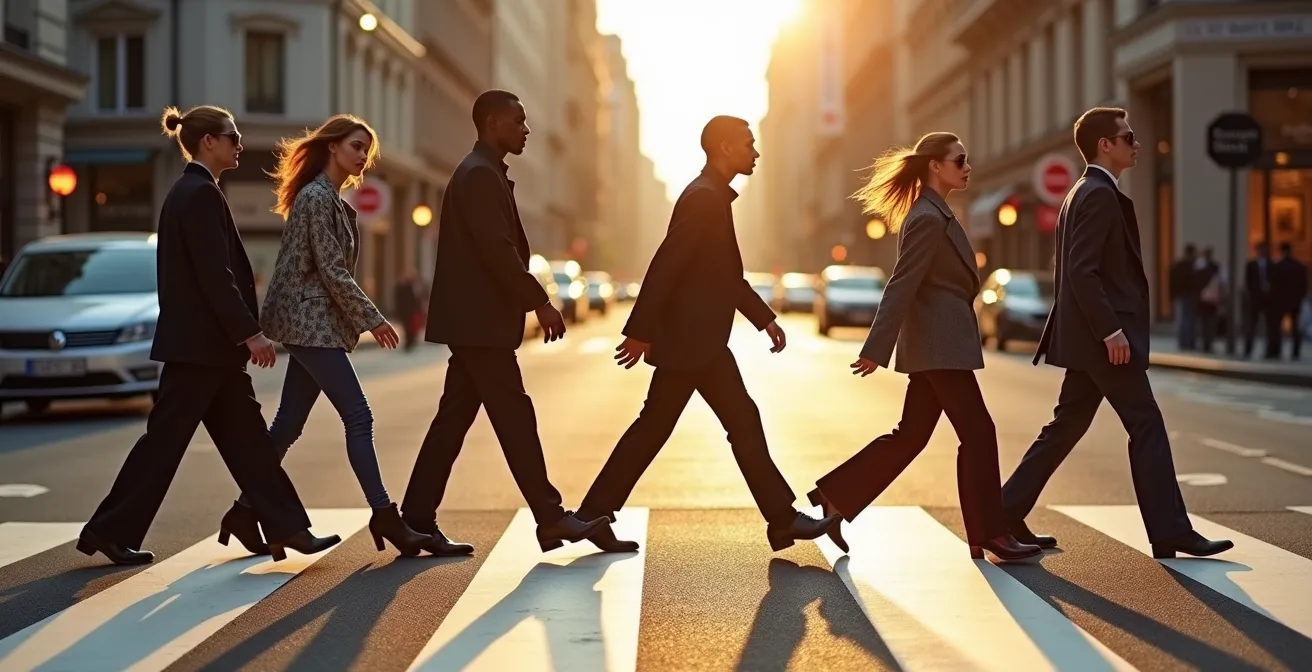
It’s easy to say street style’s influence comes from its « authenticity, » but this misses the point. The real power shift comes from the street’s ability to generate a constant stream of observable data signals. For fashion students and analysts, the critical skill is no longer just watching but decoding: measuring the velocity of a TikTok micro-trend, separating the cultural signal from the digital noise, and validating these observations to predict what will—and won’t—make the leap from a viral moment to a commercially viable collection.
The sidewalk has always been a runway in its own right, a raw, unfiltered expression of personal style. But in recent years, the dynamic between the street and the high-fashion runway has fundamentally inverted. We’ve moved past the simple trickle-up theory where designers might spot a cool kid in a certain neighborhood. Now, the street isn’t just a source of inspiration; it’s the primary engine of trend creation, a decentralized global studio operating 24/7 on platforms like TikTok and Instagram.
Many will point to « authenticity » or the « democratization of fashion » as the cause. While true, these are surface-level observations. They don’t explain the mechanism of *how* a specific aesthetic, like the resurgence of #officecore, travels from a handful of creator videos to influencing collection mood boards in Paris and Milan. The old rules of seasonal trends dictated from on high are gone, replaced by a chaotic, accelerated cycle that feels impossible to predict.
But what if the chaos itself is a language? The key is to stop seeing street style as a gallery of static images and start treating it as a live feed of data. The modern trend forecaster’s job is to be an analyst, a cultural decoder. Instead of just asking « What are people wearing? », the crucial questions become « How fast is this spreading? », « What cultural nerve is it touching? », and « Does it have the depth to last more than a season? ». This isn’t about chasing virality; it’s about understanding its velocity and resonance.
This guide breaks down the framework for doing just that. We’ll move from spotting the initial spark of a micro-trend to categorizing its potential, understanding the risks, and finally, applying this analytical lens to build collections that are both artistically relevant and commercially intelligent. It’s time to learn how to read the patterns in the noise.
Summary: Decoding the New Language of Fashion Trends
- How to Spot Micro-Trends on TikTok Before They Peak?
- Fade, Trend, or Classic: How to Categorize a New Style?
- The Danger of Jumping on a Trend When It Hits the Mass Market
- When Will the 20-Year Trend Cycle Bring Back the 2010s?
- How to Use Google Trends to Validate Your Design Choices?
- Fad or Trend: How to Spot the Difference Before Investing Millions?
- How to Identify the Next « Core » Aesthetic Before It Blows Up?
- How to Plan a Fashion Collection That Balances Art and Commerce?
How to Spot Micro-Trends on TikTok Before They Peak?
TikTok is the epicenter of trend acceleration. Its algorithm is designed to test and amplify newness at a blistering pace, creating a firehose of visual information. Experts confirm that TikTok microtrends can go viral and be adopted globally in a matter of weeks. The challenge for an analyst isn’t just to watch, but to measure the trend velocity—the speed and momentum of an idea—to distinguish a fleeting viral moment from the start of a genuine shift.
To do this, you must move beyond simply counting views or likes. The real signals are found in user behavior metrics that indicate deeper engagement. Look for a high ratio of ‘saves’ to ‘likes,’ as this suggests users see the content as aspirational or instructional, something they want to return to. Similarly, a spike in ‘shares’ indicates a concept is resonating strongly enough for users to make it part of their own digital identity. These are the first indicators that an idea has the potential to move beyond a single creator’s « For You » page.
Case Study: The Rise of #officecore
The #officecore aesthetic is a prime example of this process. It began as a playful Gen Z reinterpretation of traditional workwear, but its traction was measurable. The aesthetic gained over 700k views in the USA, not just under one hashtag, but through a cluster of related tags like #corpcore and #bosslady. This hashtag clustering is a key signal. It shows the community is actively defining and expanding the aesthetic’s boundaries, transforming corporate staples like blazers and shirting into something new with oversized fits and asymmetric details. This evolution proved it was more than a joke; it was a burgeoning micro-trend.
Ultimately, spotting a trend before it peaks requires a shift in mindset from passive consumption to active analysis. It’s about looking for patterns in content performance, monitoring how users interact with it, and tracking how an initial idea evolves as the community adopts and reinterprets it. This is the new fieldwork for the digital age.
Fade, Trend, or Classic: How to Categorize a New Style?
Once you’ve spotted a signal—a new silhouette, a color, a « core » aesthetic gaining traction—the next critical step is categorization. Is this a short-lived fad that will burn out in weeks, a durable trend that can define a few seasons, or the seed of a future classic? Misjudging this can lead to costly investments in fleeting ideas. The key is to analyze a new style against a framework of characteristics that go beyond its surface appearance, focusing on its cultural resonance and structural depth.
A fad often explodes onto the scene, driven by a single pop culture moment or a specific platform’s algorithm. It’s visually loud but lacks versatility and is easily replicated by fast fashion. A trend, by contrast, has deeper roots. It might emerge from a subculture and gain momentum across multiple platforms. It’s adaptable enough to be integrated into various personal styles and often requires new patterns or production techniques that aren’t easily copied overnight. A classic transcends digital moments entirely, embodying a timeless silhouette or idea with deep cultural significance that allows it to recur for decades.
The following table breaks down these distinctions. Use it as a diagnostic tool when you encounter a new style. By evaluating it against these five vectors—lifespan, platform presence, cultural rooting, production complexity, and versatility—you can move from a gut feeling to a data-informed assessment. This process helps separate the digital noise from a truly meaningful signal.
| Characteristic | Fad | Trend | Classic |
|---|---|---|---|
| Lifespan | Weeks to months | 1-3 years | 5+ years recurring |
| Platform Presence | Single platform dominant | Multi-platform resonance | Transcends digital trends |
| Cultural Rooting | Pop culture moment | Subculture connection | Deep cultural significance |
| Production Complexity | Easy fast fashion replication | Requires new patterns/techniques | Established manufacturing |
| Versatility Index | Low (specific occasions) | Medium adaptability | High (multiple aesthetics) |
The Danger of Jumping on a Trend When It Hits the Mass Market
In the accelerated new trend cycle, timing is everything. The moment a trend appears in mass-market retail or becomes a dominant theme on your Instagram feed is often the moment its cultural currency has already peaked. Jumping on board at this stage presents a significant risk: you’re no longer a leader, but a follower, and you’re entering a saturated market where margins are thin and the aesthetic is already on the verge of becoming passé.
The core danger lies in the gap between online visibility and real-world adoption. A trend can feel ubiquitous online while having very little presence in the streets. As one analyst noted in Harper’s Bazaar, this is the « chronically online » phenomenon. This disconnect is a trap for brands and designers who mistake digital noise for genuine consumer demand. When a trend hits the mass market, it’s often because fast-fashion brands have already capitalized on it, flooding the space and accelerating its demise.
A lot of trends are chronically online. Like wearing a skirt over pants. I’ve probably only seen two people wearing that out, whereas online, I see lots of it.
– Coote, Harper’s Bazaar Australia
Case Study: TikTok’s Disruption of the Trend Cycle
The London-based agency The Digital Fairy powerfully illustrated this danger in their report, « Fashion’s New Algorithm: How TikTok Killed the Trend Cycle. » Their analysis demonstrates that the traditional top-down model (runway to consumer) is dead. Instead, trends now emerge, peak, and die on social media at such a rapid pace that many never achieve mainstream adoption in a commercially viable way. This contracted cycle means that by the time a larger brand can tool up production, the original community has already moved on, leaving the brand with inventory that is already out of style.
The lesson for a savvy analyst is clear: mass-market visibility is a lagging indicator. True opportunity lies in identifying a trend during its initial ascent within a niche community, well before it’s been amplified and diluted for a mass audience. By the time everyone is talking about it, it’s already too late to lead.
When Will the 20-Year Trend Cycle Bring Back the 2010s?
The « 20-Year Trend Cycle » is a well-known phenomenon in fashion, suggesting that styles tend to re-emerge approximately two decades after their initial peak. We’ve seen this play out with the ’90s revival, which continues to dominate streetwear and runway looks. For instance, data from Heuritech shows that the 90s-era #grungecore has over 73 million views on TikTok, proving the cycle’s enduring power. Now, the question on every trend forecaster’s mind is: when and how will the 2010s make their return?
However, predicting the 2010s revival isn’t as simple as waiting for skinny jeans and peplum tops to reappear. The modern trend cycle, fragmented by social media, means revivals are no longer monolithic. We won’t see « the 2010s » return as a single block; instead, we’ll see the revival of specific micro-eras and subcultures from that decade. Think less about the decade as a whole and more about the distinct aesthetics like the twee/indie-sleaze of 2011, the « health goth » look of 2014, or the VSCO girl of 2019.
The key to spotting these revivals is to monitor for two key signals. First is « adjective stacking, » a term describing how users on social media combine words to form nascent aesthetics (e.g., « dark academia, » « coastal grandmother »). When you start seeing adjectives associated with 2010s culture appearing, it’s a sign of early interest. Second, look for nostalgia triggers tied to generational life stages. As Gen Zers who grew up in the 2010s enter their early twenties and gain spending power, they will naturally begin to romanticize and re-interpret the styles of their youth.
Your Action Plan: Identifying 2010s Micro-Era Revivals
- Monitor Subcultures: Track specific 2010s subcultures (Twee, Health Goth, VSCO girl) rather than the decade as a whole. Look for their hashtags and visual motifs on TikTok and Pinterest.
- Analyze Adjective Stacking: Collect instances of « adjective stacking » on social media. When you see terms like ‘indie,’ ‘blog-era,’ or ‘Tumblr’ being combined with fashion words, a micro-revival is forming.
- Map Nostalgia Triggers: Identify media (music, films, TV shows) from the early 2010s that are re-gaining popularity. This often precedes the fashion revival.
- Look for Hybrid Patterns: The revival won’t be a pure copy. Look for indie-grunge patterns that mix ’90s anti-fashion sentiment with the more polished, blog-centric street style of the early 2010s.
- Track Generational Spending: Follow economic reports on Gen Z’s consumer behavior. As their disposable income grows, their nostalgic preferences will directly impact the market.
How to Use Google Trends to Validate Your Design Choices?
Observing street style and tracking TikTok gives you a hypothesis. But before committing significant resources to a design or collection, you need to validate that hypothesis with quantitative data. Google Trends is an invaluable—and free—tool for this. It allows you to move beyond the anecdotal and measure the broader public interest in a trend, providing a crucial layer of commercial validation.
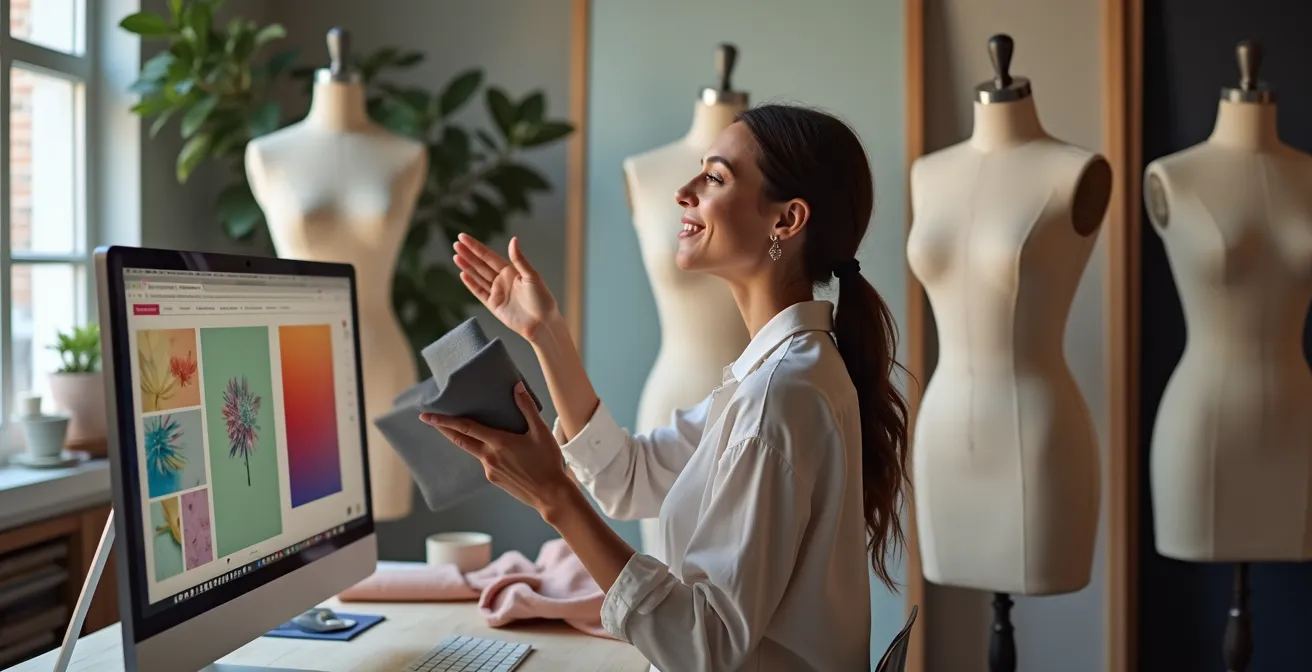
The power of Google Trends lies in its ability to reveal several key dimensions of a trend. First, you can confirm rising interest. Is the search volume for « wide-leg trousers » or « ballet flats » on a sustained upward trajectory, or was it just a one-week spike driven by a celebrity? Second, you can identify geographic diffusion patterns. Is a trend contained to one city, or is interest beginning to grow nationally or globally? This helps you gauge the potential scale of a trend.
Third, and perhaps most importantly, you can use the « related queries » feature to understand the context of the interest. Are people searching for « how to style cargo pants » or « where to buy cargo pants »? The former indicates early-stage interest and adoption, while the latter signals the trend is moving into a commercial, mass-market phase. This insight is critical for timing your entry into the market.
Case Study: Tracking Geographic Trend Diffusion
Analysis of recent fashion weeks provides a perfect example of how to use this data. Trends often emerge in hyper-creative hubs like Copenhagen or Seoul before appearing in Paris, London, or New York. By tracking search interest for specific items—like scarf coats or pinstripe power suits—in these leading cities, analysts can get a 3-6 month lead time before the trend reaches broader markets. A spike in search volume in Denmark for a specific silhouette, followed by a smaller echo in France a month later, is a strong signal of a trend with real diffusion potential. Google Trends allows you to visualize this « diffusion lag » and plan accordingly.
Fad or Trend: How to Spot the Difference Before Investing Millions?
For a brand or designer, the financial stakes in distinguishing a fad from a trend are immense. Investing in a fad means risking millions on inventory that will be obsolete in months. Conversely, dismissing a genuine trend as a mere fad means missing a major commercial opportunity. With the global streetwear market projected to reach $637.13 billion by 2032, the cost of getting it wrong is higher than ever. The key to making the right call lies in analyzing a trend’s digital footprint across platforms.
A major red flag for a fad is single-platform dominance. If an aesthetic is exploding on TikTok but has almost no presence on Instagram, Pinterest, or in fashion media, it’s likely a product of TikTok’s unique algorithmic push rather than a broad-based cultural shift. Its content style is often chaotic and spontaneous, burning brightly but quickly. A true trend, however, will demonstrate cross-platform resonance. You’ll see it emerge on TikTok, be curated and aestheticized on Instagram, saved for inspiration on Pinterest, and discussed in online forums. This multi-platform presence indicates a deeper, more sustained interest.
The following table outlines the key indicators to look for. It provides a framework for evaluating the digital signature of a new style. A potential trend will show signs of organic growth and a sustained, curated presence, attracting interest from multiple demographics and, eventually, a mix of both luxury and mass-market brands.
| Indicator | TikTok-Only (Fad Risk) | Cross-Platform (Trend Potential) |
|---|---|---|
| Discovery Method | For You Page algorithm push | Organic growth across platforms |
| Content Style | Spontaneous, chaotic waves | Curated, sustained presence |
| Lifecycle | Rapid emergence and fade | Gradual build, longer sustenance |
| Audience | Single demographic | Multiple demographics engaged |
| Brand Adoption | Fast fashion only | Luxury and mass market interest |
By using this analytical lens, you can move beyond a surface-level view and make a more strategic assessment. The goal is to identify trends that have the digital roots to support long-term growth, ensuring your investment is in a genuine cultural shift, not just an algorithmic fluke.
How to Identify the Next « Core » Aesthetic Before It Blows Up?
« Core » aesthetics—like #balletcore, #gorpcore, or #cottagecore—are more than just trends; they are fully-formed visual universes with their own values, references, and key items. They represent a collective agreement on a particular mood or lifestyle, making them incredibly powerful drivers of consumer behavior. Identifying the *next* « core » before it explodes is the holy grail of trend forecasting. It requires looking for signs of aesthetic bricolage, where subcultures piece together a new identity from disparate elements.
As Depop trend specialist Agus Panzoni notes, fashion is returning to a more foundational approach. This insight provides a clue for what to look for. As Panzoni states in a report on 2025 fashion forecasts, it’s about finding styles that can anchor a collective identity.
Fashion is returning to fundamentals: durable, versatile pieces that embody a collective aesthetic are setting the tone for 2025.
– Agus Panzoni, Depop Trend Report
This means a future « core » is unlikely to be based on flimsy, disposable items. Instead, it will be built around a central, meaningful idea. Look for nascent aesthetics forming in niche communities on platforms like Reddit or Discord, where dedicated fans of a particular film, book, or subculture begin to build a shared visual language. Often, the spark is a juxtaposition of contrasting styles. A « core » is born when these communities start combining elements in a way that feels both novel and deeply personal.
Case Study: The Evolution of #Balletcore
#Balletcore is a perfect example of this evolution. It didn’t just appear fully formed. It started with a base of 32,000 TikTok posts in late 2023, centered on classic « Petit Rat de l’Opéra » elements like knitted leggings, wrap tops, and tulle. However, it only blew up when the community started practicing aesthetic bricolage, juxtaposing these delicate, traditionally feminine pieces with contrasting urban items like baggy denim, sneakers, and utilitarian jackets. This fusion of softness and hardness, tradition and modernity, created a new, compelling narrative that resonated far beyond the world of dance.
To find the next « core, » you must be a digital anthropologist. Monitor « adjective stacking, » track how niche subcultures are merging styles, and identify the foundational media or ideas that are capturing the imagination of a new generation. It is in this creative friction between different worlds that the next big aesthetic will be born.
Key Takeaways
- Measure Velocity, Don’t Just Watch: The key to spotting trends on TikTok is analyzing engagement metrics like saves-to-likes ratio and hashtag clustering, not just view counts.
- Categorize to Strategize: Use a framework (lifespan, platform presence, cultural rooting) to determine if a new style is a fad, trend, or classic before investing.
- Mass Market is a Lagging Indicator: The moment a trend is ubiquitous in retail is often the moment it has already peaked. True opportunity lies in early, niche adoption.
How to Plan a Fashion Collection That Balances Art and Commerce?
Ultimately, all of this analysis—spotting micro-trends, validating data, and identifying core aesthetics—must serve a single purpose: to create a fashion collection that is both artistically resonant (art) and commercially successful (commerce). The modern challenge is to bridge the gap between the raw, authentic energy of the street and the refined, strategic vision of a brand. A successful collection is a conversation between these two worlds.
This balance starts with a « hero-and-basics » approach, informed by your trend analysis. Your « hero » pieces should be the artistic statement of the collection. These are the items that directly channel the core aesthetic or micro-trend you’ve identified. They are designed to be photographed, to capture the mood of the moment, and to drive the narrative of your brand. They are your art.
However, these hero pieces must be supported by a strong foundation of commercial « basics. » These are the versatile, durable, and highly wearable items that will drive the bulk of your sales. Your trend analysis should inform these as well, but in a more subtle way—perhaps through an updated silhouette, a new core color, or a specific fabric texture. They provide the commercial stability that gives you the freedom to experiment with your hero pieces.
Case Study: The Blenders Pride Fashion Tour’s Hybrid Success
The Blenders Pride Fashion Tour provides a masterclass in this hybrid approach. Collections like Kanika Goyal’s « street luxe » and NoughtOne’s « Racer 01 » successfully blended runway polish with authentic street energy. Goyal’s collection featured edgy streetwear silhouettes (the « street » component) elevated with runway-level finishing and tailoring (the « runway » component). Similarly, NoughtOne mixed luxury materials and traditional craftsmanship with motifs drawn directly from street and motorsport culture. Both collections proved that the most powerful modern fashion fuses these two influences, creating something that is both desirable and wearable.
Planning a successful collection is no longer about dictating from an ivory tower. It’s about listening to the signals from the street, analyzing them with rigor, and then translating them into a thoughtful, balanced collection that offers both bold artistic statements and the commercial foundation to support them.
Start applying this analytical lens to your own observations today. Treat every scroll on TikTok and every walk down the street as an act of data collection. By learning to decode these signals, you will not only understand why street style drives trends—you will be able to predict where it’s going next.