
The $500 price tag isn’t for the cotton; it’s the entry fee into a complex economic game where clothing acts as a financial asset.
- Brands convert cultural authenticity (« cultural capital ») into monetary value through exclusive collaborations and staggering market valuations.
- « Drop culture » uses manufactured scarcity and psychological triggers to fuel addictive, high-stakes buying behavior, solidifying an item’s aftermarket value.
Recommendation: To participate wisely, focus on acquiring timeless, foundational pieces over chasing fleeting micro-trends (« -cores ») to build a valuable collection, not a portfolio of depreciating assets.
It’s a moment of cognitive dissonance for any rational consumer: a simple, screen-printed cotton hoodie with a price tag that rivals a monthly car payment. The immediate question is, « Why? » The easy answers—hype, branding, limited editions—are just surface-level observations. They describe the symptoms but fail to diagnose the underlying economic engine that drives the global streetwear phenomenon. Many believe the value lies in superior materials or celebrity endorsements, but these are often secondary factors in a much more intricate system.
The truth is far more complex and fascinating. The $500 hoodie is not just a piece of clothing; it’s a tangible share of stock in a cultural movement. Its value is determined less by its material composition and more by a sophisticated interplay of cultural capital, manufactured scarcity, and behavioral economics. This isn’t just fashion; it’s a high-stakes market with its own set of rules, risks, and rewards. The price tag is a reflection of a brand’s ability to master this game.
This article deconstructs that very economic engine. We will move beyond the simple « hype » explanation to explore the core mechanics that assign immense value to everyday garments. We’ll analyze how subculture authenticity is monetized, how addictive buying cycles are engineered, and what risks both brands and consumers face in this volatile market. Finally, we’ll outline a strategy for engaging with these trends without falling victim to their financial pitfalls.
To fully grasp the dynamics at play, this analysis will break down the key pillars of the streetwear economy. The following summary provides a roadmap to understanding how we’ve arrived at a point where cotton has become a luxury commodity.
Summary: The Economics of the $500 Hoodie
- How to Style Oversized Fits Without Looking Sloppy?
- Skate Culture Influence vs Luxury Adoption: Who Owns Streetwear?
- The Risk of Buying Fake Merch on Resale Platforms
- Why the Thursday Drop Culture Creates Addictive Buying Behavior?
- When Did Streetwear Become Acceptable in Corporate Offices?
- The Risk of Investing Inventory in a Fleeting Aesthetic
- The Overstocking Error That Bankrupts New Brands Within 18 Months
- How to Participate in « Core » Trends Without Wasting Money?
How to Style Oversized Fits Without Looking Sloppy?
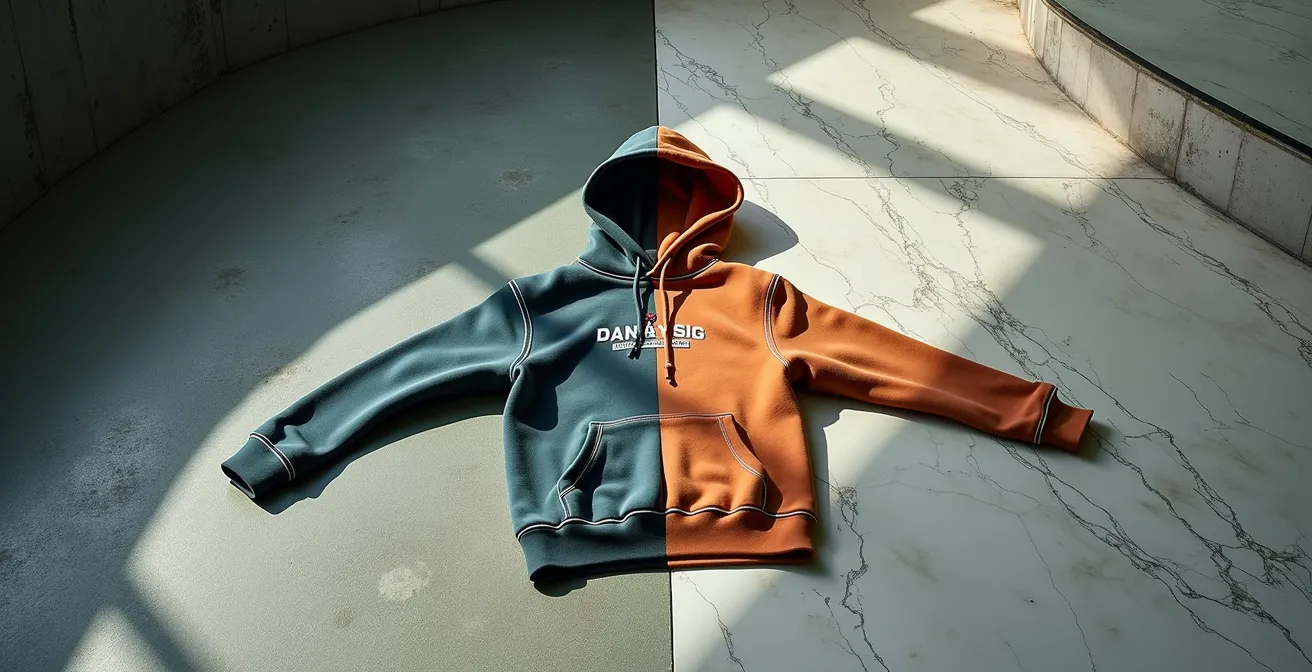
The oversized fit, a cornerstone of streetwear, is more than an aesthetic choice; it’s a statement. It signals a departure from the structured, tailored world of traditional fashion, embracing comfort and a certain nonchalance. Styling it effectively isn’t about hiding the body, but about creating a deliberate silhouette. The key is balance. Pairing a voluminous hoodie or T-shirt with a more fitted or structured bottom—like tailored cargo pants or slim-fit denim—prevents the entire outfit from appearing shapeless. Playing with proportions, such as a cropped-hem oversized hoodie, can also define the waistline and add structure.
Another crucial element is the quality and drape of the fabric. A cheap, flimsy cotton will hang limply, whereas a heavyweight, structured fleece will hold its shape, creating a powerful and intentional look. This distinction is where the economic paradox of streetwear begins. The « sloppy » aesthetic is often meticulously crafted, and its value isn’t in its conformity but in its cultural currency. As the Strategy& Hypebeast Report notes, the value is often cemented in the aftermarket.
Supreme box logo crewnecks that originally sold for $158 resell for a minimum of $500
– Strategy& Hypebeast Report, Streetwear Market Statistics & Global Trends
This demonstrates that the style’s value is not in its tailoring but in its symbolic weight. The oversized fit is the uniform of a culture that has successfully monetized its own perceived sloppiness, turning it into a highly sought-after commodity. Mastering this look means understanding the line between effortless and careless.
Skate Culture Influence vs Luxury Adoption: Who Owns Streetwear?
Streetwear’s DNA is inextricably linked to the raw, anti-establishment energy of 1980s and ’90s skate culture. Brands like Supreme started not as fashion houses but as authentic hubs for a specific community. Their value was built on cultural capital: a non-monetary currency of authenticity, credibility, and belonging earned over decades. This is the « secret sauce » that luxury fashion houses, with their centuries of heritage in haute couture, could not replicate organically. So, they decided to buy it.
The collision of these two worlds—gritty skate parks and polished Parisian ateliers—is the defining narrative of modern streetwear. When a luxury brand like Louis Vuitton collaborates with Supreme, it’s not just a design partnership; it’s a strategic acquisition of cultural relevance. The luxury house provides the global distribution, manufacturing prowess, and a stamp of elite approval, while the streetwear brand provides the one thing money can’t easily buy: genuine cool. This fusion created a new hybrid category where price ceilings were shattered. The landmark Louis Vuitton x Supreme collaboration, for example, was a testament to this monetization of culture.
This model was further solidified when private equity entered the game. The valuation of streetwear brands began to mirror that of tech startups, based not just on current revenue but on cultural influence and growth potential.
Case Study: Supreme’s Billion-Dollar Valuation
Supreme’s evolution from a single skate shop in New York to a global powerhouse is the ultimate example of cultural monetization. In 2017, The Carlyle Group, a private equity firm, invested $500 million for a 50% stake, valuing the brand at a staggering $1 billion. This landmark deal proved that a brand deeply rooted in an authentic subculture could achieve luxury-level financial valuations while, for a time, maintaining its core identity.
So, who « owns » streetwear? Culturally, its soul still belongs to the streets and the subcultures that birthed it. Financially, however, it is now owned by multinational conglomerates and private equity firms who have perfected the art of converting that authenticity into astronomical profit.
The Risk of Buying Fake Merch on Resale Platforms
When a cotton hoodie becomes an asset class, it inevitably attracts a shadow economy: the counterfeit market. The high demand and astronomical resale prices for brands like Off-White, BAPE, and Supreme create a fertile ground for fakes. For consumers, the allure of getting a « deal » on a sold-out item is strong, but the risks associated with resale platforms are significant. The problem is widespread, as market research shows that approximately 40% of streetwear consumers globally have unintentionally encountered counterfeit products online.
The primary risk is financial. A buyer might pay a premium price—often hundreds of dollars—for what they believe is an authentic, appreciating asset, only to receive a worthless imitation. Unlike a fake handbag, which might still function as a bag, a fake hype item has zero resale value and, more importantly, zero cultural capital. For the community that values authenticity above all, being caught with a fake is a significant social faux pas. The sophistication of « super fakes » has made authentication a specialized skill, requiring deep knowledge of stitching, tags, and material specifics.
The existence of this robust counterfeit market is a direct consequence of the primary market’s economics. The entire value proposition of hype streetwear is its exclusivity and proven authenticity. The resale market thrives on this, with prices soaring far beyond retail. When the potential for profit is this high, counterfeiters will inevitably follow. This creates a high-risk environment for buyers, who must navigate a minefield of fakes to acquire the genuine article, often relying on third-party authentication services which add another layer of cost.
Why the Thursday Drop Culture Creates Addictive Buying Behavior?
The « drop » is the central ritual of the streetwear economy. Typically happening on a specific day of the week (famously, Thursdays for Supreme), it’s a model of manufactured scarcity designed to trigger powerful psychological responses. By releasing highly anticipated products in extremely limited quantities at a specific time, brands create a perfect storm of urgency, competition, and FOMO (Fear Of Missing Out). This is not just marketing; it is a masterclass in behavioral economics that fosters addictive buying patterns. The data confirms its effectiveness, as verified market research reveals that 62% of streetwear consumers make impulse purchases specifically because of this scarcity-driven model.
The system is engineered to short-circuit rational decision-making. The limited time window and the knowledge that an item will sell out in minutes (sometimes seconds) force a buyer to act on emotion rather than logic. The desire to « win » the drop, to be one of the few who successfully checks out, can be as powerful as the desire for the product itself. This creates a dopamine rush similar to gambling, conditioning consumers to return week after week for another « hit. »
This cycle is further reinforced by the immediate feedback of the resale market. A successful purchase is instantly validated when the item appears on platforms like StockX for three or four times its retail price. This transforms the buyer from a mere consumer into a savvy investor who « beat the system. » The brand, in turn, benefits from this cycle, as it builds a mythos of constant, insatiable demand without ever having to risk overproduction.
Anatomy of the Drop: Key Scarcity Triggers
- Extreme Urgency: Collections often sell out in under 48 hours, with key items gone in minutes, creating an all-or-nothing purchasing environment.
- Channel Exclusivity: Online-exclusive items, which drive a significant portion of purchase decisions, remove the option of waiting for a physical store release.
- Social Media Priming: The majority of buyers follow brands on social media, where countdowns and previews build anticipation to a fever pitch before the drop.
- Scarcity Mindset: The explicit communication of « limited quantities » triggers a primal cognitive bias, making the item seem more valuable simply because it is rare.
- Resale Market Influence: A significant portion of shoppers are influenced by an item’s potential resale value, treating the purchase as a short-term investment.
When Did Streetwear Become Acceptable in Corporate Offices?
For decades, the corporate dress code was a rigid uniform of suits, ties, and leather shoes. Streetwear, with its roots in rebellion and counter-culture, was its antithesis. The shift toward its acceptance in professional settings wasn’t a single event but a gradual convergence of cultural and economic trends. A key driver was the « casualization » of the workplace, spearheaded by the tech industry, where innovation and comfort were prioritized over sartorial formality. As millennials who grew up with streetwear entered management roles, their definition of « professional attire » evolved with them.
Simultaneously, streetwear underwent its own transformation. Through luxury collaborations and celebrity adoption, items like hoodies and premium sneakers shed their purely casual connotations and became symbols of cultural awareness and, paradoxically, status. A designer hoodie from a coveted brand could cost as much as a tailored blazer, making it a new form of power dressing. It signals that the wearer is not just financially successful, but also plugged into the cultural zeitgeist. As ABC News Business noted, the hoodie became a « fashion darling » seen on major celebrities, which helped normalize it for a wider audience.

The final piece of the puzzle was the price point itself. As the premium streetwear category established itself, with average unit prices climbing, the garments gained a perceived level of quality and seriousness. Wearing a $500 hoodie to the office isn’t seen as sloppy; it’s a calculated choice that communicates a modern and sophisticated identity. It tells colleagues and clients that you are fluent in the new language of success, where cultural capital is just as important as financial capital.
The Risk of Investing Inventory in a Fleeting Aesthetic
While the streetwear market as a whole shows robust growth, with projections suggesting the global streetwear market is expected to reach $637.14 billion by 2032, the landscape for individual brands is fraught with peril. The very engine that drives hype—rapidly shifting trends and aesthetics—also creates immense inventory risk. A brand that invests heavily in a specific, of-the-moment look, like the « gorpcore » or « blokecore » micro-trends, faces the danger of that aesthetic becoming obsolete in a matter of months. This is the concept of aesthetic volatility.
When a trend dies, the inventory associated with it becomes « deadstock. » Unlike a classic white t-shirt, a hoodie with a very specific, trend-driven graphic or silhouette cannot easily be sold in the next season. It must be heavily discounted, eroding profit margins, or worse, written off as a loss. This is a capital-intensive mistake that can cripple emerging brands. The calculus is brutal but simple: the more niche and trend-dependent the inventory, the higher the risk.
Even the giants of the industry are not immune to these fluctuations in perceived value. The valuation of a brand is intrinsically tied to its ability to stay relevant and desirable. A few missteps or a failure to connect with the next generation of consumers can have significant financial consequences.
Case Study: The Fluctuation of Supreme’s Brand Value
Supreme, the gold standard of hype, provides a stark example of aesthetic volatility. After its acquisition by VF Corp for $2.1 billion in 2020, the brand’s valuation saw a significant recalibration. By early 2024, reports indicated its value had been adjusted downward, with some analyses suggesting a 28% decline or more from its peak. This demonstrates that even for the most iconic brands, cultural relevance is not guaranteed, and brand value in the trend-driven streetwear market can be remarkably fluid and subject to rapid change.
This inherent risk forces brands into a delicate balancing act: they must be innovative enough to create hype but classic enough to avoid obsolescence. It’s a high-wire act where one wrong bet on an aesthetic can have devastating financial repercussions.
The Overstocking Error That Bankrupts New Brands Within 18 Months
For a new brand entering the streetwear market, the data can be seductive. Observing high purchase frequencies, where close to 45% of consumers purchase streetwear items at least once a month, can lead to a fatal miscalculation: overproduction. Believing that strong demand translates to a need for large inventory, founders invest heavily in their initial production runs. This is the overstocking error, a cash flow trap that can bankrupt a promising brand before it even has a chance to establish itself.
The problem lies in the disconnect between the market’s overall demand and the demand for a *specific, unproven product*. Hype is not transferable. Just because consumers are buying streetwear doesn’t mean they will buy *your* streetwear. When the initial collection doesn’t sell out as projected, the brand is left with a mountain of unsold goods and, more critically, tied-up capital. This cash is desperately needed for marketing, developing the next collection, and operational costs. Without it, the business grinds to a halt.
This challenge is compounded by regional differences in taste and market maturity. A trend that is explosive in North America, driven by hip-hop culture, may have little traction in a European market more focused on sustainability. Failure to account for these nuances leads to misallocated inventory and exacerbates the overstocking problem. Successful brands understand that scarcity is a tool, not a problem to be solved. They start with small, limited runs to test the market, build organic hype, and ensure their capital remains fluid.
Understanding the diverse global landscape is critical for any brand trying to manage inventory and forecast demand. A look at regional market share and growth drivers reveals a complex and fragmented consumer base.
| Region | Market Share 2024 | Growth Rate (CAGR) | Key Driver |
|---|---|---|---|
| Asia-Pacific | 38.04% | 4.51% | Rising middle class & K-pop influence |
| North America | 35% | 8.20% | Digital trends & hip-hop culture |
| Europe | 25% | 3.8% | Sustainable fashion movement |
Key Takeaways
- The value of hype streetwear is primarily derived from intangible cultural capital and brand authenticity, not the physical materials of the garment.
- The « drop model » and other forms of manufactured scarcity are psychological tools used to create irrational demand and establish high aftermarket value.
- For both brands and consumers, the streetwear market is volatile. Brands risk obsolescence with fleeting trends, while consumers risk money on fakes and depreciating « assets. »
How to Participate in « Core » Trends Without Wasting Money?
The modern fashion landscape is dominated by an endless cycle of micro-trends, often labeled with the « -core » suffix (e.g., cottagecore, normcore, Barbiecore). For the consumer, participating in these fleeting moments can be an exciting way to express identity, but it’s also a surefire way to waste money. With 49% of consumers spend $100 to $500 monthly on streetwear, this budget can be quickly depleted on items that will feel dated in six months. A smarter approach is needed to engage with trends without building a wardrobe of dead assets.
The strategy is to differentiate between foundational pieces and trendy accessories. The foundation of a strong streetwear collection lies in timeless, high-quality staples: a perfectly cut heavyweight hoodie in a neutral color, classic sneaker silhouettes, well-made denim, and basic logo tees from established brands. These are the items that transcend micro-trends. A significant finding from a global consumer survey supports this: a majority of respondents believe that core streetwear products are, in essence, timeless.
Once this versatile and durable foundation is in place, « -core » trends can be incorporated through less expensive, more transient items. Participate in a trend with a hat, a specific color of socks, a graphic t-shirt, or a unique accessory. This allows you to signal your awareness of the current aesthetic moment without making a significant financial commitment to a piece that has a short cultural lifespan. It’s about treating your wardrobe like an investment portfolio: the bulk of your capital should be in stable, « blue-chip » assets (the staples), while a small, designated portion can be used for higher-risk, speculative plays (the trends).
Ultimately, navigating the streetwear market as a savvy consumer means adopting the mindset of a collector, not just a shopper. It requires understanding the economic forces at play and making deliberate choices that align with your personal style and financial goals. Build your collection with intention, focusing on pieces with lasting cultural and personal value.