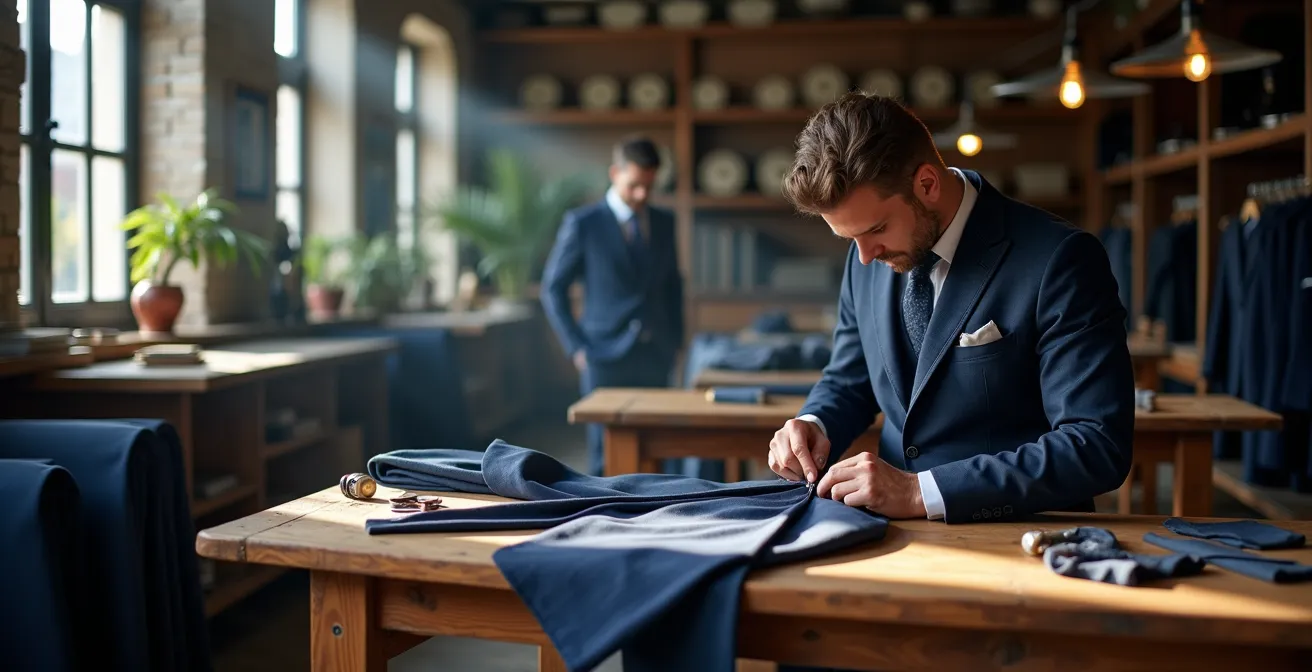
A bespoke suit is not a product you buy; it is a sartorial commission you undertake, where the price reflects an investment in unparalleled craftsmanship, not a simple transaction.
- The process involves creating a unique paper pattern from dozens of measurements, a « blueprint of character » that ready-to-wear and even made-to-measure cannot replicate.
- The value is measured in time—often over 100 hours of skilled labour—and in details, like hand-stitched buttonholes, that create a garment that lives and moves with you.
Recommendation: To understand the cost, one must first appreciate the process. Value the artistry, the time, and the human touch, for that is the true currency of bespoke.
To ask why a bespoke suit carries a price tag five times that of its ready-to-wear counterpart is to ask a fundamentally misplaced question. It implies a comparison between two items in the same category, like comparing a serviceable cart to a hand-built motorcar. They both have wheels, but their purpose, their creation, and their soul are worlds apart. The world of fast fashion and mass production has conditioned us to see clothing as a disposable commodity, valued only by its price and trendiness. We are told that a good « fit » can be achieved by simply altering a pre-made garment.
This is the great sartorial illusion of our time. A bespoke suit is not a product. It is a process, a relationship, and a piece of functional sculpture. Its value is not found in the raw cost of its superfine wool or horn buttons, but in the intangible, yet priceless, elements of time, skill, and human intuition. It is a commission undertaken between a client and a master craftsman, an intimate collaboration to create a second skin that reflects not only the client’s physical form but their very character and posture. The true cost is an investment in a tangible legacy, an object of permanence in an age of the ephemeral.
This exploration will not merely list the features of a bespoke suit. Instead, we will walk you through the hallowed halls of our craft. We will delve into the philosophy behind the handiwork, the crucial distinction between levels of customisation, and why the very concepts of time and price are perceived differently within the walls of a true tailoring house. It is a journey from the cutting board to the final fitting, revealing why bespoke is not an expense, but an education in value.
For those who prefer a visual introduction to the world of custom tailoring, the following video offers a glimpse into the process and dedication that defines this craft, perfectly complementing the detailed principles we are about to discuss.
To fully appreciate the distinction, it is essential to understand each component of the bespoke process. The following sections break down the key elements that contribute to the creation of a true work of sartorial art, from the smallest stitch to the grandest strategy.
Summary: The Anatomy of Bespoke Value
- How to Identify Hand-Stitched Buttonholes vs Machine-Made?
- Made-to-Measure vs Bespoke: Which Service Is Right for You?
- The Risk of Ordering Custom Clothing Without a Physical Fitting
- Why the Waiting List Is Part of the Luxury Value Proposition?
- What Is the Future of Bespoke Tailoring in a Fast Fashion World?
- Flat Pattern Making vs Draping: Which Yields Better Results for Tailoring?
- Legacy vs Innovation: What Drives Growth for Historic Houses?
- Why Price Increases Actually Build Desire for Luxury Brands?
How to Identify Hand-Stitched Buttonholes vs Machine-Made?
The soul of bespoke is found in its details, and no detail is more telling than the buttonhole. A machine can produce a flat, uniform buttonhole in seconds. It is functional, certainly, but it is lifeless. A hand-sewn buttonhole, particularly the famed Milanese style, is a minor work of art in itself. It is three-dimensional, constructed with a silk gimp core that gives it a raised, robust quality. The stitches are not perfectly identical; they betray the subtle tremor of the human hand, a signature of authenticity.
This is not a matter of mere aesthetics. The hand-sewn buttonhole is structurally superior, designed to endure decades of use without fraying. The process is one of patient sculpture. Indeed, the meticulous craftsmanship required for a single, perfect buttonhole demands an extraordinary investment of time; a study of the process reveals it requires 45 minutes to one full hour for a single buttonhole. Multiply that across a jacket, and you begin to understand that we measure our work in hours and days, not units and minutes.
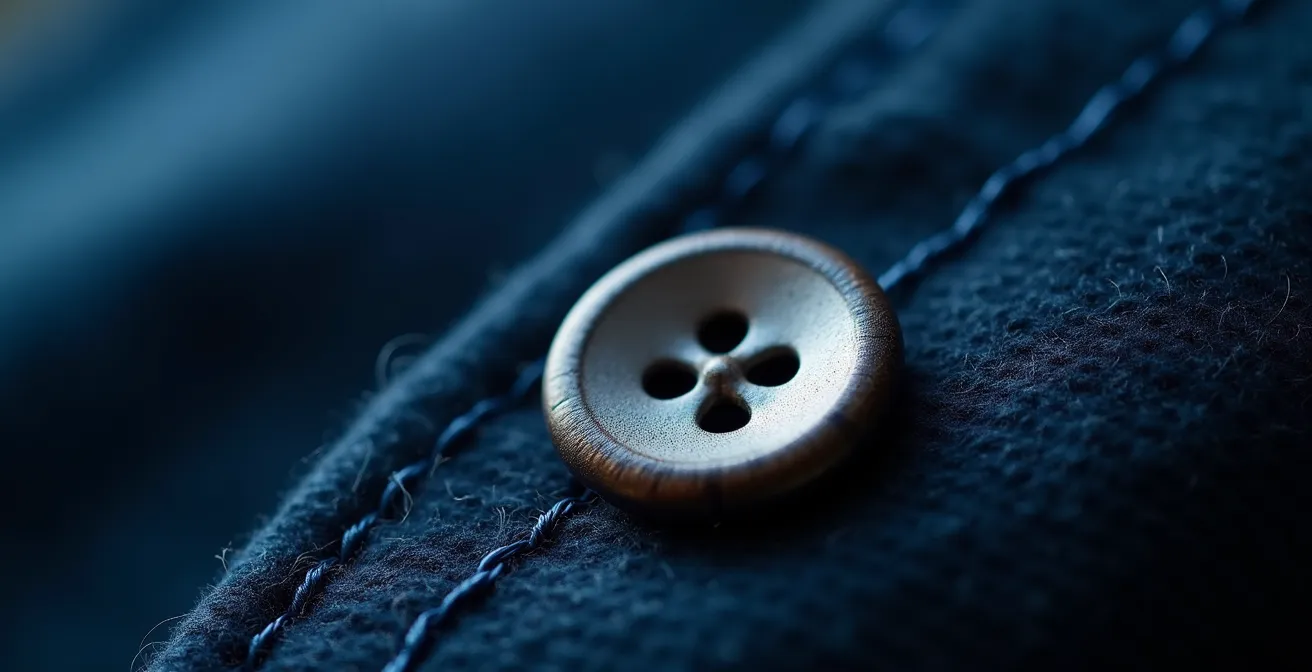
As this level of detail illustrates, the pursuit is not machine-like perfection, but human excellence. It is a philosophy that embraces the nuance of craft. As a recent analysis from Parisian Gentleman on the signals of a handmade suit notes:
Buttonholes should be slightly ragged at the back—little imperfections are the stamps of bespoke.
– The Economist: Intelligent Life, Parisian Gentleman analysis of handmade suit signals
This small detail is a microcosm of the entire bespoke philosophy: time and skill are lavished upon even the most hidden elements, because true quality is absolute. It is not for show; it is for the integrity of the garment itself.
Made-to-Measure vs Bespoke: Which Service Is Right for You?
The terms « made-to-measure » (MTM) and « bespoke » are often used interchangeably by the uninitiated, a confusion that commercial brands are happy to exploit. However, the difference between them is not a matter of degree, but of kind. It is the difference between altering a pre-existing structure and building a new one from the ground up. MTM begins with a standard-sized pattern, or « block, » which is then adjusted based on a handful of the client’s measurements. The shoulder width may be tweaked, the sleeves shortened, the waist suppressed. It is, in essence, a very sophisticated alteration.
Bespoke, by contrast, begins with a blank sheet of paper. From a comprehensive set of 25 to 30 individual measurements, the cutter drafts a unique pattern that is exclusively the client’s. This is the « blueprint of character, » capturing every nuance of posture—a dropped shoulder, a prominent shoulder blade, the arch of the back. No two patterns are alike because no two bodies are. This process requires not just a measuring tape, but a master’s eye for form, balance, and movement. The difference in process, timeline, and investment is stark, as it fundamentally separates modification from true creation.
The following table outlines the fundamental distinctions between these two services, clarifying where the true investment in time and skill lies.
| Aspect | Made-to-Measure | Bespoke |
|---|---|---|
| Pattern | Modified existing | Created from scratch |
| Measurements | 8-12 points | 25-30 points |
| Fittings | 1-2 sessions | 3-5 sessions |
| Timeline | 4-8 weeks | 8-16 weeks |
| Price Range | $700-$1,800 | $3,500+ |
Choosing between them depends entirely on your objective. If you seek a better-fitting version of a standard suit, MTM is a perfectly respectable option. If, however, you seek a garment that is a true extension of yourself, a « sartorial sculpture » that is uniquely yours in every dimension, then only bespoke will suffice. It is a commitment to a process that yields an unparalleled result.
The Risk of Ordering Custom Clothing Without a Physical Fitting
In our modern, digitized world, the temptation to apply technological shortcuts to every process is immense. The emergence of online « custom » clothiers promises the luxury of a personalized garment with the convenience of a mouse click, often relying on self-measurement or algorithmic predictions. Some companies have found success in this arena; for instance, modern technology is reshaping accessibility, with companies like Sene reporting over 90% of its orders fulfilled through digital custom-fit technology. While this innovation is noteworthy for its accessibility, it fundamentally misses the point of true bespoke tailoring.
A bespoke suit is a three-dimensional object created for a dynamic, moving body. A list of measurements, no matter how extensive, is a two-dimensional abstraction. It cannot capture the subtle interplay of muscle and bone, the way a man stands, or the gesture with which he reaches for his wallet. The physical fitting—or rather, the series of fittings—is where the art resides. It is during these sessions that the tailor sculpts the cloth directly on the client’s body. We observe the drape of the fabric, the balance of the jacket, and the « run » of the sleeve. We are not just checking measurements; we are refining a sculpture in real-time. This iterative process of crafting a « living cloth » is simply impossible to replicate through a screen.
To order a suit without a physical fitting is to trade artistry for approximation. It is a gamble on an algorithm’s ability to interpret the human form. While it may result in a garment that technically « fits, » it will almost certainly lack the life, balance, and ineffable comfort of a true bespoke commission. For those who must engage with a tailor remotely, certain precautions are essential to mitigate the inherent risks.
A Gentleman’s Checklist for Remote Commissions
- Assess the Material: Always request fabric swatches before ordering to physically assess the texture, colour, and weight of the cloth.
- Guided Measurement: Engage in a multi-angle video consultation, preferably with a local assistant to ensure the tailor’s instructions are followed precisely.
- Test the Form: Inquire about receiving a « skeleton » or test garment (a « basted fitting ») for a preliminary fitting before the final suit is cut.
- Secure the Finish: Confirm that the tailor offers comprehensive alteration guarantees or has a partnership with a local artisan for final adjustments.
- Document the Stance: Provide your tailor with videos and photos that document your natural posture and common movement patterns.
These steps can help, but they remain a compromise. The hands-on dialogue between client, cloth, and craftsman is the irreplaceable core of the bespoke experience.
Why the Waiting List Is Part of the Luxury Value Proposition?
In a world of instant gratification, the concept of a waiting list is often seen as an inconvenience or, worse, an artificial marketing ploy. For a true bespoke house, however, the waiting list is not a strategy; it is a simple, unavoidable consequence of uncompromising dedication to craft. The value of a bespoke suit is directly proportional to the time invested in its creation. This is the « currency of time, » the most precious material we work with.
One must understand that each bespoke suit represents approximately 100 hours of skilled craftsmanship from our artisans. This is not an assembly line. It is a single master cutter drafting the pattern, a single tailor shaping the canvas and padding the lapels, and a single finisher sewing each buttonhole by hand. This singular focus cannot be rushed or scaled without sacrificing the very quality that defines it. As demand for authentic craftsmanship grows, a queue naturally forms. It is a testament to the integrity of the process.
The rising interest in genuine craft is a noticeable trend. As NPD Group’s chief industry analyst, Marshal Cohen, observed some years ago, the appreciation for this art form has broadened significantly:
The word is out. Nobody knew about bespoke suits before, unless you were wealthy. Now the common guy is wearing them.
– Marshal Cohen, NPD Group chief industry analyst on market democratization
The waiting list, therefore, becomes a form of assurance. It signals that the house has not compromised its standards in the face of increased demand. It tells the client that their commission will receive the same level of undivided attention as the one before it and the one after. It is an implicit promise of quality, where patience is rewarded not with a product, but with a masterpiece.
What Is the Future of Bespoke Tailoring in a Fast Fashion World?
It is easy to assume that in an era dominated by fast fashion’s relentless cycle of consumption and disposal, a craft as patient and meticulous as bespoke tailoring would be an endangered species. The reality, however, is precisely the opposite. Bespoke tailoring is not just surviving; it is thriving as the ultimate antidote to the waste and anonymity of mass-produced clothing. It represents a conscious shift in consumer values towards sustainability, longevity, and personalization.
A bespoke suit is the epitome of sustainable luxury. It is created from natural, high-quality materials to last not just for a season, but for a lifetime. It can be altered and repaired, evolving with its owner over decades. This philosophy resonates deeply with a growing number of consumers who are rejecting disposability. Market data confirms this isn’t just a niche sentiment; a significant portion of consumers, particularly 42% of high-income professionals, are actively seeking the precision and exclusivity that tailoring offers. Far from being a relic, bespoke is becoming a beacon for the future of responsible consumption.
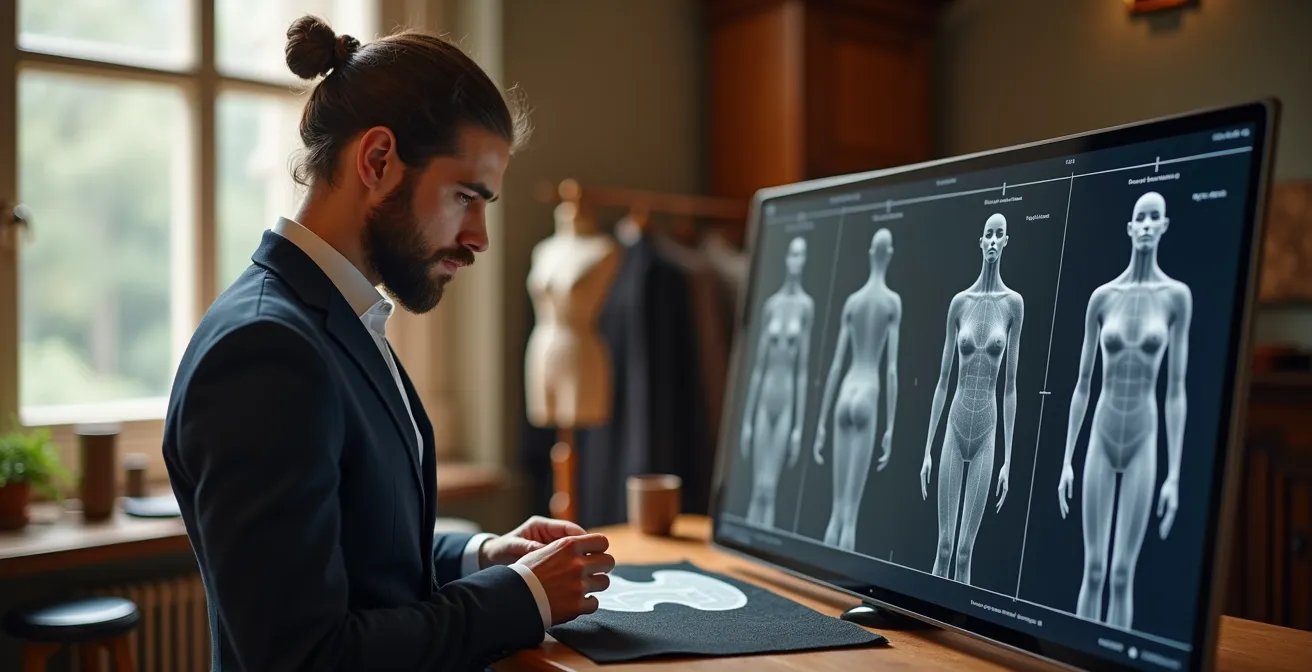
The future is not a battle between tradition and technology, but a synthesis of the two. While the core principles of handcraft remain immutable, modern tools can enhance the experience. Digital archives can preserve a client’s pattern for life, and communication tools can bridge distances. The atelier of tomorrow will honour its heritage while embracing innovations that serve the craft. The market itself reflects this robust health, as analysts predict the custom suits market is projected to grow at a CAGR of 6.329% through 2033. Bespoke’s future is secure because it offers what fast fashion never can: a soul.
Flat Pattern Making vs Draping: Which Yields Better Results for Tailoring?
To ask whether flat pattern making or draping is « better » is to misunderstand the nature of mastery. It is like asking a master linguist if grammar or poetry is more important. Both are essential languages of the tailor, and fluency in each is non-negotiable for achieving a superior result. They are not opposing methods but complementary disciplines that, when combined, allow for the creation of a truly three-dimensional form.
Flat pattern making is the science of our craft. It is a precise, mathematical process. After capturing 30-40 individual measurements, the cutter translates these numbers into a two-dimensional blueprint on paper. It is a system of angles, curves, and allowances that renders the human form with geometric precision. This method ensures accuracy, repeatability, and a solid architectural foundation for the garment. It is the engineering that underpins the art.
Draping, on the other hand, is the art of our craft. It is intuitive and sculptural. Here, the tailor works directly with cloth on a dress form or the client’s body, molding the fabric with their hands. It is a conversation with gravity, tension, and the inherent character of the material. Draping allows the tailor to solve complex fitting challenges—like a deep chest or a very erect posture—in a way that pure mathematics cannot always predict. It is how we imbue the garment with life and movement. As one professional analysis observes:
Flat patterning is the precise language of mathematics and angles. Draping is the intuitive language of gravity, tension, and flow. A master tailor is fluently bilingual.
– Industry observation, Professional tailoring methodology analysis
Ultimately, the finest garments are born from a synthesis of both. The flat pattern provides the blueprint, and draping refines the sculpture. A master cutter will often draft a pattern and then test and refine key areas, like the shoulder and chest, by draping fabric during the fitting process. One is not better than the other; they are two sides of the same coin of sartorial excellence.
Legacy vs Innovation: What Drives Growth for Historic Houses?
For a historic tailoring house, legacy is not a dusty artifact to be displayed in a museum; it is the very bedrock upon which its present and future are built. It is the ultimate expression of trust. A house that has been dressing discerning clients for centuries has proven its commitment to quality beyond any doubt. This « tangible legacy » is not a marketing story; it is a verifiable record of excellence, an unbroken chain of craftsmanship passed down through generations of artisans.
Case Study: Henry Poole & Co. – The Enduring Power of Provenance
Founded in 1806 and credited as the creator of the tuxedo, Henry Poole & Co. on Savile Row is a perfect illustration of legacy as a growth engine. The house’s history is not just lore; it is meticulously documented. They hold Royal Warrants from monarchs like Napoleon III and Queen Victoria and have preserved customer ledgers dating back to 1846. By continuing to operate from their historic premises and upholding the same exacting standards, their legacy is not a thing of the past but a living, breathing promise of quality to every new client who walks through their door. This history provides an assurance that no new brand, regardless of its marketing budget, can replicate.
However, legacy alone is not enough to sustain growth. It must be paired with a commitment to contemporary relevance. Innovation in a historic house is not about chasing fleeting trends, but about refining the client experience and adapting to modern sensibilities without compromising core principles. This might manifest as offering lighter, more comfortable internal constructions (canvassing), exploring new fabric technologies that offer performance without sacrificing elegance, or using digital tools to enhance communication with international clients.
The growth of these historic institutions is driven by a powerful symbiosis: legacy provides the trust, and innovation provides the relevance. Clients are drawn to the history because it guarantees a standard of quality, and they remain because the house demonstrates an understanding of their modern lives and needs. It is this balance that allows a 200-year-old establishment to remain more vital and desirable than a brand born yesterday.
Key Takeaways
- A bespoke suit’s value is in the process—the unique pattern, multiple fittings, and hand-finishing—not just the materials.
- Time is the most crucial ingredient. The 100+ hours of skilled labour cannot be rushed without compromising the quality that defines bespoke.
- Bespoke is the antithesis of fast fashion, representing a sustainable investment in a garment built to last a lifetime.
Why Price Increases Actually Build Desire for Luxury Brands?
The logic of conventional retail dictates that a higher price deters customers. In the world of true luxury and bespoke craft, this logic is often inverted. Here, price is not merely a cost to be borne; it is a signal of uncompromising quality, exclusivity, and profound value. When a historic house raises its prices, it is not a simple inflationary adjustment. It is a statement of confidence in its own enduring worth and a refusal to compromise the integrity of its craft.
This dynamic is rooted in the fact that genuine bespoke tailoring occupies an incredibly small niche. While it may seem prominent in discussions of high fashion, the bespoke suit industry comprises approximately 1% of the menswear market. This is not a mass market; it is a selective world where clients seek not a bargain, but the absolute best. A higher price reinforces the perception of exclusivity and assures the client that they are acquiring something rare and exceptional. It functions as a gatekeeper, preserving the intimate, artisanal nature of the workshop and ensuring that the master tailor’s time is dedicated to those who truly appreciate the art form.
One must be cautious, however, not to confuse a high price with genuine value. The world is filled with brands that inflate prices for marketing effect. The key is provenance and process. A CEO of a tech company once made a stark comparison about global pricing:
In the U.S., a typical bespoke suit costs $3,000. In Hong Kong, it costs about $300.
– Ari Zoldan, CEO of Quantum Networks on global pricing disparities
From a craftsman’s perspective, this compares two entirely different objects that happen to share the name « suit. » The $300 garment is a product of compromised labour and materials, designed to meet a price point. The true bespoke suit is the result of a process where price is the outcome, not the objective. Therefore, a price increase from a reputable house is seen by the discerning client not as a deterrent, but as a reaffirmation that the standards of the craft are being upheld, which only strengthens its desirability.
Ultimately, a bespoke suit is an heirloom in the making. It is a testament to the belief that some things are worth doing without compromise. The next time you consider such a commission, do not merely ask its price. Instead, inquire about its provenance, its process, and the hands that will bring it to life. In those answers, you will find its true, and immeasurable, value.