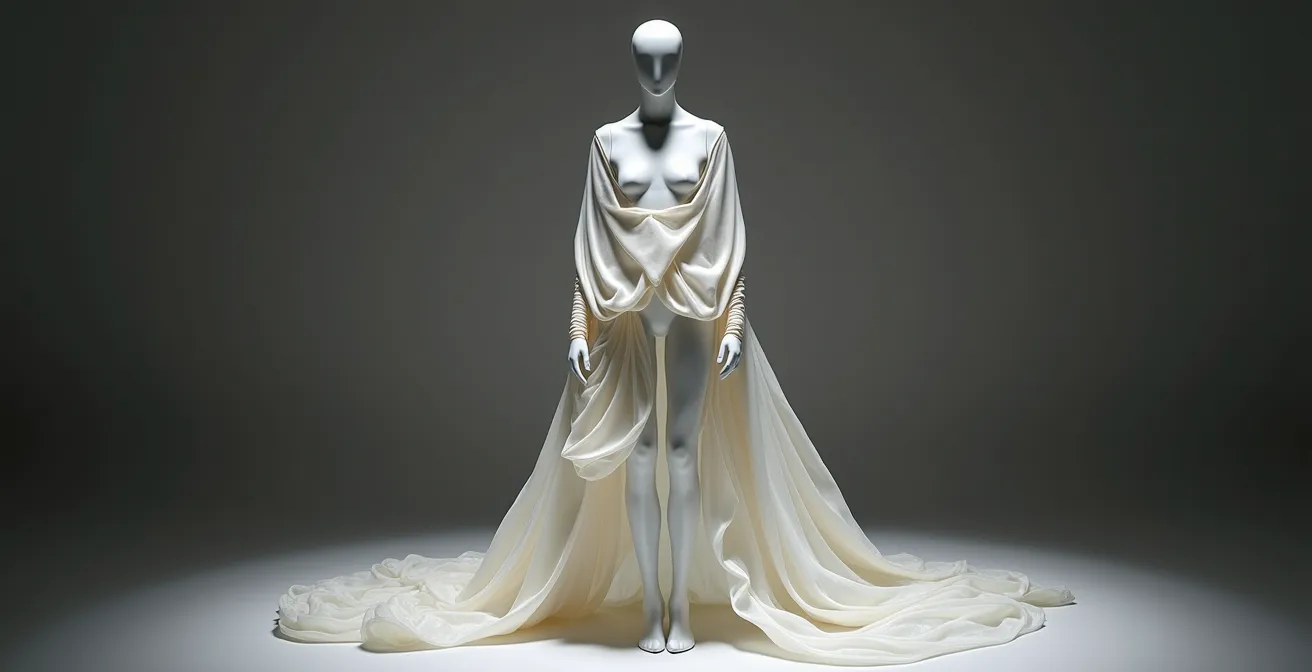
Contrary to popular belief, the ‘unwearable’ garments on the runway are not just an art project; they are the core of a sophisticated business strategy.
- They function as a high-stakes R&D lab where conceptual ideas, new materials, and future silhouettes are stress-tested.
- They act as a powerful economic engine, creating the brand aura and desire that fuels sales of more commercial items like perfume, handbags, and ready-to-wear.
Recommendation: View the next runway show not as a gallery of impractical clothes, but as a strategic preview of the concepts that will systematically shape both culture and commerce.
To the uninitiated observer, a high-fashion runway show can be a bewildering spectacle. Garments of impossible proportions, materials that defy practicality, and styling that seems divorced from reality raise a common, valid question: who would ever wear this? The easy answer, often repeated, is that it’s « art for art’s sake »—a pure, creative expression unburdened by commercial concerns. This view frames the designer as an artist and the runway as their gallery, a space for performative fantasy.
However, this explanation, while partially true, misses the far more critical point. These seemingly unwearable creations are not the final product; they are the engine. They represent the most visible part of fashion’s complex research and development process. Each show is a laboratory where abstract themes are tested, material innovations are debuted, and a brand’s core identity is distilled into its most potent form. What appears as avant-garde madness is, in fact, a calculated investment in the brand’s future.
This article will deconstruct the spectacle to reveal the underlying business logic. We will explore how these conceptual pieces are systematically translated for daily wear, the stark economic differences between haute couture and ready-to-wear, the financial machinery behind a 15-minute show, and the dynamic interplay between designer intuition and market forces. The ‘unwearable’ is not an indulgence; it is the strategic foundation upon which the entire fashion ecosystem is built.
To fully grasp this concept, we will dissect the layers of strategy and creativity that turn a fleeting runway moment into a global trend. The following sections break down the key functions of the runway, from decoding themes to understanding the powerful influence of street style.
Summary: The Method in the Madness: Why Runway Fashion Is Intentionally ‘Unwearable’
- How to Decode Runway Themes for Daily Wear?
- Ready-to-Wear vs Haute Couture: What Is the Business Difference?
- The Risk of Copying Runway Designs vs Finding Inspiration
- The « See Now, Buy Now » Shift: Did It Work?
- Why Street Style Drives Runway Trends More Than Ever?
- What Does It Cost to Produce a 15-Minute Runway Show?
- Data Analytics vs Designer Intuition: Which Should Lead the Collection?
- Why Creative Directors Move Between Houses Every 3 Years?
How to Decode Runway Themes for Daily Wear?
A runway show is a narrative, a concentrated story told through fabric, silhouette, and colour. The ‘unwearable’ statement piece is the explosive opening chapter, not the entire book. Its purpose is to establish the collection’s core themes in their most extreme and memorable form. From there, a process of systematic translation begins. The dramatic volume of a runway gown might be distilled into the sleeve of a commercial blouse. An experimental fabric might reappear as the lining of a jacket. A bold, thematic colour palette seen on the runway will inevitably filter down into more accessible items.
This « trickle-down » effect extends far beyond the brand’s own stores. As Lisa Valendza of Kent State University’s School of Fashion notes, « Everything trickles down from the runway. So, if it’s a popular color, you’ll start to see it on a greeting card, packaging or in wrapping paper. » The runway seeds ideas into the collective cultural consciousness. Decoding a show, therefore, is not about asking if you would wear the centerpiece, but about identifying the translatable motifs, silhouettes, colours, and textures that will soon become ubiquitous.
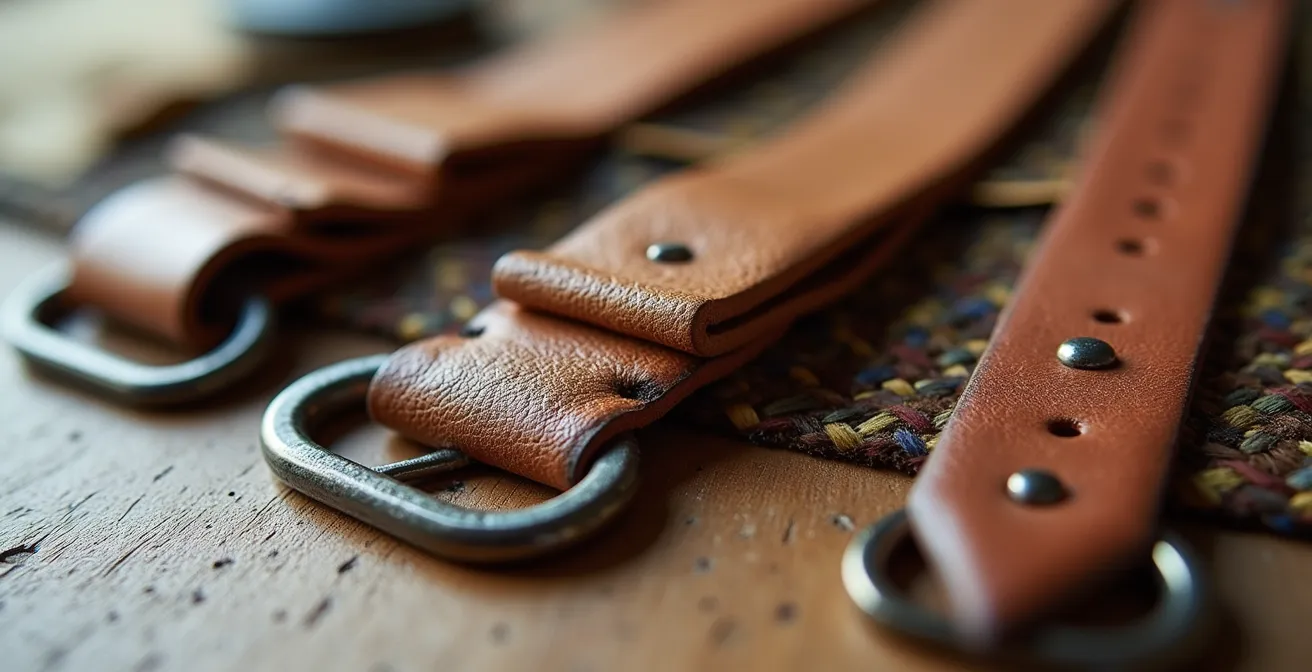
As the image of these luxury accessories demonstrates, the most conceptual runway ideas often find their most successful commercial expression in smaller, more accessible forms. The innovative texture or unique hardware from a show-stopping garment is translated into a handbag or a piece of jewellery—the very items that generate the bulk of a luxury brand’s revenue. The « unwearable » dress sells the « wearable » bag.
Your Action Plan: The Translation Framework for Runway to Real Life
- Identify the central story or motif: Look for the overarching theme or narrative the designer is communicating through the collection. Is it historical, futuristic, political, or purely aesthetic?
- Note three recurring silhouettes: Track the dominant shapes and forms. Are shoulders broad? Waists cinched? Trousers wide or narrow? These are the forms that will be adapted for retail.
- Record dominant colors and standout textures: Document the core color palette and any innovative fabric treatments. These are the most easily translated elements.
- Check for sustainable/technical innovations: Spot new materials or construction techniques that may signal a broader industry shift and eventually trickle down to mass-market retail.
- Decide which elements are wearable now, later, or aspirational: Categorize trends by their immediate applicability versus their potential to influence fashion in future seasons.
Ready-to-Wear vs Haute Couture: What Is the Business Difference?
The confusion around ‘unwearable’ fashion is often rooted in the conflation of two distinct business models: Haute Couture and Prêt-à-Porter (Ready-to-Wear). While both exist under the umbrella of high fashion, their economic functions are fundamentally different. Haute Couture is a laboratory for craftsmanship; Ready-to-Wear is the scalable commercial product derived from that research.
Haute Couture, a legally protected designation in France, involves creating bespoke, hand-made garments for a tiny client base of a few thousand worldwide. It is an enterprise of extreme artistry, with pieces costing tens or hundreds of thousands of dollars. Economically, it is often a loss leader. Its true value is not in direct sales but in the immense brand prestige and media attention it generates. The global Haute Couture market, while exclusive, is a significant business, with a market size of $1.3 Billion in 2024 and an expected steady growth. Major players like Chanel, Dior, and Givenchy use their couture shows to assert their dominance in craftsmanship and creative vision.
Ready-to-Wear, by contrast, is the seasonal collection of factory-produced clothing sold in standardized sizes through boutiques and online stores. This is where the majority of a fashion house’s apparel revenue is made. The ideas, silhouettes, and publicity generated by the Haute Couture show are translated into the more accessible, commercially viable Ready-to-Wear collections. In this model, the ‘unwearable’ couture piece acts as the pinnacle of the brand pyramid, creating an aspirational halo that drives the sales of everything below it, from dresses and coats to licensed products like sunglasses and fragrances.
The Risk of Copying Runway Designs vs Finding Inspiration
The line between inspiration and infringement is one of the most contentious issues in fashion. The runway’s function as a trend generator naturally invites interpretation from other brands, particularly in the fast-fashion sector. However, the distinction lies in the approach. Inspiration involves abstracting the core ideas of a collection—its mood, color palette, or a specific silhouette—and reinterpreting them through a unique design lens. Copying is a direct, literal replication of a design, often infringing on intellectual property.
While a garment’s design is notoriously difficult to copyright in many jurisdictions, blatant copying carries significant risk to a brand’s reputation, eroding consumer trust and devaluing its creative identity. The more nuanced approach is to engage in what can be called « iteration » or « pastiche »—building upon established public trends or blending multiple sources of inspiration to create something new. This is how the fashion ecosystem evolves, with ideas flowing from the runway and being transformed as they move through different market levels. As fashion analyst Renaud Petit suggests, « A runway show that features unwearable garments should be seen as an art exhibition. » While this view is incomplete, it highlights that the value is in the concept, not just the physical object, making a direct copy a hollow exercise.
True design innovation lies in understanding the difference between homage—a respectful nod to a source—and outright theft. Brands that succeed in the long term are those that use the runway as a starting point for their own creative conversations, not as a blueprint to be traced. They absorb the key messages of a season and filter them through their own unique brand DNA, adding to the dialogue rather than simply echoing it.
The « See Now, Buy Now » Shift: Did It Work?
For decades, fashion operated on a six-month delay. The collections shown on the runway in February (for Autumn/Winter) and September (for Spring/Summer) wouldn’t be available in stores until half a year later. This incubation period gave time for press coverage to build, buyers to place orders, and production to be organized. However, the rise of social media and the instant gratification it fosters created a disconnect. Consumers saw a look on Instagram and wanted it immediately, not six months later. This frustration gave birth to the « See Now, Buy Now » (SNBN) model.
Pioneered by brands like Burberry and Tom Ford around 2016, SNBN aimed to close the gap by making runway collections available for purchase immediately after the show. On paper, it was the perfect solution for the digital age. In practice, the experiment has been largely abandoned by the luxury sector. The primary reason for its failure is that it fundamentally misunderstood the runway’s role. By prioritizing immediate sales, it sacrificed the crucial R&D and narrative-building phase. Brands had to produce collections based on predictions of what would sell six months in advance, stifling in-the-moment creativity and risking massive financial losses on unsold inventory.
The SNBN model treated the runway as a direct-to-consumer sales event rather than a strategic communication tool. It proved that the ‘lag’ time was not a bug, but a feature. It allows for a trend to marinate, for desire to build, and for the complex global supply chain to respond. While the digital transformation of fashion is undeniable, the failure of SNBN demonstrated that the ‘unwearable’ show’s primary function is not to sell clothes, but to sell an idea—an idea whose value is cultivated over time.
Why Street Style Drives Runway Trends More Than Ever?
While the traditional fashion hierarchy dictates that trends « trickle down » from the designer’s runway to the public, the modern dynamic is far more symbiotic. Today, inspiration flows just as powerfully in the opposite direction, from the street up to the design studio. This « trickle-up » phenomenon is not new, but its influence has been exponentially amplified by social media, fashion blogs, and the global rise of streetwear.
As defined by Dr. Catherine Leslie of Kent State University, « The trickle-up is when it comes from the street or sub-cultural groups and is moving upward. » Designers and their teams now meticulously monitor how real people—influencers, subculture members, and everyday fashion enthusiasts—are interpreting, combining, and subverting clothing. Street style is no longer just a reflection of trends; it has become a primary source of them. It serves as a real-time, global focus group, revealing unmet needs and emerging aesthetic desires that data analytics might miss. The raw, authentic creativity of how a vintage jacket is paired with luxury sneakers can provide more inspiration than a historical archive.

The economic power of this movement is staggering. The influence of street style on fashion is undeniable, with the global streetwear market projected to grow from $371.09bn in 2025 to over $637 billion by 2032. This financial reality forces luxury houses to pay close attention. The ‘unwearable’ runway show, therefore, often becomes a space where these raw, street-level ideas are elevated, refined, and codified into a high-fashion narrative, completing the cycle. The runway doesn’t just dictate; it listens, absorbs, and re-transmits.
What Does It Cost to Produce a 15-Minute Runway Show?
The ephemeral 15-minute runway show is one of the most expensive marketing tools in any industry. Understanding the immense cost involved is key to appreciating why ‘unwearable’ fashion is a calculated investment, not a flight of fancy. The budget for a major luxury house’s show is astronomical, often running into the millions of dollars for a presentation witnessed in person by only a few hundred people. These costs cover far more than just the garments themselves.
Industry estimates reveal that producing a major runway show can cost anywhere from $1 million to over $20 million, and this figure often excludes the cost of creating the collection itself. The primary expenses include venue rental (often an iconic or custom-built location), elaborate set design and production, lighting, sound, model fees (top models command six-figure sums for exclusivity), celebrity stylist and makeup artist teams, public relations, and securing A-list celebrity attendance. When Chanel builds a life-sized rocket ship inside the Grand Palais or Dior takes over a historic palace, they are not just hosting a party; they are making a multi-million dollar investment in brand narrative.
This expenditure is justified because the show’s value is measured in media impact, not ticket sales. A single successful show can generate hundreds of millions of dollars in ‘earned media value’—the equivalent cost of advertising for the global press coverage it receives. The ‘unwearable’ headline-grabbing look is the key to unlocking this value. It’s the image that goes viral, lands on magazine covers, and cements the brand’s creative authority for the season, ultimately driving sales across all product categories.
| Show Tier | Total Budget Range | Venue Cost | Production/Staging | Models & Styling |
|---|---|---|---|---|
| Emerging Designer | $100,000-$300,000 | $35,000-$50,000 | $25,000-$100,000 | $40,000-$80,000 |
| Mid-Scale Brand | $300,000-$500,000 | $50,000-$80,000 | $100,000-$200,000 | $80,000-$150,000 |
| Luxury House | $1M-$20M+ | $200,000+ | $500,000+ | $300,000+ |
Data Analytics vs Designer Intuition: Which Should Lead the Collection?
The modern design studio is a battleground between two powerful forces: the creative, often visceral, intuition of the designer and the cold, hard logic of data analytics. While fashion has always been driven by the singular vision of its creators, the rise of big data has introduced a new player. Brands can now track sales data, monitor social media trends, and analyze consumer behaviour with unprecedented precision. This raises a critical question: in the creation of a new collection, which should lead?
Data can tell a designer what sold well last season, which colours are trending on TikTok, and what silhouettes are being saved on Pinterest. It can reduce financial risk by guiding production towards commercially proven concepts. In fact, market research demonstrates that 81% of consumers are willing to pay a premium for personalized clothing, a desire that data can help identify and serve. However, an over-reliance on data can lead to derivative, market-driven designs that lack a unique point of view. It can create a feedback loop where fashion only repeats what is already popular, stifling true innovation.
Designer intuition, on the other hand, is the source of genuine novelty. It is the ability to anticipate a cultural shift, to synthesize disparate influences into a new aesthetic, and to create something the public doesn’t yet know it wants. The most iconic ‘unwearable’ runway moments are born from this intuition, not from a spreadsheet. The ideal approach, therefore, is not a choice between the two but a synthesis of both. Data can provide the framework and identify the commercial opportunities, but the designer’s intuition must provide the soul and the forward-looking vision. Data can refine the product, but it cannot create the dream.
Key Takeaways
- The ‘unwearable’ runway garment is not the final product, but the starting point for a brand’s seasonal narrative and conceptual R&D.
- A process of « systematic translation » distills runway concepts (color, silhouette, texture) into commercial ready-to-wear and accessories.
- The immense cost of a runway show is a strategic marketing investment, justified by the global media value and brand prestige it generates.
Why Creative Directors Move Between Houses Every 3 Years?
The high-stakes world of luxury fashion often sees its creative directors—the star designers responsible for a brand’s entire aesthetic—playing a game of musical chairs, moving between competing houses every few years. This seemingly rapid turnover is not a sign of instability but a reflection of the intense pressure for growth and novelty that defines the modern luxury market. A creative director is hired to inject a new perspective and, most importantly, to drive financial performance.
The pressure for growth in luxury fashion is immense; while the market is valued at over $136.99 billion worldwide, its growth can be slow. When a brand’s sales stagnate, changing the creative leadership is often the fastest way to signal a new direction to the market and reignite consumer interest. Each new director brings their own unique aesthetic, a loyal following, and the promise of a fresh narrative. However, the relentless fashion calendar—requiring multiple collections per year—can lead to creative burnout. A three-to-five-year tenure is often seen as a full cycle, enough time for a designer to make their mark before seeking a new challenge.
This dynamic is also driven by the portfolio logic of large luxury conglomerates like LVMH and Kering. These groups manage a diverse roster of brands, each with its own heritage and market position. Moving a successful designer from one house to another within the portfolio can be a strategic move to revitalize a different part of the business.
Case Study: LVMH’s Portfolio Strategy
LVMH’s strategy provides a clear example of this portfolio management. Their holdings span from haute couture (Louis Vuitton, Dior) to jewelry (Tiffany & Co.) and cosmetics (Sephora). This diversification insulates them from downturns in any single market. A creative director’s success at one brand can be leveraged to boost another, treating creative talent as a strategic asset to be deployed across the group for maximum impact, as seen when Chinese demand offset cooling in other regions to lift sales.
Ultimately, the ‘revolving door’ of creative directors is a function of a system that demands constant innovation and consistent financial return. A designer’s role is not just to create beautiful ‘unwearable’ clothes, but to serve as the highly visible engine of a massive commercial enterprise.