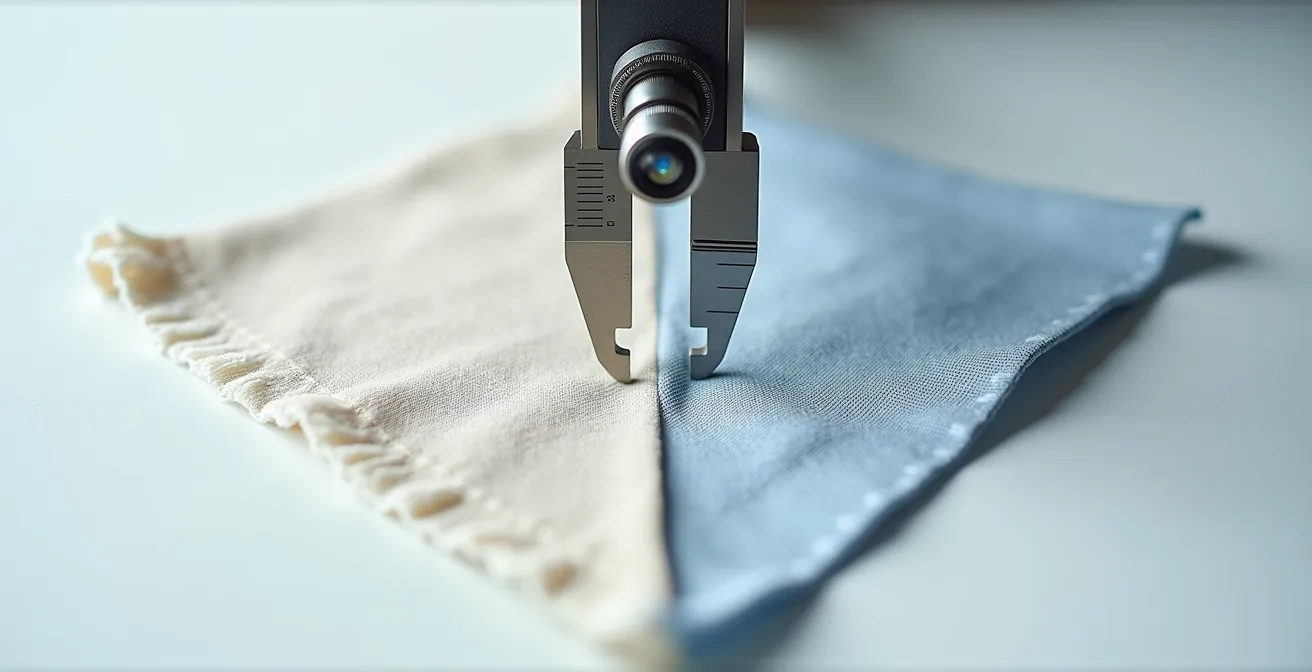
Workwear durability is not a simple choice between natural and synthetic; it’s an engineering outcome defined by measurable material properties and targeted finishing processes.
- True performance lies in understanding the structural integrity of fibers, not just their origin.
- Key metrics like fabric weight (GSM), abrasion resistance (Martindale cycles), and colorfastness grades dictate a garment’s real-world lifespan.
Recommendation: Base fabric selection on specific performance data and end-use requirements rather than relying on broad « natural vs. synthetic » categorizations.
For any workwear designer or buyer, the choice between natural and synthetic fibers often feels like a fundamental crossroads. The conventional wisdom pits the comfort and breathability of cotton against the rugged strength of polyester, presenting a seemingly unavoidable trade-off. This debate typically revolves around generic pros-and-cons lists that declare one category superior to the other, leading to simplified decisions that can compromise the final product’s performance and longevity.
However, this binary view overlooks the complex reality of textile engineering. The most durable and effective workwear fabrics are not simply chosen; they are engineered. But what if the key to unlocking ultimate durability wasn’t about picking a side in the natural versus synthetic battle, but about understanding the material science that governs performance? The true measure of a fabric’s resilience lies not in its origin but in its specific, measurable properties: its structural integrity, its reaction to chemical and mechanical stress, and the finishing processes that refine its character.
This article moves beyond the surface-level debate to provide a textile engineer’s perspective. We will dissect the critical performance metrics that define durability, explore how natural fibers can be engineered to outperform synthetics, and provide the technical frameworks needed to transition a design sketch into a structurally sound, high-performance garment. By focusing on the science, you can make informed decisions that ensure your workwear doesn’t just look the part—it performs beyond expectation.
To navigate this technical landscape, this guide breaks down the essential factors a designer must master, from initial testing to final material selection. The following sections provide a clear roadmap for evaluating and choosing fabrics based on scientific principles rather than common assumptions.
Summary: A Scientific Approach to Workwear Fabric Selection
- How to Test Fabric Colorfastness at Home Before Production?
- Why Fabric Weight Determination Is Critical for the Final Drape?
- The Disaster of Mixing Cotton and Wool in the Same Wash Cycle
- How to Improve Fabric Hand-Feel Through Mechanical Finishing?
- What Are « Performance Naturals » and Are They Worth the Premium?
- What Are Pineapple and Mushroom Leathers and Do They Last?
- How to Identify Fiber Content Using the Burn Test Method?
- How to Transition from Sketch to Structure Without Losing Design Integrity?
How to Test Fabric Colorfastness at Home Before Production?
Colorfastness is a critical performance metric for workwear, determining a garment’s ability to retain its color when exposed to various conditions like washing, light, and perspiration. For high-visibility apparel, color retention is not just an aesthetic concern—it’s a safety requirement. A simple at-home test can provide an initial assessment, but for professional applications, understanding industry-standard grading is essential. The quality of colorfastness is officially rated on a scale where Grade 5 indicates excellent resistance to fading, while Grade 1 signifies poor performance.
The primary standards for testing involve sophisticated methods. For workwear, resistance to perspiration is particularly important, as bodily fluids can cause dyes to bleed or fade. The ISO 105-E04:2013 standard specifically addresses this by treating textile specimens with histidine solutions that mimic human sweat. The samples are then evaluated for color change under pressure using standardized gray scales. This simulates the real-world conditions of a garment being worn during physical labor, providing a much more accurate prediction of its long-term stability than a simple wash test.
While a full lab test is the gold standard, designers can conduct a preliminary check. To do this, dampen a small, white piece of cotton fabric with water and a bit of pH-neutral soap. Rub it vigorously against an inconspicuous area of the colored fabric for 30 seconds. If significant color transfers to the white cloth, it’s a strong indicator of poor crocking (rubbing) fastness, and the fabric will likely fail in more demanding applications. This simple test can save significant time and resources before committing to a fabric for mass production.
Why Fabric Weight Determination Is Critical for the Final Drape?
Fabric weight, typically measured in grams per square meter (GSM), is one of the most fundamental properties influencing a garment’s performance. It directly correlates with a fabric’s durability, insulation, and, critically, its drape—how the fabric hangs and falls on the body. A lightweight fabric (e.g., 100-150 GSM) will drape fluidly, making it suitable for shirts or base layers, while a heavyweight fabric (280+ GSM) will be stiff and structured, ideal for durable outerwear like canvas jackets or work pants. Misjudging GSM can lead to a design that fails structurally or functionally.
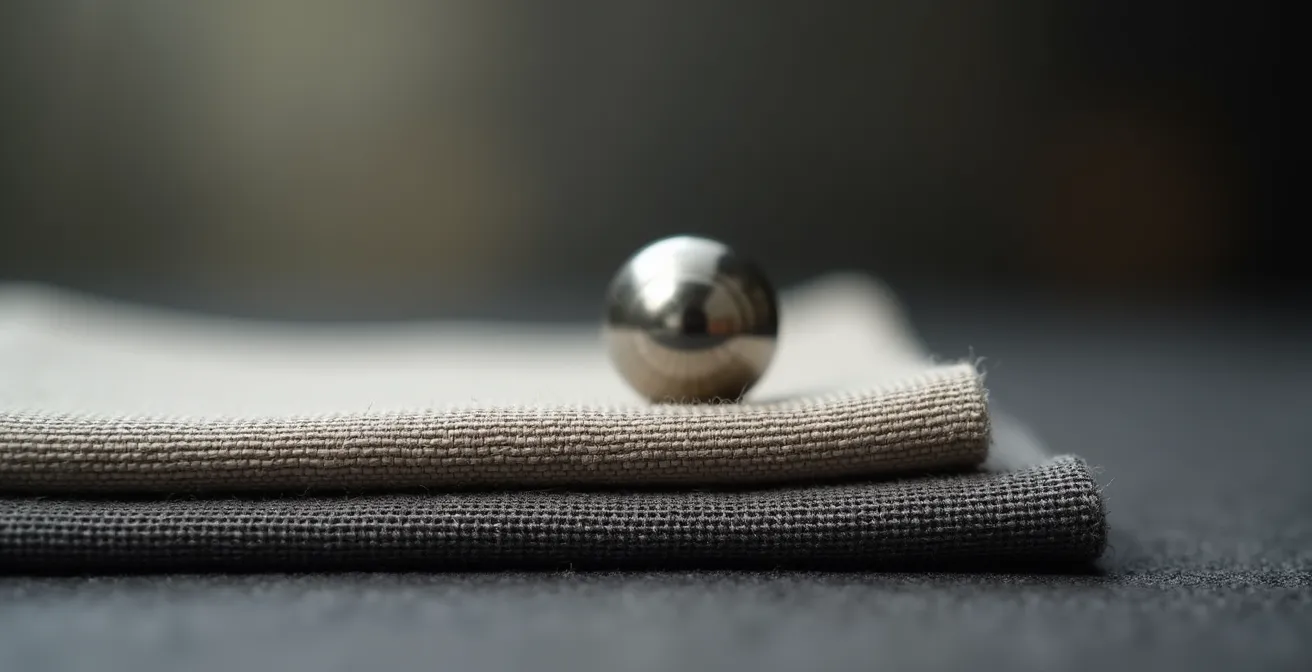
As the image above illustrates, the difference is a matter of structural density. Heavier fabrics pack more fibers into the same area, creating a robust material that better resists abrasion and tearing. This density is what gives heavyweight fabrics their strength but also their stiffness. The final drape is therefore a direct outcome of this material science, and designers must select a GSM that aligns with the garment’s intended shape and function. A structured jacket design rendered in a low-GSM fabric will appear flimsy and lack integrity, while a flowing shirt made from high-GSM canvas would be unwearable.
This relationship between weight and durability is quantifiable. The table below, based on data correlating fabric weight with performance metrics, provides a clear guide for workwear applications. It connects GSM not only to its typical use but also to its expected abrasion resistance, measured in Martindale cycles, offering a predictive tool for its lifespan under specific conditions.
| Fabric Weight (GSM) | Application | Martindale Score Range | Expected Lifespan |
|---|---|---|---|
| 100-150 | Lightweight summer wear | 10,000-20,000 cycles | 1-2 years regular use |
| 200-240 | Standard workwear | 25,000-40,000 cycles | 3-5 years regular use |
| 280+ | Heavy-duty industrial | 40,000+ cycles | 5+ years intensive use |
The Disaster of Mixing Cotton and Wool in the Same Wash Cycle
While blending fibers at the yarn stage can create high-performance fabrics, mixing garments made of different natural fibers in a wash cycle—especially an industrial one—is a recipe for disaster. Workwear often faces far harsher cleaning conditions than consumer apparel, with some industrial uniforms being cleaned at up to 95°C using high-pH detergents to remove heavy soiling. Under these conditions, the fundamental structural differences between protein fibers (like wool) and cellulose fibers (like cotton) become catastrophically apparent.
The primary issue is differential shrinkage. Wool fibers are covered in microscopic scales. When subjected to heat, moisture, and agitation, these scales interlock, causing the fibers to mat together in a process known as felting. This results in irreversible shrinkage. Cotton, a cellulose fiber, is far more stable at high temperatures and does not felt. Washing a wool-blend shirt alongside a heavy cotton canvas jacket will cause the wool garment to shrink dramatically while the cotton one remains relatively stable. The wool item will likely be rendered unwearable, a costly mistake in a uniform program.
To prevent this, strict laundering protocols are not just best practices; they are essential for asset protection. Sorting garments is critical, not just by color, but by fiber content and special treatments. For instance, garments with fire-retardant (FR) treatments must be washed at lower temperatures to preserve their chemical properties, and high-visibility apparel with reflective strips requires low heat to prevent delamination. Ignoring these separations leads directly to material failure and compromises safety, turning a simple laundry cycle into a significant financial and operational liability.
How to Improve Fabric Hand-Feel Through Mechanical Finishing?
Hand-feel refers to the tactile sensation of a fabric against the skin—its softness, smoothness, and flexibility. For workwear, a good hand-feel can significantly improve wearer comfort over a long shift. While fiber choice is a starting point, mechanical finishing processes are often employed to enhance a fabric’s texture. Common techniques include sueding and peaching, where the fabric is passed over abrasive rollers to raise the surface fibers, creating a soft, velvety texture similar to a peach’s skin. Another method is calendering, which uses heated rollers to press the fabric, increasing its smoothness and sheen.
However, these improvements in comfort often come at a cost to durability. The very act of abrading the surface to create softness can weaken the fabric’s structure. Research shows that processes like peaching and sueding can result in a 10-15% reduction in initial abrasion resistance. This creates a critical engineering trade-off for the workwear designer: how much durability can be sacrificed for an improvement in comfort? The answer depends entirely on the garment’s end-use. For a supervisor’s polo shirt, a softer hand-feel may be prioritized. For heavy-duty trousers worn by a mechanic, maximizing abrasion resistance is non-negotiable.
This is where standardized testing becomes indispensable. As Torsten Textor and his colleagues note in the Journal of Engineered Fibers and Fabrics, the Martindale test is a key method for quantifying this trade-off:
Different testing methods are established to predict textile durability, with the Martindale test being most important for apparel and home textiles in Europe, applying specific weight loading while rubbing standard wool fabric across the sample surface to assess visible fiber damage at intervals.
– Torsten Textor et al., Journal of Engineered Fibers and Fabrics
By measuring the number of rub cycles a fabric can endure before showing wear, designers can make a data-driven decision about whether a specific mechanical finish is appropriate for the application.
What Are « Performance Naturals » and Are They Worth the Premium?
« Performance naturals » are natural fibers that have been enhanced through specific breeding, advanced weaving techniques, or specialized treatments to deliver performance characteristics traditionally associated with synthetics. This category challenges the notion that natural fibers are inherently less durable or functional. The goal is to combine the inherent comfort of natural fibers with the engineered resilience of synthetics. Merino wool is a prime example. Its fibers have a natural crimp and a scaly structure that create air pockets for insulation while effectively wicking moisture away from the skin. When used in workwear base layers, these properties are highly valuable, with some merino wool blends showing 30% better thermal regulation than their synthetic counterparts.

The microscopic structure shown above reveals why merino wool performs so well. The natural crimp provides loft and insulation, while the overlapping cuticle scales on the fiber surface help transport moisture vapor. It’s a natural engineering marvel that can be further enhanced through blending with other fibers like Tencel or nylon to increase durability.
Cotton is another fiber being re-engineered for performance. For example, some modern workwear utilizes an ultralight ripstop construction that incorporates a special cotton grid weave. This grid acts as a reinforcement, preventing small punctures from turning into large tears, thus enhancing toughness without adding significant weight. These fabrics are often finished with plant-based, PFAS-free water and stain repellents, adding functionality without relying on traditional synthetic coatings. These innovations demonstrate that with the right engineering, natural fibers can meet demanding workwear standards. The premium price is often justified by the unique combination of high performance, superior comfort, and improved sustainability.
What Are Pineapple and Mushroom Leathers and Do They Last?
In the quest for sustainable alternatives to traditional materials, a new class of bio-synthetics has emerged, including so-called « leathers » derived from plant and fungal sources. The most prominent are Piñatex®, made from pineapple leaf waste, and various forms of mushroom leather, grown from mycelium (the root structure of fungi). These materials are often touted as eco-friendly replacements for both animal leather and petroleum-based synthetics. For a workwear designer, however, the critical question is not just their sustainability, but their durability.
Currently, the performance of these first-generation bio-leathers does not meet the rigorous demands of industrial workwear. Piñatex®, while innovative, is a non-woven textile coated with a polymer. This structure makes it susceptible to delamination and surface abrasion, limiting its use to fashion applications rather than high-wear gear. Similarly, many mycelium-based leathers are prone to hydrolysis (breaking down in the presence of moisture) and have low tensile strength, making them unsuitable for applications requiring robust performance.
It’s crucial to distinguish these materials from other high-performance, bio-based synthetics that are workwear-ready. The table below compares these next-generation options and clarifies their suitability. While pineapple and mushroom leathers fall short, materials like Sorona® (a corn-based polymer) and Tencel™ Lyocell (from wood pulp) offer excellent durability, moisture management, and stretch, making them viable for specific workwear uses like stretch panels and base layers.
| Material Type | Source | Durability Rating | Workwear Suitability |
|---|---|---|---|
| Piñatex (Pineapple) | Pineapple leaf waste | Moderate (delamination risk) | Fashion only |
| Mushroom Leather | Mycelium | Low-Moderate (hydrolysis prone) | Not industrial-grade |
| Sorona | Corn-based polymer | High (similar to polyester) | Suitable for stretch workwear |
| Tencel Lyocell | Wood pulp | High (moisture management) | Suitable for base layers |
How to Identify Fiber Content Using the Burn Test Method?
In a world of complex blends and misleading labels, the ability to quickly and accurately identify fiber content is an invaluable skill for any textile professional. While lab analysis is definitive, the burn test is a classic, low-tech method that provides immediate and surprisingly accurate insights into a fabric’s composition. The principle is simple: different fiber types react to flame in distinct and predictable ways, revealing their chemical origins through flame characteristics, odor, and ash residue. This hands-on method allows a designer to verify a supplier’s claims or identify an unknown fabric on the spot.
Executing a burn test requires caution and a systematic approach. The smell is one of the most telling indicators: natural cellulose fibers like cotton and linen smell like burning paper, while protein fibers like wool and silk emit an odor similar to burning hair. Synthetic thermoplastics such as polyester and nylon have a distinct chemical smell as they melt. The residue is equally informative, ranging from a soft gray ash for cotton to a hard, brittle bead for wool and a non-crushable plastic bead for synthetics. Observing these combined characteristics allows for a confident identification.
To ensure safety and obtain reliable results, it’s crucial to follow a strict protocol. The following checklist outlines the necessary steps and key identification markers for performing a burn test effectively.
Your Action Plan: Burn Test Protocol and Identification Guide
- Safety First: Always use metal tongs to hold the fabric sample. Work over a non-flammable surface like a metal tray or ceramic dish, and ensure the area is well-ventilated to safely disperse fumes.
- Natural Cellulose (Cotton/Linen): Ignites and burns readily with a yellow flame. It smells like burning paper or leaves and leaves behind a fine, soft gray ash.
- Protein Fibers (Wool/Silk): Burns slowly and will often self-extinguish when the flame is removed. It smells distinctly of burning hair and leaves a dark, brittle, and easily crushable bead or ash.
- Synthetic Thermoplastics (Polyester/Nylon): Melts, shrinks away from the flame, and can drip, creating a hazard. It produces a chemical smell. The residue is a hard, non-crushable black or tan plastic bead.
- Blended Fabrics: Will show a combination of characteristics. For example, a cotton/polyester blend will partially melt (from the polyester) while also producing some ash (from the cotton).
Key Takeaways
- Durability Is Engineered: A fabric’s performance is determined by its structure, weight, and finish, not just its « natural » or « synthetic » origin.
- Metrics Matter More Than Marketing: Base decisions on quantifiable data like GSM, Martindale cycles, and colorfastness grades to predict real-world lifespan.
- Finishing and Care Are Critical: Mechanical finishing involves a trade-off between comfort and abrasion resistance, while proper laundering protocols are essential to prevent material failure.
How to Transition from Sketch to Structure Without Losing Design Integrity?
The transition from a design sketch to a physical garment is where material science becomes paramount. A successful design is not just aesthetically pleasing; it is structurally sound, and that structure is dictated entirely by the properties of the chosen fabric. Losing design integrity often happens when there is a mismatch between the design’s intent and the material’s physical behavior. The debate of natural vs. synthetic becomes relevant here only when framed in terms of these specific properties.
For example, a designer sketching a sharp, weather-resistant work jacket must select a fabric with properties that support this vision. This means looking for high dimensional stability (won’t stretch or deform), low moisture absorption, and high abrasion resistance. This property profile naturally leads to synthetics like polyester or nylon, or tightly woven, treated natural fabrics like waxed canvas. Choosing a soft, loosely-woven wool for this design, despite its natural origin, would result in a garment that sags, absorbs water, and lacks the intended crisp structure. The design’s integrity would be lost.
The key is to deconstruct your design into a list of required performance characteristics *before* you even think about specific fibers. Do you need stretch for mobility? Look for fabrics with elastane or a mechanical stretch weave. Do you need extreme breathability? Prioritize fabrics with good moisture vapor transmission rates (MVTR). By defining these engineering requirements first, you create a technical brief for your fabric. You are no longer just choosing « cotton » or « polyester »; you are sourcing a material with a specific GSM, Martindale rating, and set of performance attributes that will bring your sketch to life without compromise.
Therefore, the most effective approach is to adopt a material-science-first mindset in your design process. Begin by translating your creative vision into a concrete set of technical performance specifications. This data-driven method ensures that every fabric choice is a deliberate engineering decision, guaranteeing that the final garment not only meets but exceeds its functional and aesthetic goals.