
The common belief is that a great sketch automatically makes a great garment. This is fundamentally wrong.
- A design’s success hinges on translating artistic intent into a geometrically sound structure, not on replicating an often-distorted drawing.
- Technical decisions about block patterns, seam allowances, and grading are not afterthoughts; they are the core of the design process.
Recommendation: Stop treating pattern making as a separate step. Instead, integrate the principles of material physics and production logic into your initial design thinking to create concepts that are inherently buildable.
Every season, I see the same tragedy unfold. A junior designer arrives, portfolio brimming with breathtaking sketches—dramatic silhouettes, impossible drapes, lines that defy gravity. They are artists. But when that 2D fantasy meets the unforgiving reality of calico, it collapses into a mess of puckered seams and awkward volumes. The designer is crushed, convinced the pattern cutter « didn’t understand their vision. » The truth is harsher: the vision was never grounded in reality in the first place. The fundamental error is believing that fashion design is purely an act of drawing. It is not. It is an act of engineering.
The industry is full of noise about finding your unique style and pushing creative boundaries. That is part of the job. However, none of it matters if you cannot build the garment. The transition from a beautiful drawing to a wearable piece of clothing is not magic; it is a technical discipline. It requires you to switch from an artist’s mindset to a structural engineer’s. You must understand that fabric has physical properties—weight, stretch, shear—that are non-negotiable. Your sketch is a hypothesis; the pattern is the mathematical proof that makes it work in the three-dimensional world.
This is not about killing creativity. It is about empowering it. A designer who understands construction can conceive ideas that are not just beautiful but also intelligent and feasible. They can innovate in a way that is meaningful because their ideas can actually be produced, worn, and loved. This guide is not another lesson in drawing. It is a lesson in translation: how to take the soul of your sketch and give it a structurally sound body. We will dissect the process, from the foundational block pattern to the final grade, to build the bridge between your imagination and a finished garment.
This article provides a complete roadmap for mastering the technical challenges of garment construction. We will explore each critical stage, ensuring your creative vision is built on a foundation of technical excellence.
Summary: A Technical Guide to Realizing Your Fashion Designs
- Why Your Sketches Fail When Translated to Fabric?
- How to Draft a Basic Block Pattern for a Bodice Correctly?
- Manual Drafting or CAD: Which Skill Should You Learn First?
- The Seam Allowance Mistake That Ruins 80% of Prototypes
- When to Simplify a Design for Mass Production Without Killing the Aesthetic?
- Flat Pattern Making vs Draping: Which Yields Better Results for Tailoring?
- The Costly Mistake of Skipping the Toile Stage in Luxury Design
- How to Grade Pattern Sizes Without Distorting the Original Silhouette?
Why Your Sketches Fail When Translated to Fabric?
The first point of failure is almost always the sketch itself. Fashion illustration has a long history of using an elongated, stylized figure—often nine or even ten heads tall—to create a sense of elegance and drama. This is a powerful artistic tool, but a disastrous technical blueprint. This stylized approach creates significant volume and length distortions when you attempt to translate it to a real-world pattern based on actual human proportions. A line that looks graceful on a 9-head figure can become bulky and ill-fitting on a standard 8-head or 7.5-head body.
Your expressive sketch captures the mood and the aesthetic. It is the « what. » But to move to production, you need a technical croquis, or a « flat, » which is the « how. » This is a crucial intermediate step. You must redraw your design on a realistic body form, forcing you to confront how and where seams, darts, and volume will actually sit. This is not about artistic expression; it is about geometric translation. You must learn to separate the expressive lines (like the impression of a drape) from the structural lines (the seams and darts that create that drape).
Case Study: The 9-Head Fashion Figure Distortion Problem
Designers who rely solely on stylized 9-head figure proportions for their initial sketches consistently face challenges in the pattern room. The exaggerated length of the torso and legs in the drawing leads to a misinterpretation of volume and silhouette. When these designs are translated to patterns based on standard anthropometric data, the proportions shift dramatically. A skirt that appeared sleek and long in the sketch becomes shorter and wider. This requires the pattern cutter to either heavily alter the pattern, deviating from the original drawing, or for the designer to create an intermediate technical croquis that reconciles the artistic vision with real-world measurements.
The problem is compounded by a failure to consider material physics at the sketch stage. A sharp, architectural line drawn on paper might be impossible to achieve with a soft silk charmeuse, which is better suited to draping. Conversely, a heavy wool will not create the fluid drape you sketched. Analyzing fabric properties—its weight, how it stretches on the bias, its stiffness—against your sketch lines is a non-negotiable part of developing a feasible design. A successful sketch is one that already anticipates the behavior of its intended fabric.
How to Draft a Basic Block Pattern for a Bodice Correctly?
Before you can design anything complex, you must master the basic block, or sloper. This is not a pattern for a garment; it is a two-dimensional map of a three-dimensional body, with no design elements and zero ease. It is your foundational truth. Getting this wrong means every subsequent pattern you develop from it will be flawed. The most common mistake I see is a focus on isolated measurements rather than the relationships between them. A correct bodice block is a system of balanced proportions.
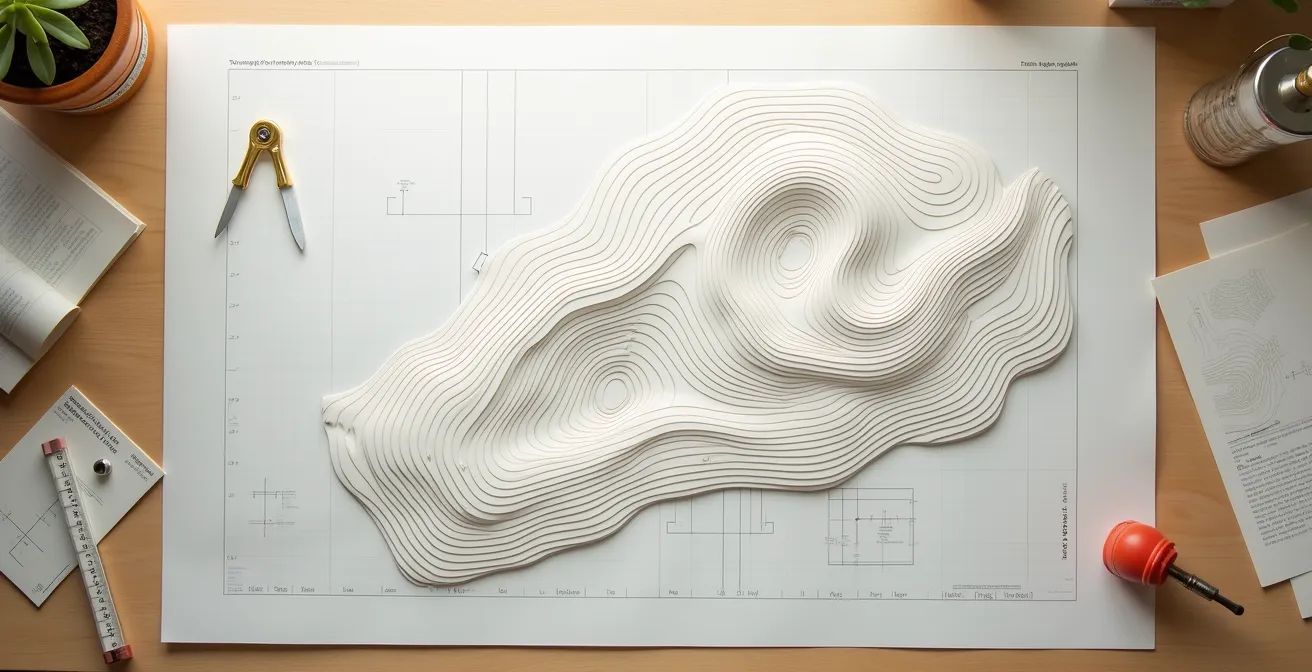
Think of the block not as a series of lines, but as a topographical map of the upper body. The darts are the contours that shape the flat paper around the curves of the bust and the blades of the shoulders. The balance between the front and back lengths, the cross-front and cross-back measurements, and the armscye depth is critical. If these ratios are off, the garment will pull, twist, or hang incorrectly, and no amount of pressing can fix a fundamental balance issue. The block is pure geometry.
A perfectly drafted block relies on understanding these critical relationships. It’s less about the raw numbers and more about how they interact to create a balanced shell that fits the body’s form. The following ratios are fundamental to achieving this balance.
| Measurement Triangle | Ratio | Impact on Fit |
|---|---|---|
| Shoulder to Bust | 1:1.5 | Upper bodice balance |
| Bust to Waist | 1:0.75 | Dart placement accuracy |
| Shoulder to Waist | 1:2.25 | Overall silhouette |
Mastering the block pattern is about internalizing this logic. Once you have a perfect, tested block, you have a reliable foundation from which you can derive any bodice design you can imagine. Without it, you are simply guessing, and your results will be inconsistent at best.
Manual Drafting or CAD: Which Skill Should You Learn First?
Junior designers are often obsessed with this question, viewing it as an either/or choice. This is the wrong way to think. The answer is not one or the other; it is both, in the right sequence. You must learn manual drafting first. There is no substitute for the tactile understanding of how a flat shape becomes a 3D form that you gain from drawing lines, walking seam lengths with a measuring tape, and physically manipulating paper darts. This process builds an intuitive understanding of geometric translation that a computer screen cannot replicate. It connects your brain to the physical realities of the material.
Once you have that foundational knowledge, you should absolutely learn Computer-Aided Design (CAD). In the modern industry, CAD is indispensable for its precision, speed, and efficiency, especially in grading and marker making. The market for 3D Fashion Design Software was valued at USD 2.65 billion in 2025 and is projected to grow, proving its industry-wide adoption. A CAD program is a powerful tool, but it’s a stupid one. It will do exactly what you tell it to do. If you don’t understand the underlying principles of pattern construction, you will simply create flawed patterns faster and more precisely. A designer who only knows CAD can click buttons; a designer who also understands manual drafting knows *why* they are clicking those buttons.
Case Study: The Hybrid Workflow in Modern Ateliers
Leading fashion companies have abandoned the manual versus digital debate, instead adopting a hybrid approach to maximize both creativity and efficiency. According to industry observations, many high-end ateliers begin the creative process with manual draping on a form to develop organic shapes and explore fabric behavior in real-time. Once the initial concept is proven, the draped muslin is digitized into a CAD system. This allows the team to refine seam lines with absolute precision, perform complex size grading in minutes, and optimize fabric layout for production (marker making). This hybrid workflow combines the intuitive creativity of the human hand with the scalable precision of digital tools, representing the true future of pattern making.
The ideal workflow in a modern studio is a hybrid one. You might start a complex design by draping on the form (a 3D sketching method), then transfer that muslin to paper to create a flat pattern. From there, you might digitize the pattern into a CAD system for final tweaks, grading, and marker making. This approach leverages the best of both worlds: the organic, intuitive nature of manual work and the speed and accuracy of digital tools.
The Seam Allowance Mistake That Ruins 80% of Prototypes
Seam allowance is not just an arbitrary border you add to your pattern pieces. It is a critical component of the garment’s engineering that dictates its finish, structure, and final dimensions. The most common amateur mistake is to apply a uniform seam allowance (e.g., 1.5 cm or 5/8″) to every edge of every pattern piece. This is a recipe for disaster. Different seams and different fabrics require different allowances for both structural and aesthetic reasons.
For example, a sharp, curved seam like a princess line or an armscye requires a *smaller* seam allowance (e.g., 6mm or 1/4″). This allows the seam to be clipped or notched so it can lie flat without pulling or creating bulk. Conversely, a straight seam on a structured garment made from a stable fabric might benefit from a wider allowance that can be pressed open to create a flat, crisp line. The type of seam finish also dictates the allowance; a French seam on a sheer fabric requires a specific width to be executed correctly, and it adds a touch of rigidity that can be part of the design intent.
This precision is not just for aesthetics; it’s a cornerstone of quality control in production. Garments are manufactured with specific tolerances. According to industry standards, quality control tolerances can be as tight as ±⅛″ to ¼″ on detail measurements. If your seam allowances are inconsistent or inappropriate for the seam type, you can easily create a cascading series of errors that pushes the final garment outside of these acceptable dimensions. This is why notch coding is so vital; single notches for the front, double for the back, and specific marks for gathering points are not suggestions, they are critical instructions for assembly that ensure accuracy.
- Sharp curves (e.g., neckline, armscye): Use smaller allowances, around 3-8mm, to allow the seam to be clipped and turn smoothly without puckering.
- Straight seams in sturdy fabrics: A wider allowance of up to 2cm can add structure and is easier to handle in production.
- French seams: This finish requires a precise allowance (e.g., 1.5cm total, sewn first at 1cm then trimmed and sewn again at 0.5cm) and adds slight rigidity, perfect for controlling soft fabrics.
- Notch coding: Always use notches to communicate assembly. Single notches for the front, double for the back, and specific T-notches for gathering points are the language of the sewing room.
When to Simplify a Design for Mass Production Without Killing the Aesthetic?
There is often a significant gap between a runway sample and the version of that garment sold in stores. This is not a failure; it is a necessary process of simplification for production. The challenge is to reduce manufacturing complexity—and therefore cost and time—without stripping the design of its core identity, or its « design DNA. » To do this, you must be able to critically analyze your own design and distinguish between the elements that create its unique aesthetic and those that are merely decorative or overly complex to execute at scale.
The first step is to identify the key aesthetic drivers. Is the power of your design in its unique silhouette? Its specific use of color blocking? An innovative seam detail? These are the non-negotiable elements. Everything else is potentially on the table for simplification. A complex, multi-darted bodice on a sample might be simplified into a single-dart system or a princess seam for production, which is faster to sew. An intricate hand-pleated section could be replaced with a machine-pleated fabric that approximates the effect.

This is not about « dumbing down » the design. It is about intelligent engineering. For every complex feature, you must ask: « Is there a simpler way to achieve 80% of this effect for 20% of the cost? » This requires a deep understanding of garment construction and production techniques. For example, a complex internal corset structure might be replaced with strategically placed boning in the seam allowances. A lapped zipper with a fly shield might become a simple invisible zipper if it doesn’t compromise the silhouette. The goal is to preserve the design intent, not necessarily every single construction detail of the original prototype.
This process of simplification should be done with the pattern, not just on a sketch. By working with the pattern pieces, you can see in real-time how changing a seam line or removing a dart affects the overall shape and fit. It allows you to make informed, strategic decisions that balance creative vision with production reality.
Flat Pattern Making vs Draping: Which Yields Better Results for Tailoring?
In the world of tailoring, the debate between flat pattern making and draping is not about which is « better, » but which is the right tool for a specific task. To create a truly exceptional tailored garment, you must use both. Think of it as the difference between architecture and sculpture. Flat pattern making is architecture: mathematical, precise, and perfect for creating the underlying structure and shell of a jacket. Draping is sculpture: organic, intuitive, and ideal for shaping details that need to respond to gravity and form, like a lapel roll or a collar.
Relying on one method alone creates compromises. A jacket drafted entirely as a flat pattern can sometimes feel stiff or lack a certain grace in the way the lapel falls. Conversely, a jacket created purely through draping may lack the crisp, geometric precision required for a perfectly balanced body. The highest level of tailoring uses a hybrid approach to leverage the strengths of each method for different parts of the garment.
This table illustrates the ideal application for each method when constructing a tailored piece, demonstrating that a hybrid approach yields the most superior and efficient results.
| Method | Best For | Precision Level | Time Investment |
|---|---|---|---|
| Flat Pattern | Structured jacket body | High (mathematical) | Moderate |
| Draping | Lapel roll, collar shape | High (organic) | Higher |
| Hybrid | Complete tailored garment | Highest | Most efficient |
A master pattern cutter will, for instance, draft the main body pieces of the jacket using the flat pattern method for absolute precision in balance and fit. However, they will then switch to draping for the collar and lapel, shaping the fabric directly on the mannequin over the jacket’s canvas structure to achieve the perfect roll and fall that is so characteristic of high-quality tailoring. This hybrid technique ensures both structural integrity and aesthetic finesse.
The Costly Mistake of Skipping the Toile Stage in Luxury Design
In the rush to a final product, there is often a temptation, especially for emerging designers, to skip the toile (or muslin) stage and cut directly into expensive final fabric. This is not a shortcut; it is a gamble with disastrous financial and creative consequences. The toile is your primary prototype, your 3D sketch. It is the single most important moment for testing and validating every decision you have made in the pattern-making process. Skipping it is an act of extreme negligence.
The economic argument alone should be convincing. A few meters of inexpensive calico and a few hours of a machinist’s time are a tiny investment compared to the cost of a failed garment cut from final fabric. A stark financial analysis demonstrates that a toile might cost $50 in calico and 5 hours of work, whereas a failed garment in final fabric could waste $1000 worth of silk and 20 hours of skilled labor. It is a simple risk-management calculation. The toile is your insurance policy against catastrophic failure.
Beyond the cost, the toile is where you solve problems. It is where you check the balance of the garment, refine the fit, adjust the placement of darts and seams, and confirm that the silhouette matches your design intent. It’s the moment you discover that an armhole is too tight, a collar doesn’t sit correctly, or a pocket placement is awkward. These are problems that are easy to fix on a calico toile but are often impossible to correct once the final fabric is cut and sewn.
Case Study: The 3D Toile Revolution with Digital Tools
The principle of the toile is so vital that it has evolved into the digital realm. Fashion brands using advanced 3D software like CLO3D can now create virtual toiles. These digital prototypes allow designers to test fabric physics, simulate movement, and check construction details with incredible accuracy before a single piece of physical fabric is cut. This modern approach maintains the core purpose of the toile—to test and validate a design—while significantly reducing waste. Studies have shown that brands adopting this technology report up to a 30% reduction in physical sample-making costs and development time, proving that the principle of prototyping, whether physical or digital, is indispensable.
Key Takeaways
- A design sketch is a hypothesis; the pattern is the engineering proof that makes it work.
- Seam allowance is a dynamic engineering component, not a static measurement.
- The toile is not an optional step; it is your most critical risk management tool.
How to Grade Pattern Sizes Without Distorting the Original Silhouette?
Grading is the process of creating a range of sizes from a single master pattern. It is also one of the most misunderstood and poorly executed aspects of pattern making. The catastrophic mistake is to assume grading is simple proportional scaling, like enlarging a photo on a copier. This is wrong. Human bodies do not scale proportionally. As sizes increase, bodies grow more in circumference than they do in length, and this growth is not uniform. Applying a simple, uniform grade rule will systematically distort the design, ruining the proportions and fit in larger sizes.
In fact, industry analysis reveals that three main problems—bad balance, wrong proportions, and incorrect alterations—affect 80% of high-end garments, with poor grading being a major contributor. The key to successful grading is three-dimensional thinking. You must apply growth not just along the X and Y axes (width and length) but also consider how the body’s shape changes. You must identify the « anchor point » of your design—a critical feature like the tip of a lapel or a specific yoke seam—that should remain stable and consistent across all sizes. The grade rules must then radiate from this point.

Furthermore, you must use relative scaling for design elements. If you have a 10cm wide pocket on a size Small, you cannot simply scale it up proportionally to be 15cm on an Extra Large; it would look comically oversized. The pocket must grow, but at a reduced rate relative to the body’s growth to maintain the original design’s aesthetic balance. This requires a set of complex, nuanced grade rules that are specific to the garment type and the target customer’s body shape.
Your Action Plan: Applying Three-Dimensional Grading Principles
- Identify Anchor Points: Before grading, pinpoint the design’s critical anchor point that must not distort (e.g., the tip of a lapel, a specific yoke seam). All grade rules should originate from or respect this point.
- Apply Circumferential & Linear Growth: Collect data on your target market’s body shape. Apply growth in both circumference (width) AND length, respecting how the body changes between sizes, not just scaling everything up.
- Use Relative Scaling: Inventory all design elements like pockets, collars, and cuffs. Never use simple proportional scaling. Create rules for relative scaling where these elements grow at a slower rate than the main body to maintain visual harmony.
- Test at Key Sizes: Confront the reality of your grading. Instead of just checking the smallest and largest sizes, create a sample at a key midpoint size (e.g., a Medium or Large) to ensure the grade is progressing correctly and hasn’t introduced fit issues.
- Maintain Proportions via Distribution: Audit your grade rules. Ensure you are distributing the grade strategically. For a jacket, more growth might be added to the back and side seams than the center front to preserve the lapel’s proportion.
Mastering grading is the ultimate expression of technical skill. It proves you not only understand how to construct a garment for one person but how to translate that design intent consistently across a full range of customers. It is the final and most critical bridge between a single beautiful sample and a successful commercial product. To apply these principles effectively, you must return to the very beginning of the process and ensure your foundation is solid. Without a deep understanding of why initial concepts fail, even the best grading will only replicate a flawed idea.