Blog
The fashion industry stands at a crossroads. On one side, the relentless pace of mass production and trend cycles; on the other, a growing demand for transparency, sustainability, and innovation. Whether you’re a startup founder sketching your first collection, a conscious consumer seeking to understand what’s behind the label, or simply curious about where fashion is heading, navigating this landscape requires more than surface-level knowledge.
The modern fashion ecosystem is remarkably complex. It encompasses everything from the factories that cut fabric to the algorithms that render digital garments in virtual worlds. Understanding this interconnected web—how ethical sourcing affects your bottom line, why a muslin prototype can save thousands, what makes a fabric truly sustainable, and how cultural sensitivity shapes brand reputation—is essential for anyone engaging with fashion today. This article explores the critical pillars that define contemporary fashion, offering you the foundational knowledge to make informed decisions in each area.
Building an Ethical Fashion Business Without Breaking the Bank
The phrase « ethical manufacturing » often conjures images of skyrocketing costs and razor-thin margins. The reality is more nuanced. While implementing ethical practices requires upfront investment, treating it as a binary choice between profit and principles misses the bigger picture.
Finding and Vetting Ethical Factories
Sourcing factories that genuinely comply with ethical standards demands more than scrolling through a supplier directory. The process starts with certification verification—but not all certifications carry equal weight. Third-party audits from recognized bodies provide stronger assurance than self-issued compliance statements. Visit facilities when possible, ask detailed questions about worker hours and wages, and request documentation. Think of it like choosing a business partner: you wouldn’t sign a contract without due diligence.
The Long-Term Economics of Sustainability
Eco-friendly manufacturing often reveals hidden savings that offset initial costs. Factories with efficient waste management systems reduce material expenses. Ethical workplaces typically see lower turnover rates, which means fewer production delays and more consistent quality. One emerging brand found that switching to a certified factory increased per-unit costs by fifteen percent but reduced returns by nearly thirty percent due to superior craftsmanship—a net positive for their margins.
Avoiding Greenwashing Traps
The marketplace is flooded with environmental claims that range from genuinely verified to completely fabricated. Learning to differentiate between legitimate certifications and marketing fluff protects both your brand reputation and your customers’ trust. Vague terms like « eco-friendly » or « natural » without supporting evidence should raise immediate red flags. Demand specifics: What percentage of materials are certified organic? Which independent body verified the claim?
The Foundation of Quality: Prototyping and Design Validation
Skipping proper prototyping is one of the costliest mistakes in fashion production. The toile stage—creating a test version in inexpensive fabric—might seem like an unnecessary step when you’re eager to get to market, but it functions as your safety net.
Why the Muslin Stage Matters
A toile or muslin prototype reveals fit issues, construction challenges, and design flaws before you’ve committed to expensive fabrics or bulk production. Imagine building a house without blueprints: you might get something standing, but it probably won’t be what you envisioned, and fixing problems after the walls are up costs exponentially more than adjusting plans on paper. The same principle applies to garment construction.
Testing Methods That Actually Work
Effective wear testing goes beyond having your friend try on a sample for five minutes. Rigorous validation includes:
- Multiple body types and sizes to ensure consistent fit across your range
- Extended wear periods to identify comfort issues that aren’t immediately apparent
- Stress testing for specific use cases (activewear needs stretch recovery testing, outerwear needs weather resistance verification)
- Washing and care trials to confirm durability claims
Cost-Effective Prototyping for Startups
Limited budgets don’t mean skipping prototyping—they mean being strategic. Digital pattern-making software can help you refine designs before cutting fabric. Local sewing services often offer sample-making at lower minimums than overseas manufacturers. Some brands even use 3D garment visualization technology to test colorways and proportions virtually before creating physical samples, reducing material waste during the development phase.
Material Matters: Navigating Sustainable and Smart Textiles
The fabric you choose determines not just the look and feel of a garment, but its environmental footprint, durability, and even technological capabilities. The material landscape has expanded dramatically, introducing both exciting possibilities and new complexities.
Identifying Genuinely Sustainable Materials
Not all « green » fabrics deliver on their environmental promises. Recycled polyester, for instance, addresses plastic waste but still sheds microfibers during washing. Bamboo fabric sounds eco-friendly until you learn that most bamboo rayon requires chemical-intensive processing that contradicts its natural origins. Tracing the supply chain of natural fibers reveals the true story: organic cotton grown with minimal water in one region might be processed in facilities with poor wastewater treatment in another.
Emerging alternatives like fibers derived from agricultural waste—think pineapple leaves, orange peels, or mushroom mycelium—show promise, but remain in relatively early stages of commercial availability. Evaluate materials based on their complete lifecycle, not just their source.
The Rise of Smart Textiles
Smart fabrics integrate technology directly into fibers, creating garments that monitor biometrics, regulate temperature, or change color. Medical applications lead the field—compression garments with embedded sensors can track circulation for post-surgical patients, while temperature-regulating fabrics help individuals with specific health conditions maintain body heat.
Yet smart clothing presents unique challenges. Battery integration creates design constraints (where do you hide a power source in a fitted dress?). Maintenance becomes complicated when your shirt requires charging or software updates. And tech obsolescence hits fashion: will your connected jacket become useless when the companion app loses support? These considerations are critical when deciding whether smart textiles align with your brand values and customer needs.
Fashion in Flux: Cultural Shifts and Digital Frontiers
Fashion doesn’t exist in a vacuum—it both reflects and shapes the society around it. Recent years have brought seismic changes in how we work, socialize, and express identity, all of which ripple through what we wear and how the industry operates.
Cultural Responsibility and Authentic Inclusion
Implementing genuine inclusivity requires more than expanding size ranges or hiring diverse models for a campaign. It means involving diverse voices in design decisions, understanding the cultural context of aesthetic choices, and recognizing the difference between appreciation and appropriation. Ignoring diversity isn’t just ethically problematic—it’s a business risk that can damage reputation and alienate entire customer segments. Navigating cultural borrowing thoughtfully means crediting inspiration, collaborating with communities, and asking whether your use of cultural elements is extractive or respectful.
The Digital Fashion Revolution
Non-physical clothing for digital spaces has evolved from a novelty to a legitimate market segment. Digital garments serve multiple purposes: influencers use them for social media content without accumulating physical inventory, gamers customize avatars in virtual worlds, and collectors invest in fashion NFTs as digital assets. Augmented reality filters let consumers « try on » makeup or accessories through their phones before purchasing.
The metaverse promises (or threatens, depending on your perspective) to expand this frontier, though compatibility issues between platforms currently fragment the market. The future of digital ownership in fashion remains uncertain, but the trajectory is clear: our relationship with clothing is no longer purely physical.
Beyond Fast Fashion: Understanding True Cost and Value
The terms « fast fashion » and « ultra-fast fashion » describe business models built on speed and volume, but their true costs extend far beyond price tags.
Fast fashion relies on synthetic fabrics like polyester and nylon that shed microfibers with every wash—these microscopic plastic particles flow into waterways and eventually oceans, where they enter the food chain. The worst fabrics in fast fashion aren’t just low quality; they’re environmental hazards. The economic model encourages overconsumption: when a shirt costs less than a sandwich, it’s designed to be disposable.
Calculating real cost per wear offers a clearer picture of value. A quality garment that costs four times as much but lasts ten times as long while requiring less frequent replacement represents a better investment. Transitioning to a slow fashion mindset doesn’t necessarily mean buying expensive designer pieces—it means asking different questions:
- Will I wear this at least thirty times?
- Can this be repaired if damaged?
- Does this align with my existing wardrobe?
- Who made this, and under what conditions?
The fashion industry’s transformation isn’t complete—it’s ongoing. Each decision you make as a creator, entrepreneur, or consumer shapes its direction. By understanding the interconnected nature of ethical manufacturing, thoughtful design processes, material impacts, cultural responsibility, and consumption patterns, you’re equipped to engage with fashion more intentionally. The industry’s future depends not on perfection, but on informed choices made consistently over time.
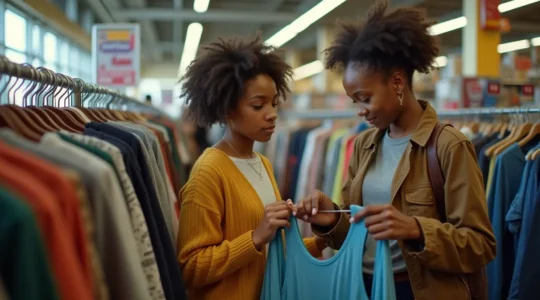
Why Fast Fashion Remains the Only Option for Low-Income Families?
The popular narrative shames budget-conscious consumers for buying fast fashion, but the real issue isn’t individual morality—it’s economic necessity. True affordability is measured in « cost per wear, » not the initial price tag. Learning to identify quality fabric and construction is…
Lire la suite
Why Digital Fashion Is the Only True Solution to Overconsumption?
Digital fashion offers the only viable path to end the destructive cycle of overconsumption by fundamentally separating self-expression from physical production. It eliminates nearly all the water use, textile waste, and carbon emissions tied to a traditional garment’s lifecycle. It…
Lire la suite
Why Gender-Fluid Fashion Is Rising in Mainstream Retail?
The mainstreaming of gender-fluid fashion is not a fleeting trend but a fundamental rewiring of the relationship between identity, the body, and the garment itself. Successful adoption hinges on a « garment-centric » design philosophy, focusing on intrinsic attributes like drape and…
Lire la suite
Tencel vs Organic Cotton: Which Is Truly More Sustainable?
The debate between Tencel and organic cotton often misses the most critical factor: true sustainability is proven through a rigorous audit, not just claimed on a label. Certifications like GOTS are not just badges; they are verifiable claims that require…
Lire la suite
Why Conductive Fabrics Are the Future of Professional Sportswear?
The viability of smart sportswear depends not on adding more sensors, but on mastering the underlying material science to create durable, comfortable, and self-sufficient garments. Durability is now achievable, with advanced coatings allowing fabrics to withstand numerous washing cycles without…
Lire la suite
Why Virtual Sampling Still Can’t Replace the Physical Prototype
Despite the hype, virtual sampling is a predictive tool, not a replacement for the physical truth of a prototype. Digital models can’t replicate the unpredictable dialogue between fabric, gravity, and human movement (the « kinetic truth »). True durability, haptic feedback, and…
Lire la suite
How to Implement Sustainable Production Without Doubling Your Costs?
The key to affordable sustainable production isn’t spending more, but investing smarter in high-impact areas with proven long-term returns. Effective ethical oversight can be achieved remotely through digital vetting, saving significant travel costs. Green manufacturing processes often lead to substantial…
Lire la suite