Forecasting 18 months out isn’t about predicting the future; it’s about building a resilient aesthetic framework that insulates multi-million dollar creative bets from market volatility.
- Data analytics don’t replace designer intuition—they de-risk it by providing an objective framework for creative exploration.
- Supply chain agility and modular design are your most powerful insurance policies against the sudden death of a trend.
Recommendation: Shift from trend-chasing to developing a core aesthetic vision that can strategically interpret and integrate future cultural signals.
For a luxury brand strategist or design director, the 18-month horizon is a territory of immense risk and opportunity. Committing millions to an aesthetic vision that will only meet the market in a year and a half feels less like strategy and more like a high-stakes wager on the cultural zeitgeist. The conventional wisdom advises a mix of runway analysis, historical cycle reviews, and trusting a designer’s « gut feeling. » While these elements have their place, they often leave brands vulnerable to the volatile, accelerating nature of modern trends, treating forecasting as a mystical art of prediction.
The core challenge isn’t a lack of information; it’s a deficit in framework. We are inundated with data, from social media metrics to runway reports. Yet, translating this firehose of information into a coherent, commercially viable, and artistically resonant collection remains the ultimate test. The prevailing methodologies often create a false dichotomy between cold, hard data and pure, unadulterated creativity, forcing a choice between a safe, data-driven collection that lacks soul, and an artistic statement that fails to connect with the consumer.
But what if the entire premise is flawed? What if true long-range forecasting isn’t about *predicting* a specific trend, but about *engineering* an aesthetic framework so robust and intelligent it can absorb and adapt to future signals? The key is not to have a better crystal ball, but to build a more resilient ship. It requires shifting our mindset from prediction to strategic preparation, where data isn’t a directive, but a tool to mitigate the risk of bold creative leaps.
This guide will deconstruct this engineering approach. We will explore how to differentiate fleeting fads from foundational trends, build a symbiotic relationship between data analytics and creative intuition, and design supply chains that are agile enough to pivot. We will analyze how to structure a collection that balances artistic integrity with commercial imperatives, ultimately creating a system that doesn’t just react to the future, but actively shapes it.
To navigate this complex landscape, we will dissect the critical questions that define long-range luxury strategy. The following sections provide a roadmap for building a resilient and visionary collection plan, moving beyond guesswork to strategic foresight.
Summary: A Framework for 18-Month Luxury Forecasting
- Fad or Trend: How to Spot the Difference Before Investing Millions?
- Data Analytics vs Designer Intuition: Which Should Lead the Collection?
- Why Forecasting Is Crucial for Luxury Supply Chains?
- How to Pivot a Luxury Collection When a Trend Dies Suddenly?
- What Happens to Luxury Aesthetics During Economic Downturns?
- Fade, Trend, or Classic: How to Categorize a New Style?
- When to Use the « Drop Model » to Create Instant Scarcity?
- How to Plan a Fashion Collection That Balances Art and Commerce?
Fad or Trend: How to Spot the Difference Before Investing Millions?
The most fundamental error in long-range forecasting is mistaking the intense, short-lived energy of a fad for the deep, structural shift of a trend. A fad is a firework: brilliant, attention-grabbing, and quickly extinguished. A trend is a tectonic plate: a slower, more profound movement that reshapes the entire landscape. Investing a luxury collection’s 18-month development cycle into a fad is a catastrophic misallocation of resources. The key is to analyze a signal’s origin and cultural velocity—how quickly it moves from niche to mainstream.
Fads often emerge from a single platform or a specific pop culture moment. They are characterized by rapid, explosive growth in visibility and an equally rapid decline. Trends, conversely, build momentum across multiple, often disconnected, cultural vectors: art, technology, socio-political discourse, and grassroots subcultures. They answer a deeper, often unarticulated, consumer need or desire. For example, the chunky sneaker wasn’t just a shoe; it was a response to a broader cultural shift toward comfort, nostalgia for the ’90s, and the casualization of luxury. It had roots in music, street style, and a rejection of formal dress codes.
Case Study: De-Risking the Chunky Sneaker Bet
A luxury brand targeting an edgy audience faced the chunky sneaker phenomenon in 2018. Instead of relying solely on intuition, they used AI to validate the trend’s longevity. An analysis by Heuritech’s platform of millions of social media images provided quantified data on the popularity of specific sneaker styles, colors, and shapes. This data didn’t dictate the design, but it gave the brand confidence that the aesthetic had deep, cross-demographic traction, confirming it was a bankable trend, not a fleeting fad, and allowing them to invest confidently in their collection.
As Valerie Steele, Director at the Museum at FIT, notes, when a style becomes ubiquitous, « It becomes a billboard that you’re wearing. » This level of adoption signals a true trend. The goal is to identify these signals before they become billboards. Advanced analytical tools can provide critical validation; for instance, the WGSN’s TrendCurve AI model achieves 94% accuracy by analyzing vast datasets to distinguish sustained momentum from short-term noise, providing a quantitative check against qualitative observation.
Data Analytics vs Designer Intuition: Which Should Lead the Collection?
The debate over whether data or intuition should drive a collection is a false dichotomy. In a modern luxury context, the two are not adversaries but essential partners in a process of creative risk mitigation. Designer intuition is the engine of innovation; it’s the visionary spark that imagines what consumers don’t yet know they want. Data analytics is the sophisticated navigation system that ensures this engine doesn’t drive the brand off a cliff. The question is not *which* should lead, but *how* they should collaborate.
Data’s primary role in 18-month forecasting is to define the « problem space. » By analyzing millions of images and data points, AI can outline the shapes, colors, themes, and sentiments that are gaining real, organic traction with target consumers. This provides the creative team with a validated framework within which to innovate. It’s not about telling a designer « make a green jacket, » but rather showing them « the desire for ‘natural’ and ‘restorative’ aesthetics is growing, and the color green is its primary semiotic carrier. » This frees the designer to explore their most creative interpretation of a « restorative green jacket, » knowing the foundational concept is commercially sound. Academic studies confirm the power of this approach, showing AI demand forecasting can deliver up to a 41% revenue improvement by better aligning production with real-world desire.
True synergy is achieved when data is used to challenge and strengthen intuition. A « Creative Red Team » model, where analysts pressure-test a designer’s vision with data-backed contrary scenarios, can be invaluable. This adversarial-collaborative process forces the creative direction to be more robust, anticipating potential market shifts and solidifying its rationale. It transforms a subjective « I feel this is right » into a powerful « My intuition points here, and the data confirms the consumer is ready for it. »
Action Plan: Balancing Data and Intuition
- Unbiased Market Mapping: Use AI tools to analyze a minimum of 3 million social media images daily. The goal is to gather unbiased, quantitative data on what consumers are *actually* wearing and aspiring to, creating an objective map of the current aesthetic landscape.
- Define Problem, Not Solution: Let data analytics outline the « problem space » by identifying emerging consumer needs, aesthetic voids, and growing sentiments. The design team’s role is to explore creative and innovative « solutions » within these validated parameters.
- Implement a ‘Creative Red Team’: Establish a formal process where data analysts challenge the design team’s core intuitions with contrary data and « what-if » scenarios. This strengthens the final direction by ensuring it is resilient and well-rationalized.
Why Forecasting Is Crucial for Luxury Supply Chains?
In luxury, forecasting extends far beyond the design studio; it is the central nervous system of the supply chain. An inaccurate forecast 18 months out doesn’t just result in a collection that fails to resonate—it triggers a cascade of devastating financial and environmental consequences. The most significant is the creation of deadstock. When a multi-million dollar bet on a specific color, silhouette, or material fails, the result is warehouses filled with unsold inventory. The Ellen MacArthur Foundation estimates the cost of disposed unsold inventory across the fashion industry reaches a staggering $500 billion annually. For a luxury brand, this waste is not only a financial drain but a direct assault on its core values of quality and exclusivity.
Effective long-range forecasting is about resource allocation. It dictates which rare materials to procure, which artisanal skills to secure, and which production capacities to book. A misstep can mean either a critical shortage of a winning product or a costly over-commitment to a loser. The long lead times inherent in luxury—sourcing exotic leathers, weaving custom jacquards, or training specialized artisans—make these decisions nearly irreversible. This is where the precision of AI-powered forecasting offers a revolutionary advantage over traditional methods.
This macro shot highlights the intricate, time-consuming craftsmanship that defines luxury. Securing these materials and skills requires commitments made months, if not years, in advance, making accurate forecasting an absolute necessity.

As you can see, the level of detail is immense. Traditional forecasting, with its longer analysis cycles and lower accuracy, creates significant risk in this environment. AI-powered systems, by contrast, offer real-time analysis and greater precision, enabling supply chains to be more responsive and efficient.
The following table illustrates the stark operational differences between legacy and modern forecasting methods, demonstrating why AI adoption is becoming a competitive imperative for supply chain optimization.
| Method | Forecast Time | Accuracy | Lead Time |
|---|---|---|---|
| Traditional Forecasting | 18-24 months | 60-70% | 3-6 months analysis |
| AI-Powered Forecasting | 3-12 months | ~94% | Real-time analysis |
How to Pivot a Luxury Collection When a Trend Dies Suddenly?
Even with the most sophisticated forecasting, the market can deliver a shock. A cultural moment can sour, a key aesthetic can become over-saturated, or a global event can instantly shift consumer sentiment. When a trend that formed the core of an 18-month plan dies suddenly, the ability to pivot is what separates market leaders from victims of circumstance. The antidote to this volatility is not better prediction, but designed-in agility. Rigidity is the enemy; a collection must be conceived with modularity in mind from its inception.
This strategy, often termed ‘Collection Modularity,’ involves designing a collection around a stable core of timeless silhouettes while isolating trend-sensitive elements into components that can be finalized or modified much later in the production cycle. This could mean designing a classic coat but leaving the choice of a specific, trend-driven hardware or lining color open until the last possible moment. It requires a supply chain structured for responsiveness, but the payoff is immense. This approach effectively creates an insurance policy against forecast error.
The rise of fast fashion, projected to become a $254.1 billion market by 2033, has conditioned consumers to expect immediacy, exacerbating the risk for slower luxury cycles. Luxury cannot and should not compete on speed, but it must learn from this agility. By building modularity into the design and production process, luxury brands can compress certain decision timelines without compromising quality.
Strategy in Action: The 15% Agility Buffer
Forward-thinking brands are now implementing ‘Collection Modularity’ by leaving 10-15% of their collection’s aesthetic details undecided until late in the process. Core garments are produced to a semi-finished state. Final trims, colors, or even embellishments are then applied based on real-time data just 12 weeks before launch. This hybrid model blends the long-term vision of a core collection with the short-term responsiveness of a capsule, allowing the brand to make small but highly relevant pivots that keep the collection perfectly attuned to the market moment at launch.
What Happens to Luxury Aesthetics During Economic Downturns?
Economic downturns are powerful filters for aesthetic expression. During periods of uncertainty and financial anxiety, consumer behavior shifts from conspicuous consumption to considered investment. The aesthetic vernacular of luxury changes accordingly. Overt, logo-heavy, and trend-driven items often recede, making way for what is now termed « quiet luxury. » This is not a new phenomenon; it is a recurring cyclical response where value is expressed through impeccable craftsmanship, timeless design, and superior materials rather than overt branding.
For forecasters planning 18 months ahead, monitoring macroeconomic indicators is as crucial as monitoring social media. A downturn signals a flight to quality and longevity. Consumers are not necessarily spending less, but they are spending differently. The psychological need is for security, and a beautifully crafted, timeless cashmere coat feels like a more prudent and lasting investment than a flamboyant, of-the-moment handbag. This aesthetic shift favors heritage brands and those whose identity is rooted in artisanship over hype. Despite these shifts, the market remains resilient; projections show luxury fashion will grow to $431.4 billion by 2033, indicating that desire persists, but its expression evolves.
However, it is a mistake to assume downturns only breed minimalism. They also create a counter-current: a desire for escapism and joy. This can manifest as a renewed interest in vibrant color, bold prints, and expressive silhouettes, but applied to classic, investment-worthy pieces. The key is that the item must still feel like a « keeper. » The challenge for strategists is to balance the sober appeal of quiet luxury with this undercurrent of defiant optimism, creating a collection that feels both safe and uplifting.
A big part of success when working in this industry is agility: paying attention to newness and not ignoring it.
– Jeffrey Roy, Editorial Fashion Specialist, Luxury Retailer
Roy’s point is crucial here. Even during a downturn, a brand cannot afford to become static. The « newness » might be more subtle—a novel texture, a perfected silhouette, an unexpected color pairing on a classic form—but it must be present to maintain relevance and desire.
Fade, Trend, or Classic: How to Categorize a New Style?
Once a new aesthetic signal is detected, the critical next step is to correctly categorize its potential trajectory. Is it a fade, a trend, or a future classic? This classification determines the level of investment and the role it will play within the collection’s strategic framework. A fade might warrant a small, low-risk capsule, a trend could define a season’s growth drivers, and a classic has the potential to become a long-term revenue stream. The categorization process relies on analyzing a style’s depth of cultural resonance and its versatility of expression.
Fades are often one-dimensional and tied to a single, highly specific reference. Trends have broader roots and can be interpreted in multiple ways across different product categories and consumer segments. Classics tap into universal, timeless archetypes of dressing (e.g., the trench coat, the little black dress). A new style’s potential can be gauged by asking: Can this aesthetic be credibly translated into outerwear, accessories, and ready-to-wear? Does it resonate with our core customer as well as a younger, aspirational audience? Does it connect to a larger socio-cultural narrative?
Consider the « Regencycore » phenomenon. It was more than a fade because it tapped into a deeper desire for escapism, romance, and historical fantasy. It could be expressed subtly through empire waistlines or overtly through corsetry. Data confirmed its depth; for example, Zalando reports ‘Regencycore’ searches surged by a 156% increase, signaling a genuine trend with commercial legs.
This portrait captures the tension between vintage inspiration and contemporary style. The ability to layer and evolve is a hallmark of an idea with the potential to become a classic, transcending its initial trend phase.
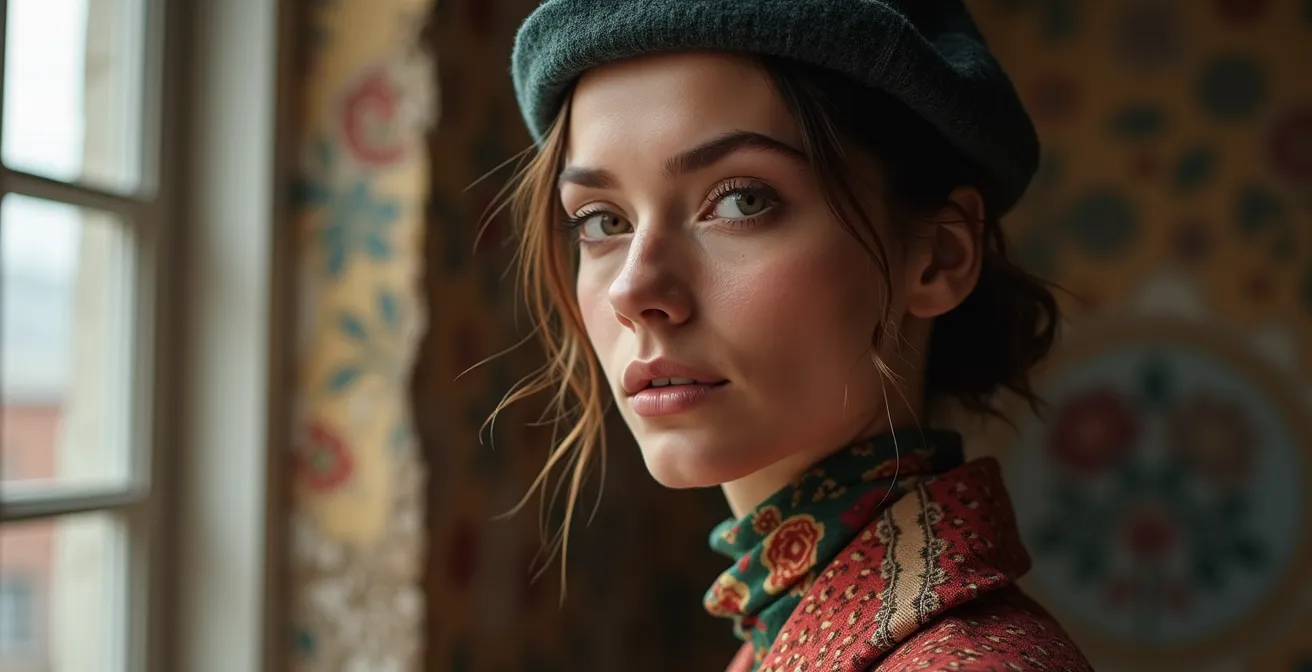
Ultimately, a style becomes a classic when it transcends its original context and becomes part of the permanent fashion lexicon. This happens when it perfectly solves a functional or an expressive problem for the wearer in a way that feels enduring. It is the forecaster’s job to identify this rare potential early on, separating the merely new from the truly necessary.
When to Use the « Drop Model » to Create Instant Scarcity?
The « drop model, » characterized by limited-edition releases announced with little warning, has become a powerful tool in the luxury arsenal. Traditionally associated with streetwear, its principles of scarcity and urgency are now being strategically deployed by heritage brands. However, its use is not a one-size-fits-all solution. For an 18-month plan, the drop model serves two distinct strategic purposes: as a real-time R&D tool and as a brand heat accelerant.
As an R&D tool, a drop can be used to test a risky or directional aesthetic on a small scale, long before committing to it for a main collection. By releasing a limited run of a product that embodies a potential future trend, a brand can gather invaluable, real-world data on consumer appetite. Is there a waiting list? Does it sell out in minutes? What is the social media sentiment? This provides concrete validation (or rejection) of a creative hypothesis, informing the larger collection strategy with minimal risk. Given that social media platforms now provide up to 70% of trend data, a successful drop creates a powerful, self-reinforcing data loop.
As a brand heat accelerant, drops are used to inject energy and cultural relevance into a brand’s narrative. By collaborating with a timely artist or tapping into a micro-cultural moment, a drop can generate a level of buzz and desire that ripples out to the main collection. It tells the market that the brand is dynamic, responsive, and culturally aware. This is particularly effective for heritage brands seeking to revitalize their image and connect with a younger demographic.
Case Study: Ludovic de Saint Sernin’s 5,110% Engagement Surge
The luxury brand Ludovic de Saint Sernin masterfully uses the drop model to create intense desire. By aligning limited releases of their sensual, gender-fluid designs with specific cultural micro-moments, they cultivate a dedicated following that eagerly awaits each new product. This strategy resulted in a staggering 5,110% increase in engagement. This proves that drops are not just a sales tactic but a powerful community-building and brand-revitalization strategy, turning each release into a coveted cultural event.
Key Takeaways
- Signal vs. Noise: The foundational skill is distinguishing a deep, structural trend from a superficial, short-lived fad by analyzing its cultural depth and velocity.
- Data as a Co-pilot: The role of analytics is not to dictate creativity but to de-risk intuitive leaps by providing a validated framework for innovation.
- Agility as Insurance: Building modularity into collections allows brands to make late-stage pivots, providing a crucial buffer against forecasting errors and sudden market shifts.
How to Plan a Fashion Collection That Balances Art and Commerce?
The ultimate goal of any forecasting strategy is to produce a collection that is both a powerful artistic statement and a commercial success. This requires a portfolio approach, treating the collection not as a monolithic entity but as a balanced ecosystem of products, each with a specific strategic role. This framework, inspired by classic investment theory, allows a brand to pursue high-risk creative expression while securing a stable revenue base.
A balanced collection portfolio consists of three key categories. First, « Halo » pieces, which typically make up around 20% of the collection. These are the high-fashion, runway-moment items. They are high-risk, creatively ambitious, and not expected to be major volume sellers. Their purpose is to generate press, define the brand’s vision for the season, and build brand prestige. Second, « Growth Drivers », composing about 50% of the assortment. These are the on-trend, desirable pieces that translate the Halo vision into a more wearable and commercial format, targeting early adopters and driving seasonal growth. Finally, « Cash Cows », the remaining 30%. These are the timeless classics, core products, and carry-overs that provide a steady, reliable revenue stream, regardless of seasonal trends.
This portfolio approach allows data and intuition to be applied where they are most effective. Intuition and pure creative vision should lead the Halo pieces. Data analytics is most critical for validating and refining the Growth Drivers, ensuring they align with proven market demand. Heuritech’s AI, for example, boasts 90% accuracy up to 24 months ahead in predicting the trajectory of such items. Cash Cows, meanwhile, are managed based on historical sales data and long-term brand strategy. This structure creates a collection that is simultaneously safe and exciting, commercial and artistic.
Action Plan: Portfolio Theory for Collection Planning
- Allocate 20% to ‘Halo’ Pieces: Dedicate this portion of the collection to high-risk, artistic statements. Their primary ROI is brand prestige and media impact, not direct sales volume.
- Invest 50% in ‘Growth Drivers’: These are the on-trend bestsellers that translate the season’s core message for early adopters. This is where data-validated trend forecasting has its greatest commercial impact.
- Reserve 30% for ‘Cash Cows’: Protect this segment for timeless classics and core products. Their role is to ensure a steady, predictable revenue stream that funds more creative risks elsewhere.
Begin today by auditing your current planning process not for its predictive accuracy, but for its strategic resilience. The future of luxury belongs to those who build it, not those who guess it.